Libertarian US Senate candidate Kyle Austin pitches himself as an alternative for voters
Oct 19, 2026 | 2:23 pm ET

Description
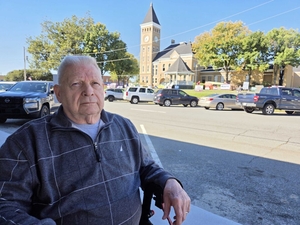
Kyle Austin is pictured on Monday, Sept. 21, 2026. (Jordan Hansen / Daily Montanan)
Kyle Austin, the Libertarian candidate for the open U.S. Senate seat in Montana, calls himself “the alternative Republican” as he bids to upend the four-way race and give voters a second conservative choice in the election.
Austin has twice ran in Republican primary races for the U.S. House of Representatives, losing to Matt Rosendale in 2022 and Troy Downing in 2024. This year, he faces off against Republican Kurt Alme, Democrat Alani Bankhead and independent Seth Bodnar.
He’s fed up with Republican politics, he said, which was why he switched his political affiliation to Libertarian. He added that it would be “too far off home base for me” to switch to the Democratic Party, saying it’s bent too far to the left.
“Republicans used to be all about small government,” Austin said in an interview with the Daily Montanan. “They’ve really shifted away from that.”
Austin has not been immediately welcomed by some longtime members of the state Libertarian Party. But Austin won their primary in June.
The Libertarian Party in Montana is concerned that if it doesn’t hit a minimum threshold of votes in the race, it could lose major party status from the state, and its candidates wouldn’t automatically appear on the ballot. But Austin said voters will follow him to the ballot box.
“I’m not campaigning as a Libertarian. I’m actually campaigning like I’m an independent. I’m a candidate for all Montanans,” Austin said. “People will follow me to the polls because I’m not like the others … I’m not a politician. They’re politicians. They’re bureaucrats. They’re bought and paid for. I’m running on my own energy, my own two feet.”
A platform built on healthcare reform
Born and raised in Havre, Montana, Austin said he grew up helping his grandfather farm and still owns agricultural land in that area. He also owns and operates Pharm406, a pharmacy serving Billings, Laurel and Butte.
He’s been a pharmacist for 18 years.
Improving Montanans’ healthcare is foundational to his campaign pitch. He said the problem starts with licensing — as it stands, medical licences are handled by the states, not the federal government.
“Healthcare professionals should be licensed on a national level, and they should be free to go state to state without restriction,” Austin said.
He advocates for shorter training programs for doctors, nurses and pharmacists. These programs take far too long, he said, specifically pointing to issues with finding workers for his own business.
Being a licensed pharmacist takes significant schooling, which can run anywhere from four to eight years. Doctors, who get extensive training in various aspects of the discipline, can be in training for around a decade.
“Should doctors be forced into a 10-year program?” Austin said. “No, get them in, teach them what they need to know. Get them out into the workforce. I learned most of my pharmacy knowledge after graduating in the workforce, on-the-job training, and that I think would be more appealing for young generations to enter the healthcare industry again.”
He’s also expressed frustration with mail-order pharmacy offerings being pushed by large pharmaceutical companies, which is not only hurting his business, Austin said, but is a similar issue for national brands like Walmart and CVS. He said it amounts to an unfair trade practice.
Austin said he’s also pushing for “rolling deductibles” that start a 12-month clock when a person begins to use their health insurance, as opposed to it resetting on a certain date each year.
“Ninety percent of the people won’t meet their deductible till December, and then when they do, guess what? It starts over Jan. 1,” Austin said.
While he’s not a supporter of Medicare for all, he said that he would push to create a private nonprofit organization, funded by taxpayers, that would consolidate Medicare, Medicaid, Tricare and other government healthcare programs “under one roof.” He’d then seek to have that program offered to businesses and individuals.
Through that, he said, they would “rewrite the rules and level the playing field” for U.S. healthcare.
Other issues
Gun owners’ rights and agricultural concerns form the rest of Austin’s main pitch to Montana voters.
He’s a gun owner and said he believes that Americans should have unrestricted access to firearms. He likes to shoot, he said, and it’s one of his hobbies while he is out on his late grandfather’s farm.
Austin expressed frustration with recent federal policy decisions that resulted in tariffs and trade problems.
“President Donald Trump really hurt farmers and ranchers over the last couple years with his tariffs, especially when it comes to fuel prices, when it comes to fertilizer prices, and when it comes to our exports,” Austin said. “Tariffs are really just a tax on the consumer, and it’s just raised the rates on things.”
He said he’d be in support of giving ranchers more leeway to kill bears and wolves in defense of their livestock. He’s also advocating for mandatory country-of-origin labeling, and for the federal government to be more hands-on with farm loans.
“Some big banks in Montana grow because when times are tough, farmers and ranchers lose their farms to the bank, and the banks turn around and sell that land and get bigger and bigger,” Austin said. “Let’s take that fear away from the farmers and ranchers.”
Land, who owns it, and what happens on it are also major topics of this election, particularly around public access. Austin is a supporter of U.S. Rep. Ryan Zinke’s A River Runs Through It Act that has been panned by some environmentalists. Concerns have been raised about the legislation largely due to a potential increase in logging, roads and motorized recreation on federal land.
Logging is an important industry, Austin said, and he doesn’t believe America’s forests are being managed properly. He says the lack of logging has led to higher costs in the building industry and wildfires causing health impacts via smoke pollution.
“What I’ve seen over my generation is the pendulum has swung too far to the left with the environmentalists,” Austin said. “And what I mean by that is we’ve killed our logging industry, we’ve killed our mill industry.”
He’s also in favor of building more dams, he said, expressing worry that Montana needs to retain more of its water.
“I do believe that if we just let water go downstream, and it ends up in the ocean, we wasted it,” Austin said.
A little more on Austin
Austin is nearly entirely self-financing his Senate campaign and has put in more than $250,000 of his own money.
Austin is a University of Montana graduate — he graduated from pharmaceutical school — and lives by himself in Billings with his dogs.
Austin has said he’s primarily connecting with voters at fairs and other events around the state.
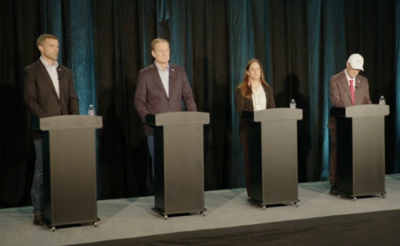
Michael Hummert, who lost in the Democratic Senate primary, says he’s been impressed with Austin, and he’s a person that will change his mind after a good argument. Austin has said he’d debate any Senate candidate.
“He’s not tied to his dogma,” Hummert said. “He’s a conservative person, but he’s not tied to the dogma of conservatism or liberalism. So that’s an important thing in a person that’s running a diverse country like ours is being able to actually be flexible in your thought and willing to listen to other points of view that you don’t agree with.”
Helena, MT