Legislation would require elections for schools to exceed property tax limits
Jan 22, 2026 | 2:45 pm ET
Description
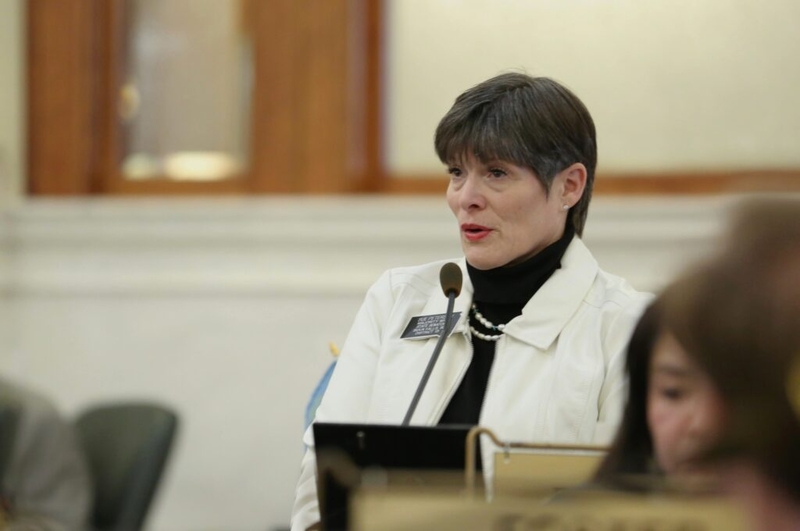
Sen. Sue Peterson, R-Sioux Falls, speaks on the South Dakota Senate floor on March 6, 2025, at the Capitol in Pierre. (Photo by Makenzie Huber/South Dakota Searchlight)
A bill to require a local election after any South Dakota school board decides to exceed property tax limitations advanced on a 4-3 committee vote Thursday at the Capitol in Pierre.
The bill targets decisions by school districts to “opt out” of property tax limitations imposed by the state, in order to raise more revenue. Local residents can already petition a board’s opt-out decision to a public vote, but there is no requirement for an election if nobody organizes a petition drive.
Under the bill, a school board could approve an opt-out with a two-thirds vote, but the decision would then go to a mandatory election. The bill also requires boards to spell out not only the number of years an opt-out would run, but the “total maximum dollar amount of taxes payable over the full term.”
Sen. Sue Peterson, R-Sioux Falls, introduced the bill. She said the change is aimed at property tax relief and accountability, telling a legislative committee that current petition signature requirements can be difficult to achieve in larger districts and that voters should have a direct say when districts seek to exceed statutory property tax limits.
Opponents, including the Sioux Falls School District and the School Administrators of South Dakota, said the measure would weaken local decision-making by elected school boards, add election costs and single out schools compared to other local governmental entities. They pointed to current law that allows referendums by petition and noted that opt-outs that reach the ballot usually pass.
“At the end of the day, there is no other group that is required to have an election” for an opt-out, said Heath Larson with the Associated School Boards of South Dakota.
Separately, the committee advanced a bill 7-0 that would expand eligibility for South Dakota’s Partners in Education scholarship program by raising the income limit for families entering the program from 150% to 200% of the standard used to qualify for free or reduced-price school lunch. It would also allow students to remain eligible in later years if their household income stays under 250% of the standard.
Since 2016, the program has provided private-school scholarships, supported by insurance company donations in exchange for state tax credits. Last year, lawmakers increased the program’s annual tax-credit cap from $3.5 million to $5 million.

Pierre, SD