Lawmakers promised civility after Melissa Hortman’s killing. A year later, there’s work to do.
Jun 12, 2026 | 5:00 am ET
Description
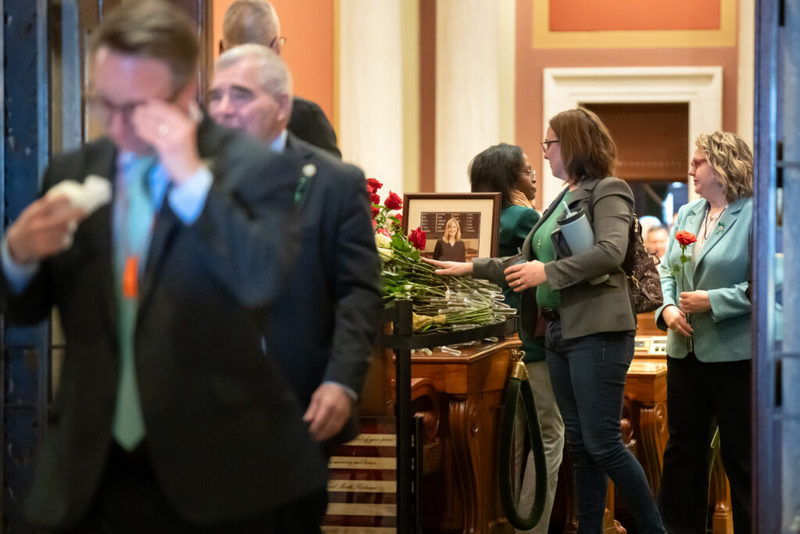
Legislators placed roses on Melissa Hortman’s desk as they left the first day of session on Feb. 17, 2026. The first day of the Minnesota Legislature was marked by tributes to Sen. John Hoffman and the late House Speaker Melissa Hortman. (Photo by Glen Stubbe/Minnesota Reformer)
Colin Hortman stood before members of the Minnesota House of Representatives in April, sharing his grief and experience living with post-traumatic stress disorder after his parents were gunned down in an act of political violence.
The timing was critical, as legislative leaders were heading into budget negotiations that can often turn publicly nasty.
In the year since former House Speaker Melissa Hortman and her husband, Mark, were killed, their son has spent countless hours researching political rhetoric. He used the moment with his late mother’s co-workers to emphasize that how legislators craft their arguments matters. He wasn’t there to lay blame on any individual lawmaker or political party.
“This can really feel abstract for the general public, but the people in that room, for myself, for my sister, for our whole family, political violence will never feel abstract again,” Hortman said in a Reformer interview.
His message to the lawmakers resembled what he and his sister, Sophie, shared days after their parents died: Love your neighbors, and treat each other with kindness and respect — words of the world religions and kindergarten teachers alike, and yet abandoned these days by many politicians.
The Hortmans were killed June 14, 2025. Days from the first anniversary of their deaths, the man who confessed to killing them, Vance Boelter, pleaded guilty to murder charges. Investigators said he had compiled a hit list of other Democrats and abortion rights supporters. He badly wounded Sen. John Hoffman and his wife Yvette at their home and went to the homes of two other lawmakers.
The shootings led to more security at the Capitol in St. Paul, including weapons screening, per an executive order from Democratic Gov. Tim Walz. Other states followed suit after other acts of violence, including an attempt to burn down the home of the Democratic governor in Pennsylvania and death threats lobbed at Republican lawmakers in Indiana who defied President Donald Trump’s demand to redraw congressional districts more favorably for his party.
Since Hortman’s horrific death, Minnesota lawmakers vowed to do better and refrain from spreading dehumanizing language in hopes of preventing future political violence that wrecks families and tears apart the civic fabric.
But Republicans and Democrats said in interviews that has been a struggle.
Colin Hortman said sharing his message with lawmakers back in April — the first private meeting he had with them since his parents’ death — was important because lawmakers have a platform, and they can “butterfly effect … outward” a humanizing message.
“There’s a lot of research that shows how political rhetoric can justify political violence, and that the words that we use matter,” he said. “When we dehumanize each other, that can lead to dehumanizing physical actions.”
Before the 1994 genocide in Rwanda, for instance, the Hutu majority frequently called the Tutsi minority “cockroaches.” Nazis referred to Jews as subhuman.
Just as hateful rhetoric has become almost commonplace in American political discourse, political violence has increased with it.
According to the National Consortium for the Study of Terrorism and Responses to Terrorism, the first eight months of 2025 saw a 34.5% increase in total terrorism and targeted violence compared to the same period in 2024. Threats against members of Congress have skyrocketed (including a man squirting a substance from a syringe at Minnesota U.S. Rep. Ilhan Omar), as reported by the Bridging Divides Initiative at Princeton University. There were several spikes in threats against local officials, with the year’s most intense coming after the September killing of conservative commentator Charlie Kirk. Citing survey data, the initiative reported “75% of local officials are now less willing to engage in key political activities due to concerns about hostility.”
Hoffman, who was shot nine times and whose wife Yvette was shot eight times on the night of Hortman’ s killings, returned to the Capitol earlier this year. He encouraged lawmakers to see each other as people first.
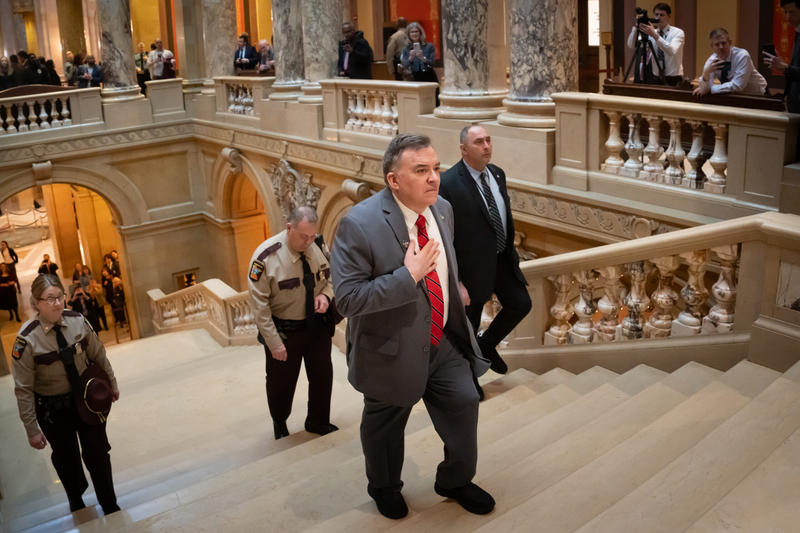
“In moments like this, politics must fade, and humanity must take over. This is not a weakness, it is a strength. It is a proof that beneath our disagreements, behind our election certificates, we still recognize one another as human beings,” Hoffman said during his first floor speech after he was shot.
The paradox of the Hortman tragedy is that she is remembered as a tough politician but was well-liked because she treated people — her caucus, the opposition, the Capitol staff — with respect and decency.
Hortman refrained from “dehumanizing rhetoric or personal attacks,” said House DFL leader Zack Stephenson, who was pallbearer at Hortman’s funeral. “She found that part of politics really distasteful and she didn’t like it.”
Amid attempts to deescalate, vitriol remains
Lawmakers say they’ve made progress on their vow to cool their rhetoric, but the vitriol is still present: in the Capitol’s committee rooms, on the floor of the House and Senate, and especially on social media, when they don’t have to look their opponent in the face. The incentives are working against peace-seeking lawmakers — polarizing and provocative content receives more engagement, which is gold in the attention economy.
“A lot of people are genuinely kind in person, and then it’s so disappointing to see them do a post later, just trying to demonize the other side,” said state Sen. Julia Coleman, a Waconia Republican. Her most popular posts, she sorrowfully acknowledged, are those hammering the opposition.
While the national political and media atmosphere have created barriers to a more civil discourse, Minnesota’s unique circumstances have ladled on extra acid. Within hours of Hortman’s death, some right-wing influencers — and U.S. Sen. Mike Lee of Utah — were spreading disinformation about the cause of her killing, undermining grieving for those who knew her and poisoning the well for Minnesotans who didn’t.
When two children were shot and killed and more than two dozen injured in August at Annunciation Catholic Church in Minneapolis, the two parties debated one of the most divisive issues of our time: gun control, and the resulting acrimony met expectations.
A few months later, Trump — himself the victim of three known assassination attempts — referred to Somali Minnesotans as “garbage” and sent 3,000 immigration agents to the state. That led to the shooting deaths of two U.S. citizens at the hands of federal agents, massive protests against the heavy-handed enforcement, and further drove a wedge between Minnesota Democrats and Republicans.
Several Republican state lawmakers, including Rep. Walter Hudson of Albertville and Sen. Steve Drazkowski of Mazeppa, blamed their Democratic colleagues and the resistance to the immigration crackdown for the deaths of Renee Good and Alex Pretti.
“Multiple members of this Legislature were involved in the Signal chat groups, the paramilitary organization formed by Minnesota Democrats throughout the core cities in this state,” Drazkowski said. “Because of that, we actually had two people in this state die — a very unfortunate thing.”
Lawmakers told the Reformer that abstaining from wrathful rhetoric is more top of mind since Hortman’s death, but with the high-stakes midterm elections coming up, many are afraid that a coiled bitterness will emerge, despite nearly everyone’s hopes.
Coleman said that she often thinks to herself, “Would my kids be proud of me if they read this?” before posting or saying something.
The public also plays a role in political discourse, Coleman noted: Many of the worst things that have been said about her are in the comment sections.
“I think all of society has to look inward and say, ‘What is my part in toning down this rhetoric?’” Coleman said.
Cross-stitching for peace
Rep. Athena Hollins, a St. Paul Democrat, was on the brunt end of political rhetoric this session after a Minnesota House GOP X account posted her remarks about “class warfare” — including a quotation attributed to philosopher Jean Jacques Rousseau:“eat the rich.” Hollins proposed a bill to create a fifth income tax tier for the wealthiest Minnesotans.
The result, she said: death threats.
(Hollins is not alone in receiving threats. A woman was charged in March for making threatening phone calls to Republican House Speaker Lisa Demuth. The woman’s guns were confiscated by way of a “red flag” law that Hortman helped shepherd through the House in 2023.)
“It’s weird because people scolding me — saying I incited political violence — they actually incited political violence,” Hollins said.
Behind closed doors, lawmakers often treat each other with respect and have fun together, like when Hollins gifted Rep. Paul Torkelson, R-Hanska, a pillow.
Torkelson told Hollins that in high school he was in a band named “Lil’ Tork and the Machine.” Hollins said she was “tickled” by this admission, so she created a logo for his band and cross-stitched it onto a pillow.
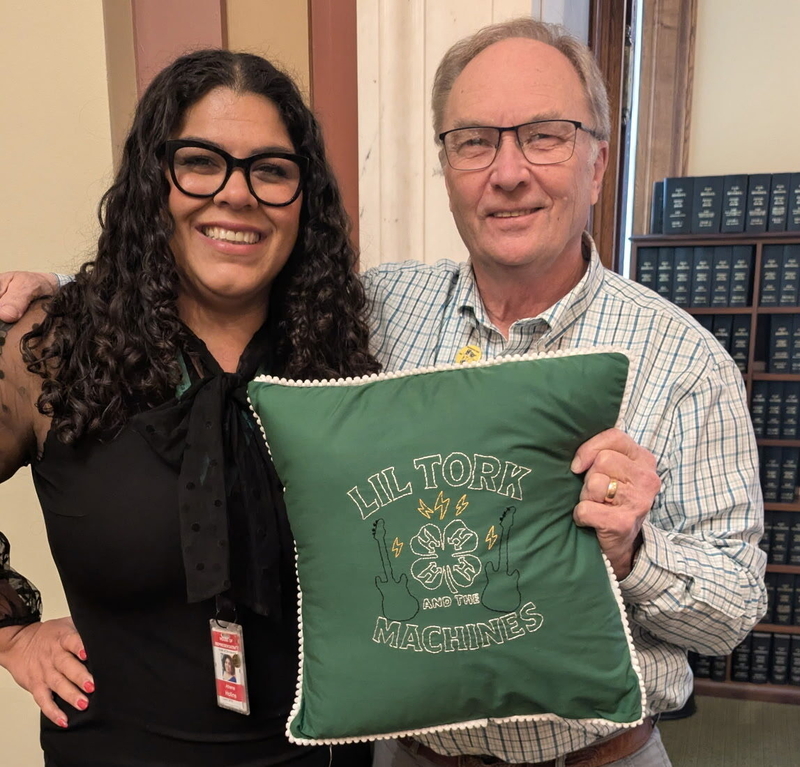
Hollins said the time getting to know Torkelson helped them “connect on a human level” rather than just as political opponents.
She said that the ultimate illustration of civility work was the Legislature’s bipartisan deal to close out the session. Given the latent hostility and the upcoming election, they had every incentive to do nothing.
Instead, not long after Colin Hortman spoke to the 134 members, the House — comprising 67 Democrats and 67 Republicans — passed a deal to increase infrastructure spending; bail out the fiscally ailing Hennepin County hospital; give drivers a small tax break on their tabs and homeowners a small break on their taxes; institute fraud-prevention measures; rein in homeowners’ associations; regulate social media use among kids under 16; and ban prediction markets.
It was a session that Melissa Hortman would have been proud of — while gearing up for a summer of the ultimate small-d democratic civility tool: door knocking.

Saint Paul, MN