Lawmakers pave way for Maine jails to have discretion over holding immigration detainees
Mar 23, 2026 | 4:18 am ET
Description
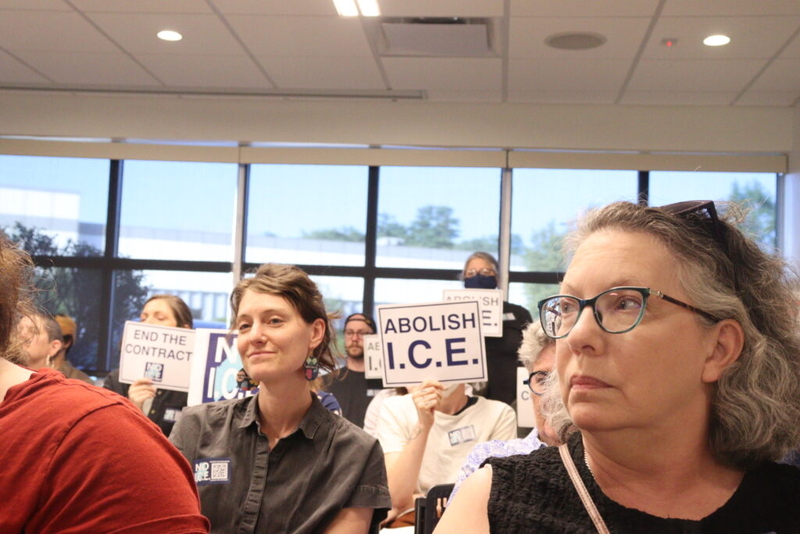
About 120 people attend the Cumberland County Board of Commissioners meeting on July 21, 2025 in Portland to urge the county jail to stop housing people for federal immigration authorities. (Photo by Emma Davis/ Maine Morning Star)
Lawmakers advanced a bill that would allow Maine jails to refuse to hold immigration detainees, laying the groundwork to settle the legal question at the heart of the dispute over a federal contract with Maine’s largest jail.
“I think everybody wins,” Cumberland County Sheriff Kevin Joyce told the Criminal Justice and Public Safety Committee on Wednesday about the legislation.
With late votes tallied Friday, the committee backed the measure 8-5, sending it to the full Maine Senate and House of Representatives for consideration.
Since President Donald Trump began ramping up immigration detentions, Cumberland County Jail has faced mounting pressure from community members to end its longstanding contract under which the federal government pays the facility to house its detainees. But the board of commissioners pushed off its decision, citing ambiguity as to whether they could refuse to hold federal detainees, regardless of the contract, because of a decades-old state law.
The underlying law
The underlying law that lawmakers are attempting to alter was enacted in 1964 to address a narrow and urgent problem: there was no statutory authority governing cooperation between state and local law enforcement and the detention of people charged with crimes.
The city of Rockland had stopped accepting people arrested by state police and neighboring municipalities. The Maine attorney general issued an opinion stating that the city as a subdivision of the state could not refuse to accept people arrested for violations of state criminal law.
As a result, the Legislature took emergency action to codify that opinion.
Nothing in the legislative history of the law suggests a mandate to house federal detainees accused of civil infractions, bill sponsor Sen. Rachel Talbot Ross (D-Cumberland) and other supporters said.
That’s the law that this bill, LD 2058, seeks to clarify.
Maine law currently stipulates that municipal and county jails “shall at all times be available for detention of persons arrested by state or any other law enforcement officers.” The bill would add the stipulation, “unless a person is being detained solely for a civil immigration violation,” which supporters say more accurately reflects the original intention behind the statute that was established in 1964.
The legislation would clarify who jails are mandated to hold, not who they can hold. But such a clarification would presumably put to rest the debate over whether Cumberland County Jail or any other facilities could decline to hold civil immigration detainees.
It would also bring that old law more in line with another forthcoming law that restricts local involvement with federal immigration enforcement, according to committee analyst Will Tew.
“You might not agree with the underlying policy,” Tew told lawmakers, “but I think that this change probably more closely aligns with what the state law is.”
Confusion between criminal and civil offenses
Maine does not have a standalone U.S. Immigration and Customs Enforcement detention facility. The only ICE facility in the state, which is located in Scarborough, is an administrative building for routine check-ins with three small, short-term holding cells.
That means jails have been relied on for immigration detentions, increasingly during Trump’s second term.
Immigration detention is an administrative, or civil, form of confinement. It is therefore not intended to be punitive, though often looks similar to criminal custody because the U.S. prison and immigration systems are interconnected. The line between the two has been further blurred as the Trump administration has used both policies and rhetoric to try to characterize all undocumented immigrants as criminals.
And, that blurriness was demonstrated during the tense committee debate about the bill, with Republicans opposing any limits to federal access to the state’s jails.
Following uproar over jails holding ICE detainees, lawmakers consider tweaking state law
The majority of people detained during Trump’s second term have no criminal convictions, and many have no criminal charges at all.
“It’s a common misconception of, ‘Okay, well, if they’re held in jail, they must have committed crimes,’” said Anna Welch, founding director of University of Maine’s School of Law’s Refugee and Human Rights Clinic. The clinic has helped provide legal support to more than 300 people held in Cumberland County Jail and Two Bridges Regional Jail in Wiscasset during Trump’s second term, most of whom were being held in civil custody.
The Cumberland County Sheriff’s Office doesn’t have a direct contract with U.S. Immigration and Customs Enforcement but has had a contract with the U.S. Marshal Service since July 2010 under which it’s compensated per day to house federal detainees, including people awaiting a hearing on their immigration status or deportation.
Joyce told Maine Morning Star the jail informed ICE that “we weren’t interested in holding individuals detained due to an administrative or civil violation,” a stance he reiterated to committee members in explaining why he supports the legislation.
“The elephant in the room is ICE and some of their tactics about asylum seekers, and I’ve been trying to stay away from that and only hold the criminals, the worst of the worst,” Joyce said.
That’s the terminology ICE used when launching its large-scale operation in Maine in January, during which agents detained many asylum seekers and others pursuing lawful immigration processes.
One was a corrections officer recruit, who Joyce said was lawfully allowed to work in the U.S. and had no criminal record. After Joyce publicly rebuked the detention of his staffer, the federal government pulled all of its immigration detainees from Cumberland County Jail.
“[Federal authorities are] still going to do what they do,” Joyce said of the impact of the bill. “It’s just that Maine jails won’t be holding the administrative or civil violators that everyone is concerned with.”
The contract with the U.S. Marshal remains, and the jail is still holding other federal detainees.
The initial version of the bill presented at the public hearing would have mandated jails to hold people only on criminal charges with documented probable cause, whereas the version that passed committee creates an immigration-specific exception.
That appears to address concerns raised by the Department of Corrections that the initial version would have made it so jails wouldn’t have to accept people arrested for violating probation, which is often not charged as new criminal conduct, or people found incompetent to stand trial or not criminally responsible, as they would no longer be facing criminal charges once those charges are dismissed.
Augusta, ME