Lawmakers have ignored an Oklahoma constitutional edict for years. Kevin Stitt called their bluff.
Sep 03, 2026 | 6:30 am ET
Description
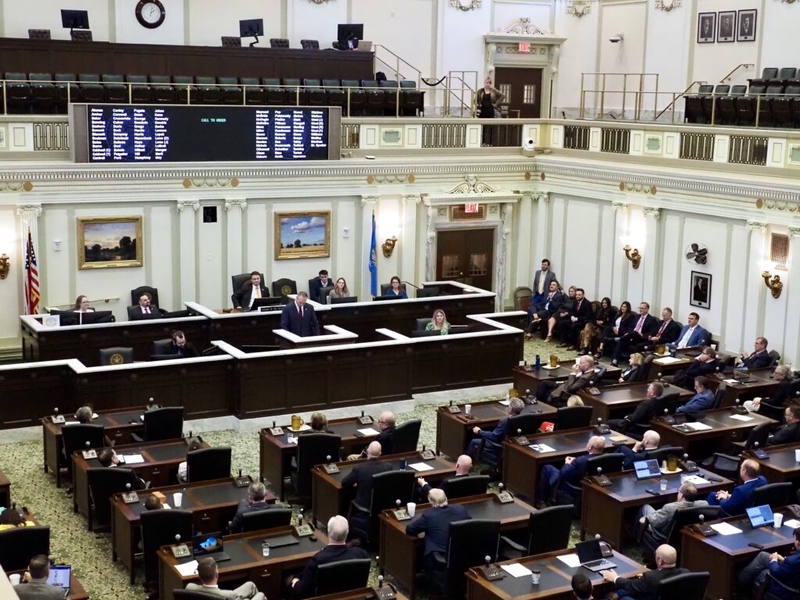
House Speaker Charles McCall, R-Atoka, gives a farewell speech on the House floor to recognize his final days in the state Legislature on May 22, 2024, at the state Capitol. McCall is term-limited after 12 years in office. (Photo by Nuria Martinez-Keel/Oklahoma Voice)
Oklahoma’s Constitution requires that lawmakers give voters the right to consider calling a constitutional convention at least once every 20 years.
Yet lawmakers last placed the referendum on the ballot in 1970 — 56 years ago. In 1994, the Legislature asked voters to repeal the 20-year requirement entirely; voters rejected it.
After years of lawmakers from both parties failing to comply with the constitutional requirement, Gov. Kevin Stitt’s patience has run out. He recently issued an executive order that sets a special election on April 6, 2027 where voters would at long last have the chance to decide whether to call a convention.
Critics argue Stitt lacks the authority to place a question on the ballot unilaterally. Stitt counters that the Legislature has abdicated its constitutional duty, and his oath of office compels him to enforce the requirement.
While attorneys debate the separation of powers, the underlying politics are simple: The Legislature systematically violated the Constitution because an independent assembly of Oklahomans threatens its power.
A citizen-led convention would give the people of Oklahoma the most realistic path to making constitutional reforms the Legislature won’t make on its own or its special interest allies won’t allow. Those could include adopting modern democratic best practices and other policies that ensure the people remain the ultimate authors of their government.
The concept of holding a constitutional convention was invented in Massachusetts in the late 1770s because lawmakers have an inherent conflict of interest when revising their own powers. Massachusetts’ innovation was to elect delegates independent of the legislature to propose constitutional changes, subject to direct voter approval.
The early state framers did not fully foresee how fiercely modern legislatures would protect their gatekeeping power. To prevent politicians from stonewalling needed reforms, 14 states, including Oklahoma, established the Periodic Constitutional Convention Referendum as a legislative bypass mechanism.
Over the years, I’ve examined and tracked how state legislatures across the country continue to undermine voters’ constitutionally protected right to call conventions.
Oklahoma stands out for its brazenness.
While lawmakers in other states use subtle maneuvers to undermine the process, Oklahoma’s Legislature has simply ignored its constitutional duty for more than half a century.
Oklahoma lawmakers often blame procedural gridlock between the House and Senate for their failure to comply with the Constitution. But American history shows that when a ruling party genuinely wants to pass legislation, procedural roadblocks vanish.
This institutional self-preservation also explains Oklahoma’s recent legislative attacks on citizen ballot initiatives. Like conventions, citizen initiatives bypass legislative control. In response to citizen success in getting measures before voters, lawmakers have consistently sought to raise signature thresholds and shorten petition windows to restrict grassroot access.
Tellingly, Oklahomans secured both the citizen right to place issues on the ballot and the periodic ability to call constitutional conventions through its original statehood convention.
Oklahoma lawmakers have demonstrated a preference for the standard legislative process over both initiatives and conventions because legislators get to control the agenda.
In the Capitol, leadership can pass favored bills while quietly burying popular reforms that would restrict their own influence — such as redistricting, term limits, transparency measures, and ethics oversight. They may also bury popular reforms — such as campaign finance, lobbying, administrative procedure, and legislative procedure — that would harm their special interests allies that have undue influence over Oklahoma’s government.
An open-ended constitutional convention strips away those legislative firewalls.
The political dynamics of an initiative petition versus convention differ for a minority party. With a ballot initiative, organizers can tightly narrow the agenda to a single popular issue that the majority party refuses to hear. A convention, by contrast, opens the entire constitutional agenda — inviting debates on popular reforms that face bipartisan opposition among political insiders.
Oklahomans should view legislative outrage over Stitt’s convention order with deep skepticism.
The stakes in this fight are clear: If this executive action is abandoned, the constitutional convention is functionally dead in Oklahoma. Modern legislatures simply will not call a convention that threatens their own power.
Putting this referendum on the ballot is the only plausible path to restoring a constitutional right that lawmakers have suppressed for decades and that courts in other states have often treated as a “political question,” meaning a matter the judiciary considers beyond its authority to resolve.
Even if Oklahomans ultimately reject calling a constitutional convention, putting the question on the ballot re-establishes a vital principle: The people, not entrenched politicians, hold the ultimate authority over the state’s foundational document.
Oklahoma City, OK