Las Vegas data center expansion approved as officials ponder need for future regulations
Jun 18, 2026 | 7:56 am ET
Description
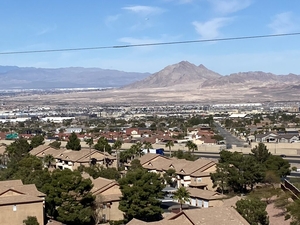
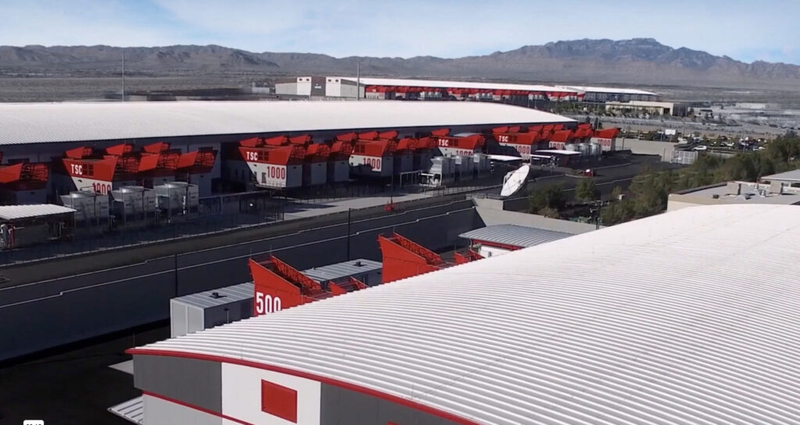
A Switch data center campus in Las Vegas. (Photo from Switch promotional video)
The Clark County Commission, in its capacity as the zoning board, unanimously approved a proposal to expand the largest data center campus in Southern Nevada on Wednesday, but not without adjustments and acknowledging the need for future data center regulations.
Switch, a Las Vegas-based tech company, is seeking to build a nearly 57,000 square-foot data center on nine acres of private land along the north side of Warm Springs Road just west of Decatur Boulevard. The new development requires a zoning change and would be built alongside existing data centers on the company’s massive southwest valley campus.
Switch’s original proposal sought a landscaping waiver that would allow the company to forgo planting trees along the perimeter of the property and in the building’s parking lot, as required by county ordinance to combat extreme heat.
However, the company agreed to withdraw the waivers Wednesday after discussions with county commissioners who signaled they would not support it.
“The waivers related to landscaping were withdrawn and are not ones that I would have considered,” said Clark County Commission Chair Micheal Naft.
Switch also agreed to cover the cost of a short reinforced concrete barrier along the sidewalk adjacent to the data center to provide adequate pedestrian safety, a condition the county required in order to approve the company’s waiver to forgo a detached sidewalk due to space limitations created by an existing county wall. In Clark County, all roadways 60 feet or larger require detached sidewalks — a feature that separates pedestrian walkways from roadway curbs by a landscaping buffer strip.
Trees and landscaping will instead be placed on an elevated platform along the wall.
“There is no room for a landscaping strip between the sidewalk and the face of the wall. We are just going to be shifting that quantity of trees and shrubs to the top side of the wall, so by net, the quantity will be the same,” said Natalie Steven Roberts, the vice president of construction development for Switch.
During public comment, more than a dozen residents spoke in opposition to the data center’s expansion, citing environmental impact, energy consumption, and potential strain on Nevada’s electric grid and water resources.
Before approving the zone change, Naft highlighted what he said is the board’s history of prioritizing responsible development, including working with the Southern Nevada Water Authority to ban the installation of new evaporative cooling systems in the Las Vegas Valley.
“The people on this board have done more than this entire state when it comes to demanding responsible development, when it comes to sustainability,” Naft said.
The commission chair emphasized business practices implemented by Switch to improve sustainability of their data centers, including the use of air-cooling to reach “near zero water consumption,” sourcing all their energy from renewable sources on the open market, and “using existing electric infrastructure that they put in place at their own cost.”
The new data center is on a “closed loop” water system and is only expected to use about 1,000 gallons of water a day.
“This application has received 6.5 out of seven points on the maximum of seven points that are attainable through the sustainability code. I think that is important to note for the record,” Naft said.
All members of the zoning board voted to approve the expansion while also emphasizing the need to look into a data center ordinance to manage future developments.
“I do think that going forward we should look at having some type of a data center ordinance or somewhere where we put all the pieces together,” said Clark County Commissioner Tick Segerblom. “Maybe come up with some type of criteria that we look at, because I don’t think we can sustain this very long.”
Municipalities in Nevada continue to grapple with where and how data centers should be built.
The City of Reno became the first municipality to place a moratorium on data centers earlier this month as they look into creating regulations for the resource-intensive facilities.
On Tuesday, the City of Henderson also introduced a measure that would place a moratorium on permit applications for data centers in the city. The bill will be heard by the city council at their July 21 regular meeting.
Last month, the Nye County Water District Governing Board unanimously approved an emergency order requesting that the Nye County Commission place a moratorium on data centers in the Pahrump Valley.
And the Clark County Zoning Commission raised concerns Wednesday about the cumulative effects of data center expansion without clear regulations on how to assess the large-scale facilities’ impact on utilities and city resources.
“Moving forward, I think that we should — as Commissioner Segerblom said — look at what those future regulations could possibly look like,” County Commissioner William McCurdy said.
County Commissioner James Gibson said that some data centers are “difficult for us to make a zoning decision on, because we don’t have ordinances, we don’t have structure that enables us to do that.”
“I’ve indicated that I don’t support data centers,” Gibson said. “They consume water and that they tie up the production capacity of the energy supplier in the valley, which creates a hardship on all of the rest of us and the way that we develop.”
County Commissioner Marilyn Kirkpatrick, who also serves as the chair of the SNWA Board of Directors, assured residents that county officials are “not willy-nilly approving things, we’ve thought about a lot of these things.”
Las Vegas, NV