Land named for colorful character ‘Herring Pete’ added to Alaska’s Kachemak Bay State Park
May 26, 2026 | 2:00 pm ET
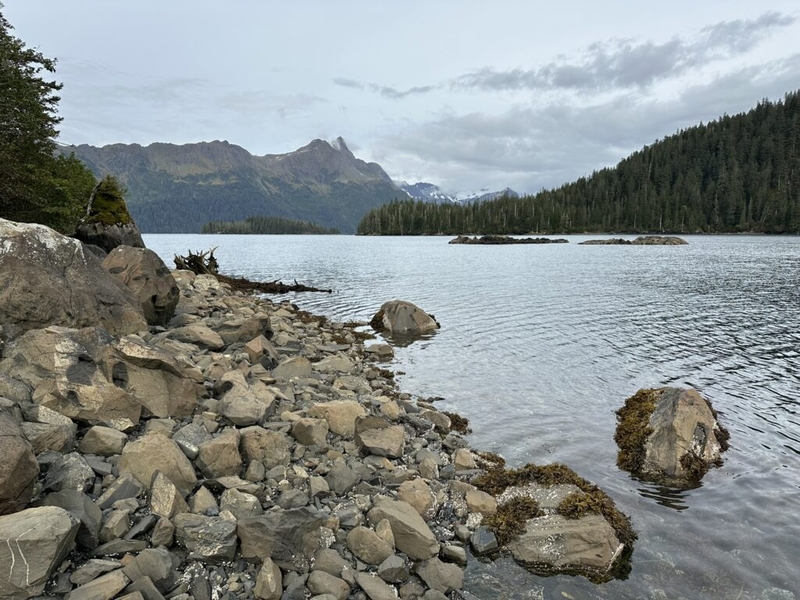
Description
Mountains are viewed across the water from Herring Pete's Cove, now part of Kachemak Bay State Park. (Photo provided by The Conservation Fund)
A century ago, a Norwegian-born mariner nicknamed “Herring Pete” and his Austrian-born wife operated a fox farm on a scenic, remote and mountainous Kenai Peninsula island.
Now that 24-acre island parcel is part of 400,000-acre Kachemak Bay State Park.
The Conservation Fund, a private nonprofit that protects vulnerable lands and habitat, has purchased the site on Nuka Island known as Herring Pete’s Cove and donated it to the state.
Nuka Island, which comprises about 15,300 acres, is adjacent to Nuka Passage, a well-traveled, safe and sheltered route used by boaters sailing between Seward and Homer. The region is a destination in itself for wildlife watchers. It has salmon, seabird colonies, marine mammals and land mammals.
“It is a wild and fascinating, beautiful place,” said Chris Little, Alaska field representative at The Conservation Fund. It is rich with fish and wildlife, and “the scenery is absolutely breathtaking.”
With the purchase of Herring Pete’s Cove, all of Nuka Island is now folded into Kachemak Bay State Park. The Conservation Fund’s 2023 acquisition of a site called Mike’s Bay added 22.5 acres.
“Now the entire island is public, which is really cool,” Little said.
The Conservation Fund previously added acreage elsewhere to the park to ensure public access to a site called Saddle Trail. That purchase, comprising 5 acres, was completed in 2022, and the parcel was officially added to the park in early 2023.
Aside from its natural beauty, the Nuka Island site has historic significance.
Herring Pete Sather and wife Josephine, known as “Mrs. Herring Pete,” were icons in that part of the Kenai Peninsula.
“Because the couple was involved in so many activities, many consider them the pre-eminent historical figures associated with Kenai Fjords National Park,” according to a National Park Service historical account. Pete was considered eccentric but friendly and skilled, and Josephine was considered an adventurous and capable outdoorswoman. Her son from her first marriage, Frank Angerman, served in the Alaska territorial legislature.
Herring Pete was born Peder Pederson. He became known as “Herring Pete” to distinguish him from all the other Norwegian mariners named Peterson or something similar, according to a book by author Doug Capra about the region’s history called “The Spaces Between: Stories from the Kenai Mountains to the Kenai Fjords.”
Herring Pete was not the original operator of the Nuka Island fox farm. That distinction belonged to Josephine and her second husband, Edward Tueck. After Edward died, Josephine accepted Herring Pete’s marriage proposal to ensure that she could stay on the island and keep operating the farm, according to the National Park Service.
The acceptance was despite earlier impressions Herring Pete left on Josephine, according to Capra’s book.
“Herring Pete was the dirtiest man I’d ever seen,” she is quoted as saying in the book. “His sweater was held together by wire, so he wouldn’t take it off all winter.”
Pete died in 1961, and Josephine died in 1964. After a period when other families lived there, the University of Alaska in 1988 gained title to Herring Pete’s Cove.
The university’s sale to the Conservation Fund, at an undisclosed price, and the subsequent transfer to the Alaska Division of Parks and Outdoor Recreation were made final in March. The parties decided to announce the deal this month to time it with the start of the summer tourist and recreation season.
The Conservation Fund has preserved over 400,000 acres in the state since 1994, from the Utqiagvik area in the Arctic to the Tongass National Forest in Southeast Alaska.
Juneau