Form allows hundreds with felony convictions to find their voter eligibility
Sep 03, 2026 | 3:43 pm ET
Description
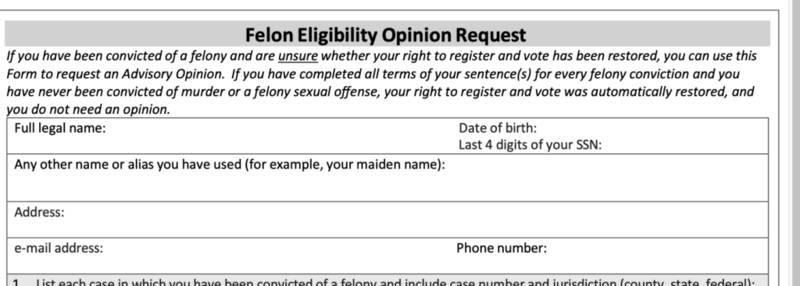
Screenshot of top of form that individuals with felony convictions in Florida can complete and send to the state's Division of Elections to verify voting eligibility.
In the first statewide election since Florida created a process to allow those with felony convictions to learn whether they are eligible to vote, an advocacy group says it helped more than 400 people submit an inquiry with the state’s Division of Elections.
The development comes nearly eight years after Floridians approved Amendment 4, designed to restore voting rights to nearly 1.5 million people with felony convictions. But the process became onerous in 2019, when Republican lawmakers passed an implementing bill that required payment of all outstanding fines, fees, and restitution before those voting rights could be restored.
Meanwhile, the state failed to provide a centralized database for citizens to research the debts they owed. The Florida Rights Restoration Coalition, the group behind Amendment 4, filed a lawsuit against the state in 2023 “for its unwillingness to fix Florida’s broken election system.”
The two sides ultimately came to a negotiated settlement. The result was that the state agreed to provide Floridians with felony convictions who were uncertain about their legal financial obligations to fill out an advisory opinion request form with the state.
“In the past year, I’d say we filed over 400 advisory opinions on behalf of returning citizens or helped them file their own advisory opinions so that the state is giving them clarity on their eligibility to vote,” said Raven Lightsey, executive director for the FRRC.

The rule giving the Division of Elections responsibility for advisory opinions was issued in November 2024. It says the division must respond within 90 days of receiving the form to indicate whether an individual is eligible or ineligible to register and to vote.
“Sometimes, in some cases, that 90-days mark sometimes gets passed, in some cases due to discrepancies in the applications,” Lightsey said.
The Phoenix reached out to the Department of State earlier this week to ask how many advisory opinions it’s fielded since the request form went live, as well as how often it’s been able to provide an opinion within 90 days. The department had not provided that information by time this story was published.
Different policies and procedures?
Once provided with the information about their voting eligibility, individuals need to work through their local clerk of the court to fulfill their financial responsibilities. Lightsey said sometimes there is a lack of consistently between what the state provides and what the clerks say about what the former felon owes.
“We know that the clerks of the court are independently elected for their counties,” she said. “Sometimes they have different policies and procedures in terms of how they process collection costs versus fees that were assessed at the time of sentencing, so one of the things that we’re trying to work on is some alignment between the state’s advisory opinion process and the clerk of court’s understanding on how to use that information to apply payments to people’s fines and fees accounts.”
A spokesperson for the Florida Court Clerks & Comptrollers couldn’t provide much clarity on that issue.
“Questions regarding how a particular individual’s financial obligations are reflected in local court records would need to be directed to the clerk of the court in the county where the case originated,” said Kasey Hyde, external communications manager for the Florida Clerks.
The Florida Restoration Rights Coalition went to court in 2023 following what it and other voting-rights advocates described as a dark a moment in the movement to restore voting rights to what they refer to as “returning citizens.”
That would be Aug. 18, 2022, five days before the primary election in Florida, when DeSantis announced that 20 individuals had been arrested by officers with the FDLE and the Florida Election Crimes Security unit for breaking election law (later amended to 19). Subsequent reporting found that many of those charged had been told by a government official that they could vote, while others received voting information cards in the mail.
FRRC doesn’t support centralized database
During the most recent legislative session, Broward County Democratic state Sen. Tina Polsky filed legislation (SB 132) that would have required the Florida Commission on Offender Review to develop and maintain a database with information to assist a person about whether they qualified to have their voting rights restored. The measure went further than similar legislative efforts, winning unanimous approval in two committees.
However, the House companion never received a hearing.
The FRRC doesn’t support that legislation, worried it “exposes” people who are already sensitive to the criminal legal system, Lightsey said.
“Having a centralized repository like that is not the safest thing for returning citizens. I think that the state can do a little bit better than just having a centralized repository of everybody having a felony conviction, for example,” she said.
“I think what we need are systems that talk to each other so that the system that the state is using to determine a person’s voter eligibility through that advisory opinion process, they’re using the four-corners rule — which means I’m looking at what was accessed at the time of sentencing, while clerks are looking at, ‘Well, here’s all the collection costs. Plus your fines and fees which you owe us.’
“Those collection costs are not a barrier to voting. And so what we need is clarity on that statute first, and then having systems built around that who speak to each other across the state, so that I’m not hearing one thing from the state and another thing from my local clerk.”
Tallahassee, FL