Kansas political history book highlights influence of centrist governors with bipartisan instincts
Oct 28, 2024 | 10:16 am ET
Description
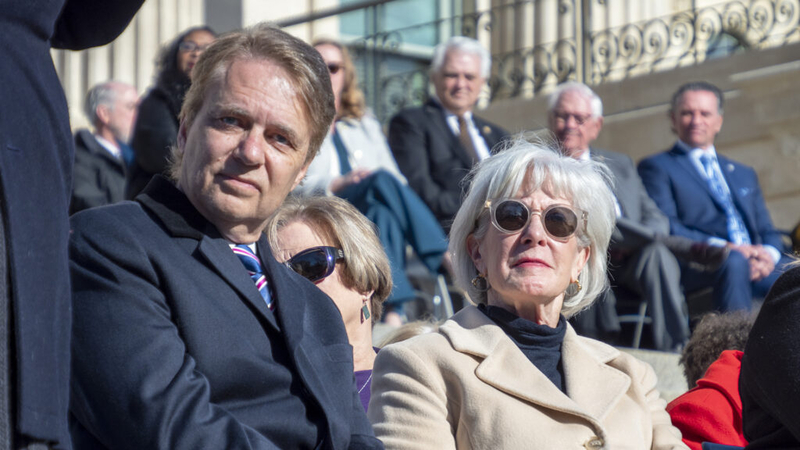
Former Kansas governors Jeff Colyer and Kathleen Sebelius attend the Jan. 9, 2023, inauguration at the Statehouse after Gov. Laura Kelly won a second term. Political scientists track "The Arc of Kansas Politics" in a new book that examines governors who served the state since 1975. (Sherman Smith/Kansas Reflector)
TOPEKA — The pattern embraced by Kansas voters when electing governors during the past half century meant the state consistently alternated between Republicans and Democrats while rewarding candidates with experience in elective office.
With one significant exception, the eight people elected governor in those five decades, starting with Republican Robert Bennett in 1975 and culminating with Democrat Laura Kelly in 2022, could be classified as centrists open to bipartisanship. They exhibited different leadership styles, but outside of Republican Sam Brownback this group was comprised of policy-oriented chief executives who sought to distance themselves from interests of culture warriors.
To a degree, Kansas voters followed advice of Gov. Robert Docking, a conservative Democrat in the Republican state who held the office from 1967-1975.
“Docking coined a phrase: Kansas government should be ‘austere but adequate,’ ” said Michael Smith, a professor at Emporia State University. “We make the argument that that really frames Kansas government for generations. And then, of course, we have the Brownback years, which were a major shift.”
Smith collaborated with Ed Flentje, professor emeritus of Wichita State University, to edit and write “Reform and Reaction: The Arc of Kansas Politics.” The idea of the book was conceived and launched by Burdett Loomis, a University of Kansas professor who passed away in 2021. Other authors were former Kansan residents Chapman Rackaway of Radford University and Patrick Miller of Kent State University.
Together, they charted the nuanced story of Kansas politics through the administrations of Bennett, John Carlin, Mike Hayden, Joan Finney, Bill Graves, Kathleen Sebelius, Mark Parkinson, Brownback, Jeff Colyer and Kelly. The book chronicled challenges and agendas of the governors, bitter division within the GOP, persistent numerical disadvantages of Democrats, Brownback’s experiment with deep red-state politics and ramifications of all that drama.
On the Kansas Reflector podcast, Smith and Flentje discussed eras marked by devotion to modernizing antiquated institutions of state government, the transition to a period of policy activism and the political aftermath.
“About a 20-year period of institutional reform followed by roughly 20 years of activism in public policy,” Flentje said. “We then get to the reaction.”
In terms of institutional change, reapportionment of seats in the Kansas Legislature rid the state of a system in which each county was guaranteed a representative in the House. Since the 1970s, House districts have been based on population. It brought a raft of new people into the Legislature who reimagined state policy on economic development, school finance and transportation infrastructure.
“What you had were folks who took public policy making very seriously, and they were willing to put careers on the line, be the first to stick their head out over the mountain and take on difficult issues,” Flentje said.
Hayden, a Republican governor from 1987 to 1991, and Carlin, a Democrat who served two terms from 1979 to 1987, focused on bread-and-butter issues that weren’t especially ideological. Both were from western Kansas, served as speaker of the Kansas House and were keen to support the agricultural economy.
Finney, a Democrat who was state treasurer for 16 years, was elected governor in 1990 by defeating Hayden. She was the first woman in the United States to defeat an incumbent governor and a rare pro-life Democratic governor. Finney didn’t seek a second term, and Kansas moved on to Graves, a Republican who had been secretary of state.
Graves dealt with division in the Republican Party that pitted conservatives against moderates, but he managed to cut taxes and promote spending on K-12 schools. GOP infighting gave Democrats leverage to influence legislation.
“He was elected in ’94 and it was an interesting time period, because Graves was very moderate. He was pro-choice,” Smith said. “So you have this very moderate leadership of a Republican governor, but yet you have this conservative rebellion going on.”
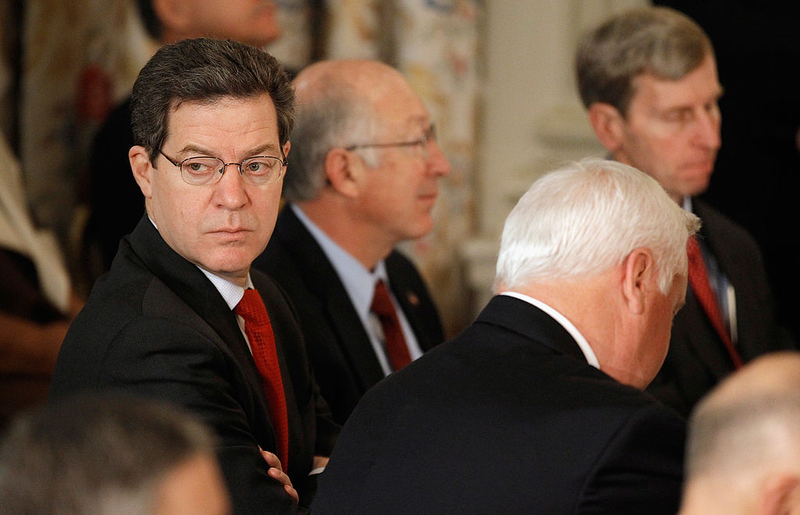
Graves served two terms and turned the governor’s mansion over to Sebelius, a Democrat, former House member and state insurance commissioner. Sebelius’ progressive instincts were a backstop against conservative policy emerging from the Legislature. She resigned in 2009 to work for President Barack Obama as secretary of the U.S. Department of Health and Human Services.
Sebelius’ lieutenant governor, Mark Parkinson, was a Republican-turned-Democrat who declined to seek a full term. Parkinson was accused of handing the job to Brownback, a U.S. senator who failed to gain traction in a 2008 campaign for president but had little trouble winning the race for governor in 2010. His election advanced an ideologically conservative agenda, especially opposition to abortion, and led to promotion of a risky plan to eliminate the state income tax.
“I don’t think Sam knew a lot about state government or state politics,” Flentje said. “He was an agriculture secretary, congressman, senator, and that’s not a good background for learning about the intricacies of state government — whether it’s infrastructure, roads or schools, or you name it.”
In 2012 and 2013, the GOP-led Legislature passed and Brownback signed bills that eroded the state’s tax base and failed to deliver promised job growth. State revenue shortfalls led to an increase in the sales tax and undercut funding for highways and education. In 2017, a bipartisan majority in the Legislature repealed the Brownback tax program.
“Brownback’s favorability ratings were in the toilet. And so you had a crop of legislators step forward — moderate Republicans and Democrats — and a coalition came together,” Flentje said.
Brownback resigned as governor in 2018 to work for President Donald Trump as U.S. ambassador for international religious freedom. Brownback handed the keys to Colyer, who had served in the House and Senate.
Colyer lost the GOP gubernatorial primary by several hundred votes to Kris Kobach, who was the secretary of state. In November 2018, Kobach was defeated by Kelly, a Democratic state senator from Topeka. Kelly won reelection in 2022 by outrunning Derek Schmidt, a Republican who had served three terms as attorney general.
“Kelly, I think, is a throwback to the moderate tradition,” Smith said. “It’s well known that she’s strongly supported by former Governor Sebelius, who I believe was instrumental in urging Kelly to run.”
Flentje said the arc of Kansas politics indicated a reform era of state government could be on the horizon.
“It’ll be based on what folks have figured out before,” he said. “Taking public policy seriously, putting bipartisan coalitions together. We’ll see if that indeed is the case.”
Topeka, KS