Kansas legislators share frustration over surging waitlist for services to people with disabilities
Aug 24, 2026 | 11:15 am ET
Description
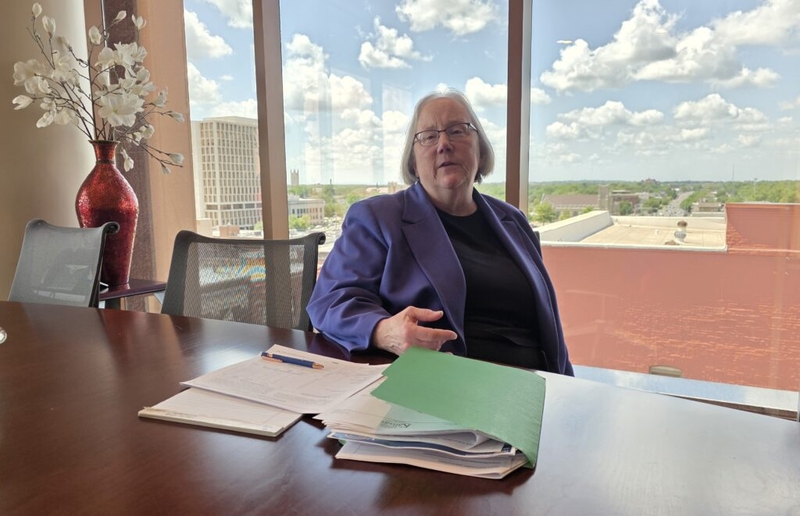
Laura Howard, secretary of the Kansas Department for Children and Families, recommends the Kansas Legislature appropriate more state funding to deal with a backlog of more than 5,000 people waiting for Medicaid disability services. KDADS is under attack for shifting $24 million approved for the waitlist to another area of the agency's budget. In this Aug. 26, 2025, image, Howard discusses agency business in her Topeka office. (Photo by Morgan Chilson/Kansas Reflector)
TOPEKA — Kansas legislators object to diversion of $24 million to disability services for the frail elderly and people with brain injuries that had been earmarked for benefit of Kansans with intellectual or developmental disabilities stuck for years on a bloated waiting list.
During an interim legislative hearing at the Capitol, the administration of Democratic Gov. Laura Kelly was accused of misappropriating the Medicaid dollars. One Republican House member used salty language to underscore frustration with how funding was deployed, while a GOP senator argued executive branch officials should be fired. Democratic legislators were dumbfounded bureaucratic obstacles hadn’t been resolved by state and federal officials.
The Legislature passed a law capping the state’s waitlist for people with intellectual or developmental disabilities, or I/DD clients, at 4,800 in fiscal year 2025 and 4,000 in fiscal year 2026.
Instead, Kansas House Speaker Dan Hawkins and other lawmakers said the I/DD waitlist surged to 5,348 in August — the second month of fiscal 2027.
“These caps were enacted into law,” Hawkins said. “They were not suggestions the administration could ignore when they became inconvenient.”
The House speaker said the Kansas Department for Aging and Disability Services engaged in a “blatant bureaucratic shell game, and families waiting years for services deserve answers.” He said KDADS compounded the problem by not providing the House and Senate a strategic plan for reduction and eventual elimination of the I/DD waiting list.
KDADS Secretary Laura Howard said the agency partially fulfilled the Legislature’s directive by adding 200 new slots in the I/DD service delivery system. She said the $24 million was transferred — with the Legislature’s consent — from the I/DD and physical disability service baskets to prevent waiting lists from forming among the frail elderly or those with brain injuries.
“We share the Legislature’s interest in decreasing the I/DD waitlist. It can do so by appropriating adequate funding when legislators return in January,” Howard said.
Rep. Will Carpenter, an El Dorado Republican who chairs the Legislature’s oversight committee on Medicaid, said it was outrageous the Kelly administration plugged a budget hole with an appropriation aimed at getting I/DD Kansans off the waitlist.
“I’m just frustrated about how much damn time it takes for these folks to get approved when we have the money sitting there,” Carpenter said. “I apologize for being rude, but this has went on long enough, and I’m done.”
“Basic question: Why does it take so long to approve a person? They’re on the list already,” said Rep. Barbara Ballard, D-Lawrence.
Michele Hayden, the long-term service and support commissioner at KDADS, said the federal government imposed numerous complex rules on Medicaid recipients. If service slots were funded in Kansas, she said, people on the waitlist were sent a letter informing them of an opening. If the waitlisted individual was interested in that opportunity, she said, that person could need an updated disability assessment. The person might have to fill out an amended application and need to secure a service delivery plan from a Medicaid contractor, she said.
“Yes, it can be very long,” said Hayden, who indicated KDADS was looking at options to speed the process.
“Wow, this is frustrating just asking the question,” Ballard said. “There must be a better system or a process that would allow people to matriculate quicker.”
Sen. Stephen Owens, R-Hesston, said the problem warranted dismissal of personnel at KDADS, but he didn’t offer specific recommendations. He expressed hope the person elected Kansas governor in November to replace Kelly in January held state personnel responsible for the mishap.
“We just really should call a spade a spade,” Owens said. “This is a failure of leadership and people need fired.”
Sara Hart Weir, executive director of the Kansas Council on Developmental Disabilities, said growth of the I/DD waitlist should be viewed as a crisis and the step backward should be managed as if lives depended on it.
She said Kansas needed a five-year crisis management plan that acknowledged the necessity of sufficient multiyear funding and enabled the state to identify, prepare, enroll and serve those requiring I/DD services.
The state’s current administrative system couldn’t produce accurate waitlists, mandated duplicate paperwork across state agencies and was slow to distribute Medicaid dollars to people desperate for home- and community-based services to better respond to a disability, she said.
In the end, Weir said, no eligible Kansan should involuntarily remain on a waiting list for more than 90 days after completing the financial and functional eligibility process.
“Our state of Kansas has been managing the service crisis with a spreadsheet and a prayer, and we need a business plan,” Weir said.
Topeka, KS