Kansas communities can learn from ‘painful’ data center lessons in other states, experts say
Aug 27, 2026 | 9:00 am ET
Description
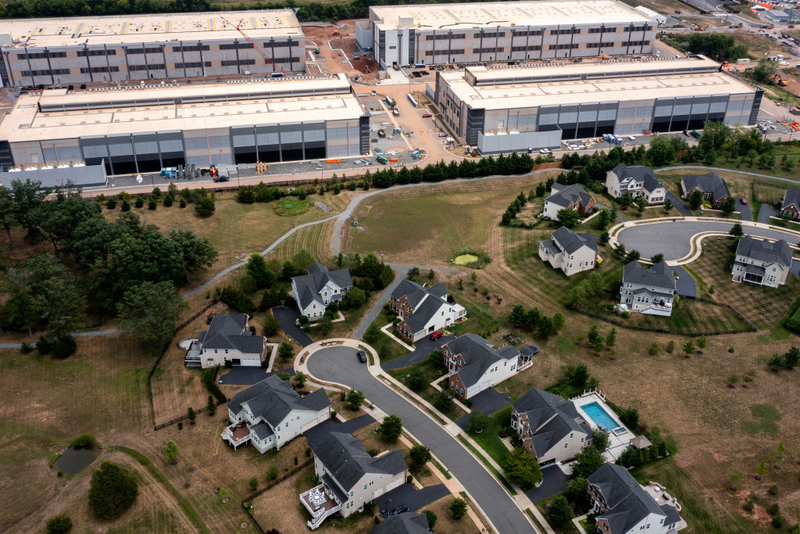
An Amazon Web Services data center, located in Loudoun County, Virginia, is one of 253 data centers that have forced county leaders to create policies to protect the community. (Photo by Nathan Howard/Getty Images)
TOPEKA — Kansas communities exploring data center development must put policies in place to protect residents, the environment and long-term economic growth before building begins, national experts say.
Mike Turner, a Loudoun County, Virginia, county official, learned about holding data centers accountable through “painful lessons.”
Loudoun County is often called “data center alley,” with 70% of the world’s internet traffic going through 253 data centers located there. Turner wrote a white paper about what government entities should consider before approving a data center.
“The 15 best practices are based on six factors that you have to address before we say yes to a data center: sound, power, water, emissions, setback and appearance,” he said. “Right now, if you measured, we probably don’t pass five of the six. Our new ordinances that we’re crafting and have been crafting for the last two years do address all six.”
The county’s application process is about two years long, Turner said. Ordinances are adapted over time.
Kansans fear impacts of data centers despite promise of economic benefits
For example, Turner said the county decided data centers must have Tier IV backup generators, even though Tier II are the minimum acceptable standards.
“Tier IV diesel generators, the current, highest EPA standard for diesel generators, are much quieter and filter out more than 90% of all pollutants,” Turner’s paper said.
Best practices are learned over time, and Turner travels the country sharing them with other communities.
Kathryn Kline Tyndall led a team for the Bipartisan Policy Center in Washington, D.C., holding roundtable discussions nationwide, including in Kansas City, Missouri, about data center development.
She said it is easy for communities to feel a “David and Goliath” relationship as they talk with data center developers who have experience handling negotiations.
Being prepared and taking the time to learn from other communities can make a difference. One Maryland county planned ahead, talking about power needs, possible locations and other options, before a data center approached them, she said.
Although the Bipartisan Policy Center report wasn’t meant to make policy recommendations but to gather information, she said several roundtable attendees thought technical assistance for communities from state and federal levels might be needed.
“It was proposed that a state task force group would come into communities with some expertise and more experience and knowledge and help communities negotiate these deals,” she said. “I think something like that seems like it could be worth exploring.”
Turner’s 56-page white paper, which he has been updating since July 2024, isn’t a layman’s guide to data center development. It goes in depth on energy usage and power lines and even looks at possible future industry changes that would affect operations.
Water usage
Drought conditions in Kansas, as well as declining aquifers that threaten the state’s agriculture industry, make water usage a prime concern in Kansas.
Turner said Loudoun County’s 253 data centers use about 10% of the county’s potable water.
“Water has not been an issue for us, but then virtually all of our data centers are on closed-loop water systems,” he said. “In today’s day and age, I would not approve a data center on anything other than a closed-loop water cooling system.”
Closed-loop systems are recharged every few years, and Turner said communities need to know how that works and where the water will be discharged.
“You’ve got to address wastewater with your water authority,” he said. “Wastewater, whether it’s an open loop or closed loop system, is going to contain biocides, anti-corrosion chemicals, and heavy metals, and that’s all got to be cleaned out.”
The water utility will need to understand how to treat wastewater from the data center, Turner said. In Loudoun County, the wastewater is discharged into the Potomac River, “so it’s very clean,” he said.
Increased utility usage associated with data centers also causes increased water usage tied to power generation, according to a report from the sustainability advocacy group Ceres.
The effect of power generation on water varies in each state and even down to localities, depending on whether power generation comes from natural gas, renewable energy, coal or nuclear, the report said.
“Nationally, data centers rely heavily on water-dependent electricity generation,” the Ceres report said. “Natural gas supplies 40% of their electricity, followed by renewables (24%), nuclear (20%), and coal (15%). Though there are many renewable projects in the pipeline to meet the growing energy demands (65% of renewable power purchase agreements in the U.S. signed since 2021 have been dedicated to data center operations), these options are often limited by timing or transmission and distribution issues across the grid.”
Energy usage
Utility regulators at the Kansas Corporation Commission set a large load tariff in November for big power users like data centers in an attempt to make sure infrastructure costs aren’t passed along to residential and small business consumers. While one energy expert called the tariff a “model” for other states, one conservation organization expressed caution.
In a statement, Sierra Club said it signed on as one of the convenors on the large load tariff but was concerned because Evergy, the state’s largest electric utility, is building natural gas plants and delaying coal plant retirements to meet energy demands.
Turner’s paper notes negative effects on climate sustainability goals, and he explored changes that may occur as power grids are stressed and data center companies develop new ways to cool their systems.
Objections to data centers became louder in the last few years in Loudoun County, Turner said, and he believes most of the problem is about energy usage.
In Loudoun County, PJM Interconnection — a regional transmission organization that manages power transmission needs and energy markets like the Southwest Power Pool does for Kansas and the Midwest — determined that it had underestimated five-year infrastructure needs by a factor of 10, Turner said.
“We’ve got nine overhead transmission lines under construction in Loudon County right now, and it’s not going to be enough, in my opinion,” he said.
Southwest Power Pool made a similar projection, with energy usage in its 14-state area expected to grow by 96% over the next decade.
“Generally speaking,” he said, “my rule of thumb is every data center is going to come with an overhead transmission line, at least a single 230-kV line overhead, and a substation, at least one substation, maybe two. So you need to plan on all of that.”
Energy usage affects not just a single community but an entire region, said Kansas Health Institute analyst Emma Uridge, who worked on a team to examine the environmental footprint of data centers.
The East Coast and other areas have seen power failures, she said, and it is a concern that has to be looked at from a regional and statewide perspective.
“One solution that I’m seeing to respond to this is actually legislation that’s putting some responsibility on developers to make upgrades to the grid and any related infrastructure for them to successfully kind of connect to the grid when they come online,” she said. “I’ve been seeing policy that would require on-site renewable energy.”
Noise, light pollution
Noise and light pollution are handled through design perimeters and location, Turner’s paper said, and aren’t as challenging as the utility usage issues. As part of 15 best practices for communities, he recommends requiring significant setbacks from the road, berms and tree plantings, and other tactics.
Many of those are already used in economic development, such as for manufacturing plants, said Mike Morse, partner at Kansas Commercial Real Estate Services Inc. in Topeka and a proponent of a Compass Datacenter facility trying to open southwest of the capital city.
The city of Topeka recently passed a one-year moratorium on data center development to better research the issue.
Morse said Topeka has noise standards and other criteria that any developer has to meet. Compass has already done decibel testing to see what the noise level is at the property now, knowing it would need to comply with local regulations, Morse said.
The Bipartisan Policy Center’s Tyndall said roundtable discussions talked about noise and light pollution as hyperlocal issues. Sometimes, she said, it can be more about perception of a problem. One group went to a data center and it wasn’t loud, Tyndall said.
“This really brings home an important point that it’s not really about the numbers as much as it’s about the community perception on some of these pieces,” she said, adding that it turns back to having “honest faith conversations” about community concerns and being transparent.
Transparency
One of the primary challenges is lack of data about the actual effects data centers have on the electric grid and water resources, Uridge said. The KHI report found that “current corporate emissions reporting practices present a related challenge.”
For instance, one analysis found that some data centers may emit more carbon dioxide than publicly reported, the KHI report said.
“Despite existing policy frameworks, including the U.S. Energy Act of 2020, which mandates studies on data center energy and water use and development of efficiency metrics, voluntary disclosure of energy and water use by data center operators remains inconsistent, limiting the ability of researchers, regulators and public health professionals to fully assess the sector’s environmental footprint,” the report said.
Communities can change that through their practices, Turner said. He recommends allowing no nondisclosure agreements, for instance. He helped Newcastle County, Delaware, write an ordinance for a data center that wanted to build.
“The data centers have to live by those rules,” he said. “The key is does the local governing authority have the authority to enforce these rules with new data centers, and that’s critical. There are states that are taking local authority away and making the decision at the state level. That is a huge mistake because every data center application is a unique, community-based solution.”
Topeka, KS