Justin Trudeau says Trump’s ‘win-lose’ approach is hurting U.S.-Canada relations at Brown lecture
Sep 22, 2026 | 8:53 pm ET
Description
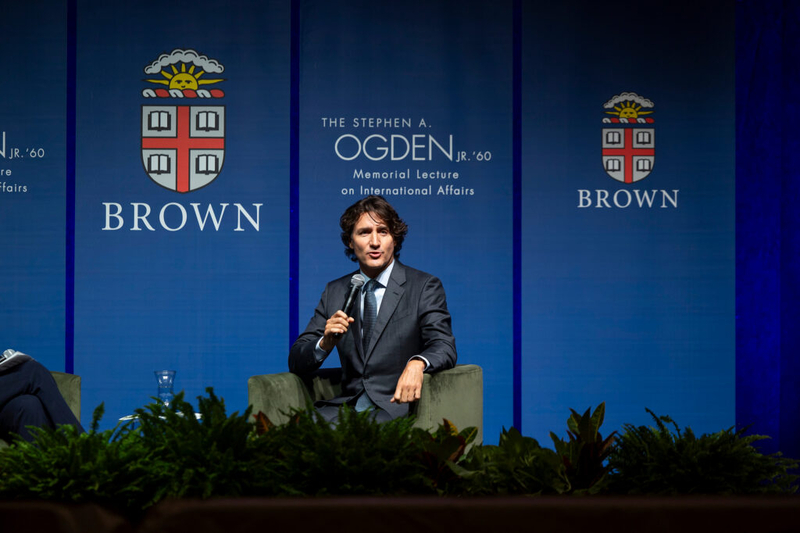
Former Canadian Prime Minister Justin Trudeau speaks during the Ogden Memorial Lecture on International Affairs in Brown University’s Pizzitola Sports Center on Tuesday, Sept. 22, 2026. (Photo by Nick Dentamaro/Brown University)
The last time former Canadian Prime Minister Justin Trudeau was in Rhode Island, he spoke to a gathering of U.S. governors to advocate for free trade amid tensions between the two North American neighbors.
Nearly a decade later, Trudeau returned to Providence where he said the relationship has moved beyond ordinary trade disputes to what he described as a threat to Canada’s sovereignty under the Trump administration
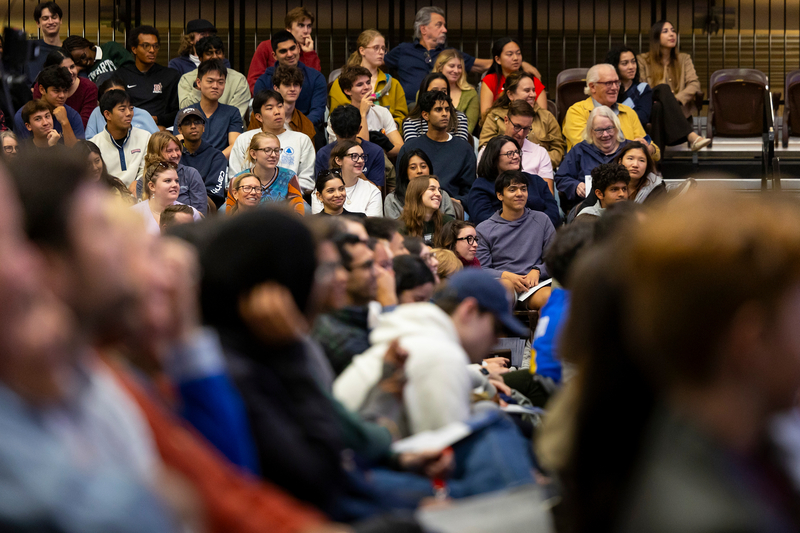
“Canadians are feeling rightly, deeply destabilized by this,” Trudeau told a crowd of more than 2,000 people inside Brown University’s Pizzitola Sports Center Tuesday. “And it seems to have no logical point.”
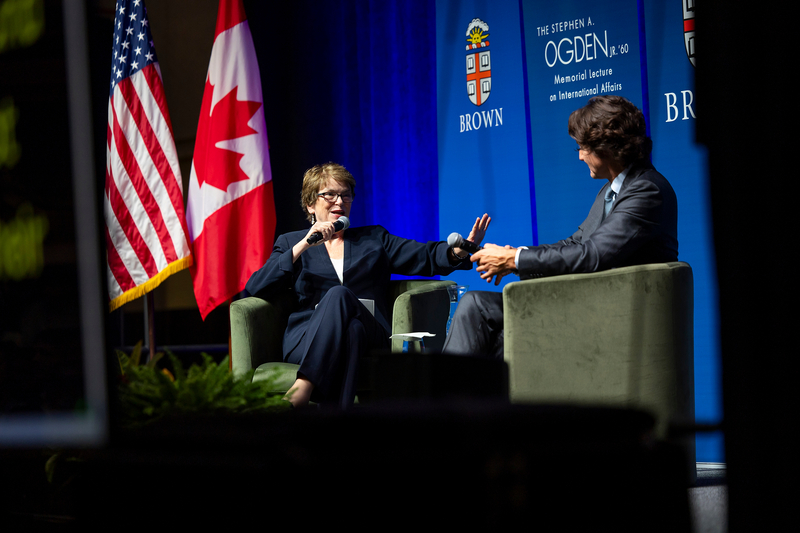
The former Canadian prime minister’s remarks came as part of Brown’s 106th Stephen A. Ogden Jr. ’60 Memorial Lecture on International Affairs. Much of the hour-long discussion with University President Christina Paxson focused on differences between the two countries’ healthcare systems, the value of diversity and the increasingly strained relationship between the U.S. and its northern neighbor.
Trudeau, 54, served more than nine years as Canada’s 23rd prime minister after leading the Liberal Party to a historic majority government in 2015. Amid declining support and poor polling, he announced in January 2025 that he would resign as prime minister once a successor was chosen. He was succeeded by fellow Liberal Mark Carney that March.
His time in office was marked by the COVID-19 pandemic and the global economic disruptions it caused, along with a domestic agenda that included a gender-balanced cabinet, a national $10-a-day childcare program, efforts toward reconciliation with Indigenous peoples and climate policies aimed at encouraging clean energy investment.
“That was a decade that encompassed some of the most consequential and challenging periods in recent history,” Paxson said when introducing the former prime minister.
Looking back on his tenure, Trudeau described a period in which leaders were repeatedly forced to make consequential decisions with limited information. That included renegotiating the North American Free Trade Agreement (NAFTA) during President Donald Trump’s first term, when the former prime minister made his last Providence stop at the Rhode Island Convention Center.
Trump had campaigned on tearing up NAFTA, which prompted Trudeau to seek allies among U.S. governors whose states depended heavily on trade with Canada. During his 2017 visit to Providence, he recalled governors made the case that preserving the agreement was in the interest of American workers and businesses, not just Canada.
When the Trump administration later presented Canada with a take-it-or-leave-it offer, Trudeau said his government chose to walk away rather than accept a deal it considered bad. That willingness to leave the negotiating table ultimately helped bring the two sides back to a deal, he recalled.
“And we were safe for a while,” he said.
Trudeau said the experience taught him that countries need to be willing to walk away from a bad deal while still looking for ways to reach a “win-win” outcome.
“Between countries, a win-lose historically, and in fact often, ends up being a lose-lose,” Trudeau said. “The resentment, the failures, and hardships that goes through the losing country ends up spilling over into conflict, into shifting geopolitics, into you know all sorts of negativity.”
But Trudeau said Trump has sought “win-lose” deals. He pointed to the administration’s tariffs on Canadian aluminum and softwood lumber as examples, arguing that they ultimately hurt American consumers and businesses.
He noted the United States still relies heavily on Canadian supplies. Tariffs therefore raise the cost of products that use the metal, including beer cans, without necessarily increasing U.S. production.
Tariffs on Canadian aluminum, he said, raise the cost of beer cans because the U.S. still needs Canadian metal. Increased import taxes on Canadian lumber similarly raise costs for homebuilders who rely on Canadian wood to meet demand.
“There is a pattern here of doing things that are driving up prices for your consumers, and not necessarily making anything better for America by fighting with one of your oldest and best allies,” Trudeau said.
The conversation later shifted from trade to another major difference between the two countries: healthcare. Trudeau defended Canada’s universal system against criticism over wait times and rationing.
“How does someone who doesn’t have health coverage in the United States feel about wait times? Or rationing?” he said, eliciting applause throughout the arena.
Trudeau also contrasted the countries’ approaches to diversity, describing the United States as a “melting pot” and Canada as more of a “mosaic” in which people maintain aspects of their cultural identities while sharing common values. But he said diversity is only an asset if people are willing to be curious about those who come from different backgrounds and hold different views.
“Democracies only work when you’re able to find common ground with someone totally different than you,” he said.
Providence, RI