Judge calls Trump mail ballot rule 'substantively unconstitutional' as court battle extends
Aug 31, 2026 | 4:08 pm ET
Description
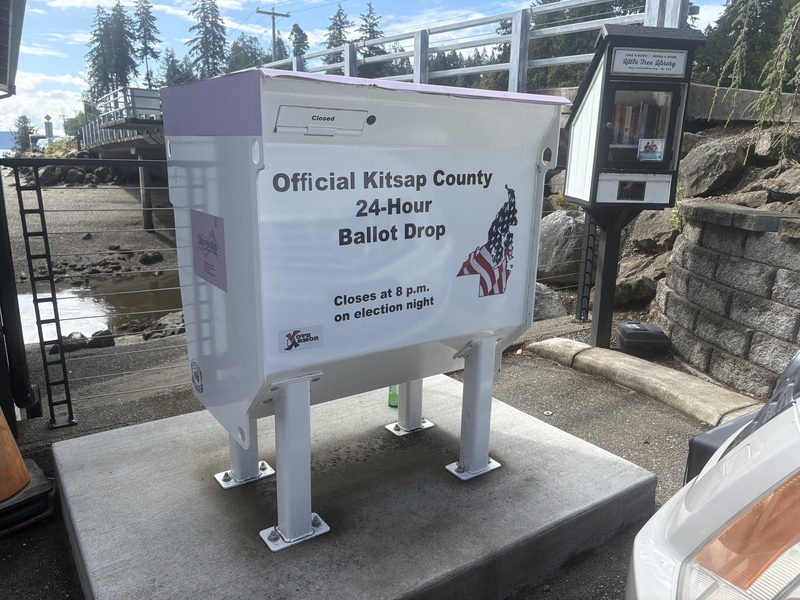
A ballot drop box in Kitsap County, Washington, pictured Aug. 29, 2026. Washington is one of the eight states that conducts elections entirely by mail. (Photo by Jacob Fischler/States Newsroom)
A Massachusetts federal judge on Monday declined the Trump administration’s request to overturn the temporary restraining order she signed last week that blocks the U.S. Postal Service from carrying out a rule placing new restrictions on mail-in voting.
The 14-day order published Aug. 27 was not appealable, U.S. District Judge Indira Talwani wrote in a brief order Monday. But even if the order could be appealed, the administration would lose on the merits, Talwani wrote.
“It is likely that the USPS lacked authority to issue the Final Rule and that the Final Rule is substantively unconstitutional and contrary to law,” she wrote.
She dismissed the administration’s argument that the temporary restraining order came too close to Election Day as a “cynical interpretation” of the U.S. Supreme Court’s Aug. 24 decision that allowed President Donald Trump’s related executive order to move forward on procedural grounds.
The high court found that Trump’s executive order, which directed the Postal Service to create the rule, could not be challenged until the rule itself was in place. It made no determination on the merits of the rule.
“A Final Rule has now issued and, contrary to Defendants’ cynical interpretation, the Supreme Court has not endorsed the view that any challenge to the Final Rule is now too late,” Talwani, whom President Barack Obama appointed to the bench, wrote.
She added that she disagreed with the USPS argument that the requirements of the rule, which would force states to overhaul their vote-by-mail systems ahead of the Nov. 3 midterm elections and to gain federal government approval of lists of voters who requested mail ballots, were “modest.”
The administration is also fighting Democratic-led states and voting rights groups in the 1st U.S. Circuit Court of Appeals over Talwani’s temporary restraining order and in Talwani’s court over a longer pause of the final rule.
Several Republican state attorneys general, representing Alabama, Florida, Indiana, Kansas, Louisiana, Missouri, Montana, Nebraska, Oklahoma, South Carolina, South Dakota and Texas, joined the suit on the federal government’s side.
The rule’s challengers say it is an inappropriate incursion of states’ power to administer elections, and would likely disenfranchise people who depend on mail ballots to vote.
Trump has long claimed, without evidence, and despite his personal use of the service, that mail voting enables election fraud.
The administration has said its rule is needed to ensure that noncitizens do not vote in federal elections, which studies have shown is rare.
Trump issued the executive order March 31. States and voting rights groups immediately sued to stop it, but the legal battle heated up last week with the Supreme Court’s procedural decision on its emergency docket.
The states and groups challenging the law quickly refiled their lawsuits to reflect that the rule had been published Aug. 21.
All States Newsroom content is free to republish. Read our republishing policy for more information.