Iowa Democrats say they’ll consider fate of ’28 caucuses after midterm elections
Jul 24, 2026 | 5:56 pm ET
Description
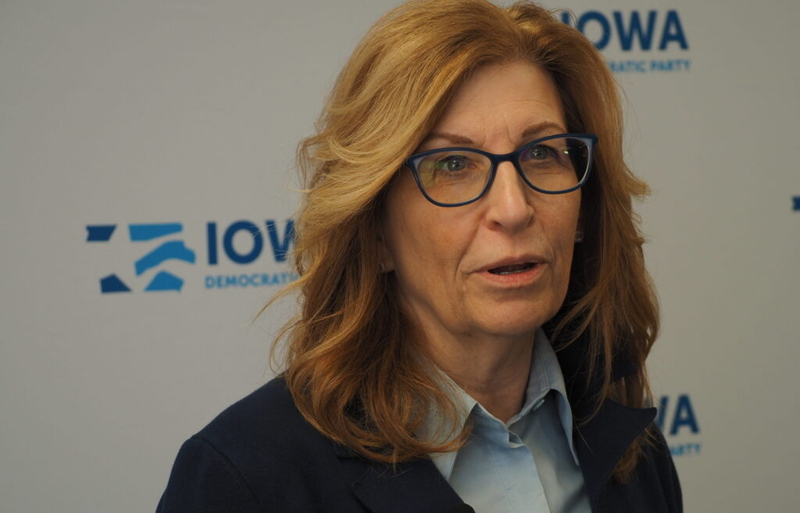
Iowa Democratic Party Chair Rita Hart did not rule out defying the national party when scheduling the Iowa caucuses in 2028. Here, she is shown speaking to reporters at the party's headquarters in Des Moines on March 5, 2024. (Photo by Robin Opsahl/Iowa Capital Dispatch)
Iowa Democratic Party Chair Rita Hart said the party will “have more to say after November” about its path forward in the 2028 presidential nominating cycle after a Democratic National Committee panel denied Iowa a waiver to hold an early contest.
Members of the Rules and Bylaws Committee voted Friday in Washington, D.C., to have South Carolina lead Democrats’ 2028 nominating calendar, with the state’s primary set to kick off the nominating process Jan. 22, 2028.
The panel also approved waiver requests from five other states to hold their nominating contests before Super Tuesday, with a tentative order set for Nevada’s contest on Feb. 1, New Hampshire, Feb. 8; New Mexico, Feb. 15; Michigan, Feb. 22 and Virginia Feb. 29.
Notably absent from the 2028 calendar is Iowa, the state which held its “first in the nation” status leading the presidential nominating cycle for both parties for several decades. This changed beginning in the 2024 presidential nominating cycle, after the DNC approved a new calendar that started with South Carolina, followed by Nevada, New Hampshire, Georgia and Michigan.
Because there were issues with Georgia and New Hampshire implementing the new calendar during the 2024 cycle, the DNC decided to restructure its nominating calendar once again ahead of 2028.
Iowa Republicans continued to hold first-in-the-nation caucuses in 2022 and are expected to be first again in 2028.
Scott Brennan, an Iowan serving on the DNC and a former member of the Rules and Bylaws Committee, said in a news conference Friday he expected Iowa would not be chosen in the early window once again. Brennan lost his spot on the RBC in 2025, after the election of DNC Chair Ken Martin earlier that year.
“Look, I’m not surprised by this decision,” Brennan said. “It was probably decided 18 months ago when the new members of the Rules and Bylaws Committee were appointed by Chair Martin. … When we lost the White House, we did make a good faith effort to share our concerns, but clearly, our case was not heard by this committee or Chair Martin.”
The panel approved four states to represent the Eastern, Midwest, Southwest and Southern regions of the U.S. in the early window, alongside granting waivers to two additional states — New Mexico and Virginia. In the current calendar set up, Michigan is set to be the only state in the “Midwest” region to hold an early contest, which is set to be the fifth of six in the early window.
Iowa Rep. Ross Wilburn, D-Ames, one of the Democrats who presented before the RBC earlier this year, said he shared Hart’s “frustration and disappointment” about the panel’s decision Friday. He said the proposed calendar “signals to voters here in the Midwest that their voices don’t matter.”
“As I told the committee in May, if we want to build lasting, sustainable majorities, then enact real change, Democrats need to invest in Iowa and the Midwest — not leave us behind, like they did today,” Wilburn said. “We can’t win the White House without the Midwest, and we can’t afford to continue to let Republicans have a spotlight in Iowa and Middle America.”
While the DNC did not give Iowa approval to hold a contest in the early window, the state party still has the ability to “go rogue” and hold a contest out of compliance with the DNC calendar. This decision would result in penalties — the DNC would not seat state delegates at the 2028 national convention, and the state party would incur a $270,000 fine. Candidates campaigning in Iowa, if the state holds a rogue contest, would be banned from earning delegates in early states, and would not be allowed to appear in DNC-approved debates.
Despite these sanctions, Iowa Democrats are still considering this path in 2028. The discussion comes after New Hampshire defied the DNC calendar in 2024, which resulted in the state initially having their delegates stripped but later restored by the DNC. New Hampshire also gained an additional seat on the RBC after the 2024 election.
With South Carolina given the starting position again in 2028, Brennan said, “New Hampshire’s not gonna stand for this calendar” and expected similar conflicts to occur. He also said “Nevada was all in on being first” and were unhappy with the RBC decision, which he said means “all bets are off” on the calendar approved Friday standing.
Iowa GOP chair pushes for rogue Democratic contest
In 2024, the state complied with the DNC calendar. Iowa GOP Chair Jeff Kaufmann told reporters Friday he believed this decision was “an abrogation of duty on the part of the Iowa Democratic Party” and led to the DNC disregarding Iowa in the 2028 process.
“The bottom line is, the time when you should have stood up to the Democratic National Committee was at the last caucus,” he said. “… You don’t have to be a political sage to realize what was occurring and what was going on here, and the Iowa Democratic Party let it happen by not pushing back. And now we’ve got the situation where, exactly what I’ve been saying all along, is the coasts, the progressive wing, has literally targeted the state of Iowa and yanked them out.”
Kaufmann said he wants to see Iowa Democrats give a “clear, decisive reaction that says, ‘we are going first, and we are going to comply with state law and hold a caucus.'”
“And at the same time, they’re saying that, I’d like to see follow up, follow up promises from their political leaders that they will stand with them,” Kaufmann said. “… That’s what I would do. Will that work? I don’t know. Seems to have worked pretty well with New Hampshire.”
While Hart did not say if the state would hold an unsanctioned contest in 2028, she said Iowa Democrats are in a difficult position and that she had received many comments from people encouraging the state party to not comply with the calendar.
“I had this conversation with Ken Martin and with some of the members of the RBC, that it’s pretty hard to defend any kind of situation that we’re in right now,” Hart said. “When we got slapped last time, when we worked in cooperation with the DNC and lost our representation on the RBC, in comparison to other states that did not cooperate and got rewarded. So it’s really hard to make a case to these people that say, you know, ‘why work with the DNC going forward?’ But I would say that that is a conversation that is not doesn’t need to be taking place right now. As we, when we get to November, and we have some newly elected Democratic officials, they’re gonna have some things to say about that, along with the rest of our Democrats.”
Iowa is expected to have many competitive races in the 2026 general election, including the race for Iowa governor between State Auditor Rob Sand, a Democrat, and businessman Zach Lahn, as well as races in Iowa’s 1st and 3rd Districts where Democratic challengers hope to unseat GOP incumbent Reps. Marianette Miller-Meeks and Zach Nunn. Iowa’s U.S. Senate race, where GOP U.S. Rep. Ashley Hinson faces Iowa Rep. Josh Turek, D-Council Bluffs, has also gained national attention.
Hart expressed frustration with the DNC moving forward with setting the 2028 nominating calendar before the 2026 midterms, saying it could have an impact on Democratic candidates’ ability to win in states like Iowa.
However, Brennan offered optimism, saying, “frankly, by doing this, it allows us to just purely focus on these elections in November.” He said Democratic victories in Iowa in the midterms would put the state party in a stronger position on future conversations about the 2028 nominating cycle.
“I think after the election, when it goes well, then I think we will just tell the national folks that, you know, we are ready to participate in the ’28 process on our terms,” he said. “… I’m not worried about them. We focused here, because we’re gonna win elections here, and then, we’ll go tell them what we’re gonna do.”
Des Moines, IA