Invasive freshwater jellyfish found near Canyon Ferry Reservoir
Oct 08, 2026 | 5:25 pm ET
Description
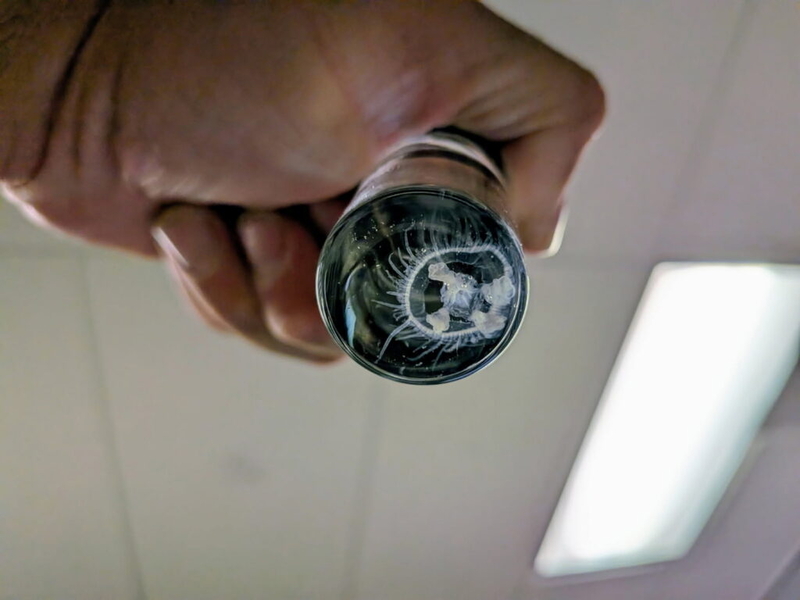
A freshwater jellyfish captured in Montana. (Montana FWP photo)
The Treasure State is being invaded by aquatic jellyfish from parts unknown, and while Montana Fish, Wildlife and Parks said they’re not dangerous, it’s an introduced species, not native to the state.
“It’s not something we’re really alarmed about,” said Tom Woolf, who coordinates FWP’s Aquatic Invasive Program. “It’s an awareness kind of thing. They don’t harm people or anything, and their impacts on the environment appear to be small, but they’re not a desirable thing.”
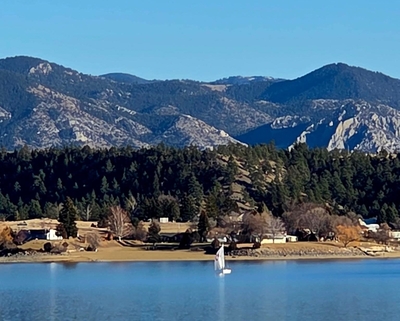
The jellyfish, Craspedacusta sowerbii, known as “a common freshwater jellyfish,” was discovered in a pond near Canyon Ferry Reservoir this summer by Vivi Veitch, a 10-year old who reported the sighting to her dad, according to the FWP. The father then called FWP, which sent a team to find the jellyfish.
Invasive plants and animals can have a wide range of impacts on the state lands and waters, ranging from incredibly bad to relatively harmless. The jellyfish fall into a relatively harmless category, but since they’ve been introduced, they can’t easily be removed and now essentially join the ecosystem.
“I thought I was seeing lots of plastic, so I tried to pick it up because you don’t want plastic in the lake,” Veitch told FWP. “But it was really hard to pick up because it was slimy.”
The common freshwater jellyfish is native to the Yangtze River area of China and is now found in most states across the U.S. The first time it was ever noted outside of China was in England in 1880, according to FWP documents. The same species was noted 17 years ago in Montana, at a pond at an abandoned golf course near Great Falls.
It’s tiny and spends most of its life attached to underwater surfaces in microscopic polyps that go dormant in the winter. The free-floating (medusa) phase of its life cycle is only around for a short time in the summer.
Montana Fish, Wildlife and Parks documents following the initial discovery say the average size of those collected in 2009 were about 29 mm across (or, a little bigger than one inch). Freshwater jellyfish feed on zooplankton, an important foundational component of aquatic food webs on which other creatures also depend.
Officials say it’s unclear how the jellyfish got there, and could have been moved in a variety of ways.
Woolf said they’re common in the Midwest, and could have entered via a boat, but can also live in ornamental potted plants and occasionally get in scuba gear as well.
There’s a reason one of FWP’s main public advertising campaigns is “Clean, Drain, Dry” — aquatic species can attach themselves to boats, floats, tubes, inflatable kayaks and paddleboards, as well as any other item that touches the water. And FWP needs the public’s help both to prevent the spread of invasive species — and reporting them when they see them.
“If you see something strange, report it, so we can verify it,” Woolf said. “If it was something like an invasive plant or invasive crayfish or something like that, there’s a potential for us to get in and do a response. If the population is small and we detect it early enough with some of these species, we can go in and take them out.”
Montana has boat checks throughout the state and officials say anyone, even if their paddleboard or float is folded up in their car, is legally required to stop for an inspection. All out-of-state boats are also required to stop for inspection.
FWP and contracted staff have performed 114,000 inspections so far this year at 17 watercraft inspection stations, Woolf said. They’ve intercepted 600 boats carrying weeds this year, 31 stops that found either zebra or quagga mussels, and more than 1,000 inspections that found boats with standing water in them.
One of the biggest worries is zebra and quagga mussels, which can cause algae blooms, take food from native species and can clog water and hydroelectric systems.
Both quagga and zebra mussels are found throughout the eastern and midwestern U.S. Quagga mussels have been creeping closer to Montana and are present in California, Arizona, Nevada, Utah and Idaho. There have been detections of mussel larvae in two Montana reservoirs, but the state responded, and Montana is still considered free of both mussels.
There’s also additional worries about a newer invasive species, golden mussels, which is native to eastern Asia.
Collaboration between government agencies, tribal governments, and the public is incredibly important to tackle invasive species issues, Woolf said. The issue has also led to the creation of the Montana Invasive Species Council, which recently turned 10 years old and has a biennial summit, which this year will run from Nov. 4-5 in Helena at the Heritage Center.
The positions on that council are appointed by the governor and cover a wide range of stakeholders and invasive species, which also includes insects, weeds and feral hogs.
“The cost of more effective prevention, detection, response, and mitigation will not be insignificant,” the MISC’s website says. “But if we were to fail, the costs would be many times greater: Enormous economic damage, unending costs of mitigation, and most of all, the priceless destruction of the natural and cultural heritage entrusted to us.”
Helena, MT