Customers get higher bills while Black Hills Energy discovers data center gold
Nov 12, 2026 | 6:02 pm ET
Description
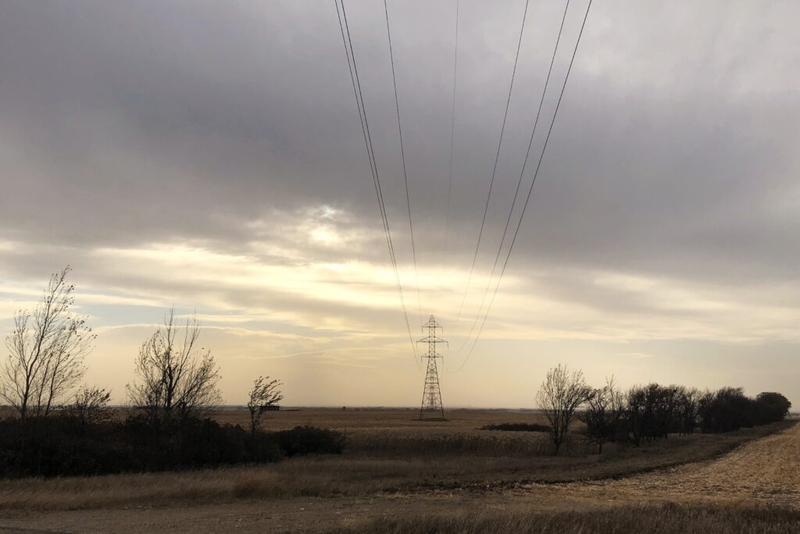
Electric transmission lines near Clark, South Dakota. (Photo by Robert Zullo/States Newsroom)
While Rapid City residents debate whether data centers belong in their backyard, a homegrown corporation is quietly anchoring some of the largest tech developments in the country — just across the state line.
Back home, its South Dakota electricity customers face substantial rate increases. Meanwhile, Black Hills Corp. expects to earn $150 million annually by 2030 from supplying electricity to Google. That’s more than half the $291.6 million that Black Hills Corp. earned for shareholders in 2025.
On Nov. 5, Google announced a $17 billion investment in a data center near Cheyenne, Wyoming. Rapid City-based Black Hills Corp., parent company of Black Hills Energy, has agreed to help power it.
Black Hills plans to invest $1.8 billion in natural gas generating plants and coordinate electricity from other producers through a privately managed power system.
Regulators approve $16 monthly Black Hills Energy rate hike as extra $20 surcharge looms
Altogether, the arrangement involves 2,700 megawatts of generating resources.
At the end of 2025, Black Hills owned 1,386 megawatts of generating capacity across its electric utilities in four states.
Black Hills plans to build 564 megawatts of new generation, enough capacity to match the average electricity needs of about 410,000 South Dakota households. The state had approximately 434,000 residential electric customers in 2024.
Google isn’t alone. Black Hills already supplies electricity to Microsoft’s Wyoming data centers and is preparing to supply Meta’s upcoming artificial intelligence facility. Microsoft recently purchased 3,200 acres for possible expansion.
Black Hills’ November investor presentation outlines 600 megawatts of planned demand from Microsoft and Meta alone by 2030. Including Google and other prospects, the company describes a development pipeline exceeding 3,000 megawatts, with another 2,500 megawatts or more being explored.
Wyoming has spent years attracting data centers with available energy, tax incentives and fiber-optic infrastructure. Black Hills is capitalizing by pursuing another $686 million in transmission investments. And its expansion isn’t limited to data centers.
Black Hills received Montana’s approval this week for a merger with NorthWestern Energy, following an earlier approval by South Dakota. The combined entity will be called Bright Horizon Energy and will be headquartered in Rapid City.
Residents of Rapid City have packed public meetings about a proposed data center ordinance to voice anxiety over energy and water consumption, noise and property values. Nearly 940 public survey responses were submitted, and the Planning Commission subsequently decided to postpone consideration of the ordinance until January.
Electricity prices are another sore point in the Black Hills, and the latest compounding increases carry sticker shock.
On Nov. 4, the South Dakota Public Utilities Commission approved a rate increase expected to raise bills by 13.62% starting Dec. 1. The commission estimates $16.34 will be added to the monthly bill for a household using 650 kilowatt-hours. In a separate proceeding, Black Hills seeks another $17.26 monthly per average household for its Lange II generating plant under construction in Rapid City, this time using 600 kilowatt-hours.
South Dakota households averaged 994 kilowatt-hours monthly in 2024. At that consumption, the combined increases will add an extra $53 a month — or $636 annually — if the separate Lange II charge takes effect as proposed.
My calculations, based on commission documents, show that a Rapid City household, at the state average, would pay $208.32 per month, well above the state’s 2024 average of $127.81.
But on Monday, commission staff objected to Black Hills Energy’s application for the Lange II surcharge. Staff contends the interim rate hike proposed did not comply with state law and urged the commission to at least suspend the implementation of a rate hike for 180 days. It also noted the impact on consumers during the Christmas and winter heating months.
News that the parent corporation expects to earn $150 million annually from Google may not generate quite the enthusiasm around the kitchen table that it does in the corporate boardroom.
The Wyoming tech investments aren’t driving these local rate hikes. Black Hills says its Google contracts are structured to prevent costs from being shifted to existing customers.
Still, the optics aren’t particularly flattering.
Rapid City is struggling with whether to accommodate even small data centers, while a corporation headquartered in the city is helping power some of the nation’s largest.
Black Hills Energy has found a new gold rush in Wyoming, with extraordinary earnings potentially ahead.
Back home, its electricity customers are discovering that not everyone strikes gold. Some just get the bill.

Pierre, SD