How will Indiana define medical frailty? State is still working out the details.
Sep 22, 2026 | 5:00 am ET
Description
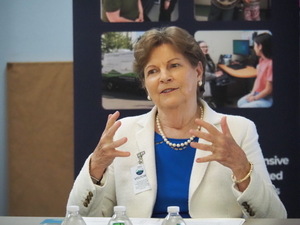
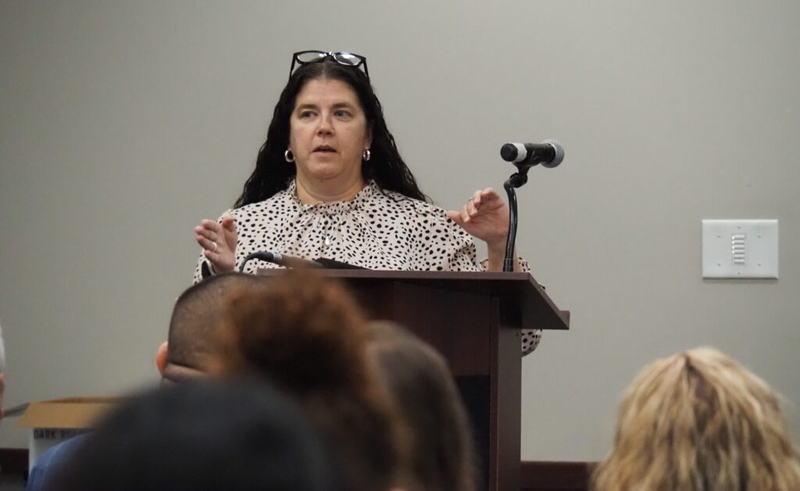
Sunshine Beam, director of the Division of Family Resources for the Indiana Family and Social Services Administration, answers questions at a town hall on Monday, Sept. 21, 2026. (Photo by Mackenzi Klemann/Indiana Capital Chronicle)
The Indiana Family and Social Services Administration still doesn’t know who will qualify for a medical frailty exemption from the state’s forthcoming Healthy Indiana Plan work requirements, with just three months before the requirements take effect.
Thousands of low-income Hoosiers insured through HIP, a Medicaid plan for able-bodied adults ages 19-64 who earn a bit too much for traditional Medicaid, could be subject to work requirements come January 1.
HIP members will need to demonstrate they’ve been working, volunteering or in school for 80 hours a month for three months prior to their application or redetermination to remain insured. Earning at least $580 a month — the equivalent of a minimum-wage job at 80 hours — would also meet the requirement.
There are exceptions to the rule, including for adults deemed too medically frail to comply.
But the federal Centers for Medicare and Medicaid Services is still redefining medical frailty as states begin rolling out work requirements for Medicaid plans like HIP, outlined in last year’s One Big Beautiful Bill Act.
“Someone who is medically frail today may not be medically frail come January,” said Sunshine Beam, director of the Division of Family Resources at Indiana FSSA.
The agency hosted a town hall Monday at the Indiana Government Center in Indianapolis to answer questions about the change.
Medical frailty emerged as a consistent point of confusion for the social workers, non-profit groups and medical providers in attendance who work closely with Indiana’s HIP population.
Today, a person may be considered medically frail due to a variety of debilitating conditions like blindness, substance-use disorders, severe mental illness and other disabilities or complex medical conditions.
“HIV used to fall under medically frail,” said Shawn Delmolino, a licensed social worker for the LifeCare HIV clinic at IU Health. “It seems like it’s questionable now.
“My concern is people who are experiencing homelessness really struggle to find employment for a million reasons that you can imagine, and now if they’re experiencing homelessness, living with HIV and uninsured — I’m really scared. I’m really scared for our clients.”
An interim final rule from CMS narrows that definition: only conditions that significantly impair a person’s ability to meet work requirements can be excluded, though it is up to states to determine which conditions make the list.
An email from FSSA to HIP members and providers Monday said the agency is still working with CMS to finalize medical frailty exclusions, promising more guidance in the future.
Challenges
The change may be particularly challenging for homeless Hoosiers, who already struggle to find employment and whose lack of housing means they may not see notices in the mail about their HIP coverage.
“We work with vulnerable people,” said Cagney Gladin, a fellow social worker with the LifeCare clinic. “People are losing their housing. The economy is not getting easier, and people are becoming more unstable. You have clients we have for years now told there’s not a work requirement for falling under a medically frail status. They’re losing their housing. They don’t have a place to get mail.”
Given the three-month lookback period, which starts in October for anyone applying for HIP coverage in January, Gladin asked whether FSSA will adopt a probationary period for Hoosiers who used to meet medically frail status.
“There aren’t any workarounds,” Beam said, telling another audience member the prospect of these Hoosiers becoming uninsured is a “concern for us all.”
“I don’t have a good answer. I think we’re trying really hard to follow the letter of the law and also do what’s right,” Beam said.
She added, “Unfortunately, there are going to be situations where our hands are tied.”
Asked whether retired Hoosiers who started drawing Social Security early would qualify for an exemption, Beam said most would likely meet the monthly $580 income requirement anyway.
Others will need to volunteer to make up the difference, she said. That may include work with a non-profit or church group, but mowing a neighbor’s lawn likely wouldn’t qualify, Beam said.
Indianapolis, IN