How the Supreme Court campaign finance ruling is altering Maine’s ongoing legal battle
Jul 10, 2026 | 5:03 am ET
Description
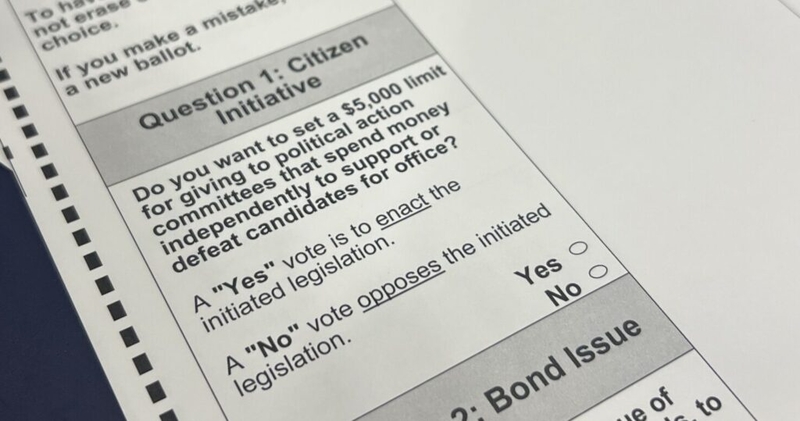
Question 1 on Maine's November 2024 ballot asked voters to limit the amount of dark money spent in state elections. (Photo by Emma Davis/ Maine Morning)
The political action committees that sued Maine over its 2024 law limiting contributions to super PACs are arguing the U.S. Supreme Court’s campaign finance ruling last week affirms their case.
“There really is nothing left for the lower courts to do,” said Charles Miller of the Institute for Free Speech, one of the plaintiff’s attorneys.
But the other side argues the SCOTUS ruling, which effectively eliminated limits on coordinated party expenditures, is not relevant to the Maine case.
“At 50,000 feet they’re both campaign finance cases,” said legal scholar Lawrence Lessig, the person behind Maine’s law, but “if you come down to 40,000 feet, you just have to recognize that the history of campaign finance cases comes in two fundamentally different buckets.”
The Supreme Court decision deals with expenditures, or total spending, as opposed to contributions, which are direct donations to a candidate or a committee. Lessig views that distinction as the crux of the ongoing legal battle in Maine.
Both sides made their cases in new filings. They provide a preview of oral arguments slated for later this month in Boston.
In 2024, Maine voters overwhelmingly passed a citizen-initiated ballot question that set a $5,000 limit on contributions to political action committees that independently spend money to try to support or defeat candidates, commonly referred to as super PACs. Shortly after, political action committees tied to a Republican state lawmaker sued the state over the law.
But that was the hope of the committee behind the referendum all along. They proposed it with the help of Lessig’s non-profit Equal Citizens with the ultimate goal to bring the issue to the U.S. Supreme Court.
They want the opportunity to convince the high court that there is a core flaw in the interpretation of the landmark Supreme Court ruling that has allowed super PACs to spend unlimited money in elections. It’s an argument that Lessig has been pedaling for years.
Last July, the Maine district court ruled that the state law was unconstitutional. Then last fall, two appeals were filed in the First Circuit Court of Appeals in Boston, one by the state and one by the committee behind the referendum and Lessig’s organization. In December, the plaintiffs offered their rebuttal. Many of these filings have been repetitive, but the latest SCOTUS ruling adds another layer.
SCOTUS decision
Last week, the Supreme Court decided that limits on how much political parties can spend in coordination with candidates violate free speech, siding with a 2022 Republican-led challenge, which included Vice President JD Vance, a senator at the time.
The court ruled that if the only justification to restrict campaign spending is to prevent corruption, then the limits on political party spending should be struck down because parties have to disclose where money is going through and coming from.
By contrast, super PACs already didn’t have limits on the amount of money they can raise and spend on elections. But those groups can’t coordinate with candidates, whereas parties can.
The decision is now expected to result in more money flowing into parties. It is likely to immediately benefit Republican candidates in Maine’s nationally watched U.S. Senate race and others across the country, given the party’s cash advantage and reliance on outside groups.
The case in Maine
The attorneys for the PACs suing over Maine’s law filed a letter late last week arguing that the SCOTUS decision supports their case.
The majority of the high court reasoned that existing disclosure and contribution rules are sufficient to prevent corruption for political parties. While the decision was about political parties, the plaintiffs in the Maine case argue that applies with even greater force to super PACs, which, unlike political parties, cannot coordinate with candidates at all.
But the Supreme Court case did also explicitly mention super PACS.
“Donors can and do send their funds to Super PACs and other outside groups that have a First Amendment right to receive and spend unlimited money to support their independent political speech,” Justice Brett Kavanaugh wrote in the majority opinion.
As a result, Miller concluded in the filing in the Maine case, “Game over.”
But Lessig offered the exact opposite perspective in his response letter filed on Monday. “Wrong,” he wrote, adding that the plaintiff’s argument to the contrary shows “their continued failure to distinguish between the constitutional limits on expenditures and contributions.”
Since Buckley v. Valeo in 1976, the Supreme Court has generally said that contribution limits are constitutional but not expenditure limits. The Supreme Court extended this reasoning to corporations and unions in Citizens United v. FEC in 2010. Three months later, in SpeechNow.org v. FEC, the DC Circuit Court upheld that contributions to PACs cannot be regulated, either, so long as the PAC is independent.
Lessig argues SpeechNow does not follow logically from Citizens United. That’s the core flaw he’s using Maine’s law to try to point out.
Large contributions to PACs inevitably create a risk of corruption, Lessig said, given that donors and candidates have the opportunity to collaborate even if a PAC is independent.
“The mechanism to make sure there isn’t the chance that there’s some kind of quid pro quo [corruption] exists in the context of expenditures. It doesn’t exist in the context of contributions,” Lessig said. “That’s what makes a difference fundamentally in why Maine is allowed to regulate in the context of contributions, even though Maine can’t regulate in the context of expenditures.”
Lessig’s group has also made the argument in its filings to date that the original meaning of the First Amendment would not have blocked state legislatures or the people from limiting the size of contributions to political action committees.
The Supreme Court was asked by American Promise in an amicus brief to consider whether Buckley was consistent with the original meaning of the Constitution, but the court didn’t address it.
“Equal Citizens has pressed that question precisely,” Lessig concluded in his response letter Monday.
Augusta, ME