How Maryland’s partisan election system disenfranchises a quarter of voters
Aug 10, 2026 | 4:04 pm ET
Description
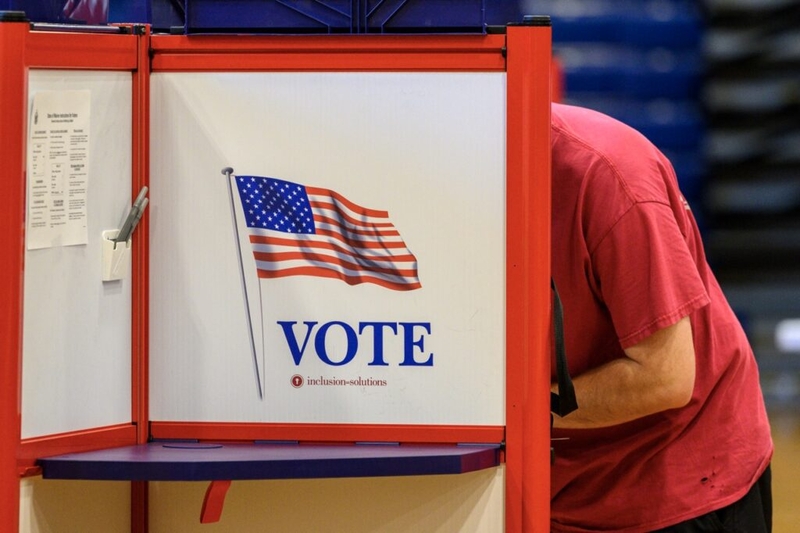
Voting at the Portland Expo in Maine’s June 9, 2026, primary election. Maryland prohibits unaffiliated voters from voting in the state's partisan primaries, essentially disenfranchising close to a quarter of registered voters, writes Roberto E. Alejandro. (Photo by Jim Neuger/Maine Morning Star)
The party primary season recently wrapped up in Maryland. Unfortunately, for many Maryland offices, there will be no real general election, as the primaries have already settled the races. This means many Marylanders end up disenfranchised, playing no role in the election.
This is especially true of the roughly one-quarter of Maryland voters registered as unaffiliated. These voters are both functionally excluded from elections as well as denied the opportunity to see unaffiliated candidates on the general election ballot.
In the 2024 presidential election, 22% of Maryland voters, almost a quarter, were registered as unaffiliated according to Maryland State Board of Elections data. Yet someone who wants to run for office as a voice for this significant population faces steep hurdles.
To run as a Democrat or Republican, one simply pays a modest fee to register in that party’s primary. In contrast, someone who wishes to run as an unaffiliated candidate must obtain 10,000 signatures from registered voters in order to get on the ballot. This is a high bar and prevents unaffiliated candidates from running for office and offering a meaningful alternative to the major parties.
The General Assembly oversees our election law and is dominated by Democratic and Republican partisans. These partisans have tilted the field to effectively exclude unaffiliated candidates from running and unaffiliated voters from participating in elections.
Unaffiliated voters are disenfranchised because Maryland’s election rules often ensure that a partisan primary, not the general election, determines who will hold a given office, cutting unaffiliated voters and members of other parties out of the election process.
The Maryland Constitution states that, “The People of this State have the sole and exclusive right of regulating the internal government.” Unfortunately, depending on the district where you live, only voters registered with a particular party have any say in the regulation of our internal government.
The consequences are obvious. A broadly unaccountable Democratic legislature has made Maryland unaffordable for working families. Our taxes are higher than those of our neighboring states with less efficient government services. Utility bills routinely crush family budgets. Businesses bear unnecessary fee and compliance burdens whose costs are built into the goods and services residents purchase, thus functioning as regressive taxes that raise cost of living.
Our MVA fees have become so obscene that many residents would rather drive all the way to Virginia and falsify a government record than pay them. Increasingly, Marylanders are simply moving to lower cost states in response.
That so many Marylanders have no say in the makeup of the legislature has not only impacted cost of living, it has fostered corruption, particularly among Democrats. Sheila Dixon, Nat Oaks, Cheryl Glenn, Catherine Pugh, Marilyn Mosby. How many Democratic office holders in a predominantly blue state have to enter plea deals before space is made for meaningful alternatives?
The party system cannot be relied upon to offer such alternatives. If you live in a predominantly Democratic district, you are faced with a Republican party that has veered so far right that Larry Hogan, a two-term governor of a blue state, no longer has a place in it. If you live in a predominantly Republican district, you are faced with a Democratic party increasingly defined by self-styled socialists whose approach to policy will never make your cost of living lower and often consists of distractions. Maryland’s third parties, whether the Libertarians, Greens, or No Labels, have made no compelling case for how they would be different from the mainstream parties and often fail to recruit or nominate qualified candidates for office.
Unaffiliated voters are not seeking a third party, in any event, and there is little to recommend additional forays down the partisan path. Unaffiliated candidates have an opportunity to serve as a corrective to poor partisan choices, if only they could get ballot access.
It may be argued that the 10,000-signature requirement prevents unelectable candidates from running. There are two obvious responses. First, unelectable candidates routinely run in the partisan primaries. Second, it is the people’s prerogative to determine who is a valid or electable candidate, not the General Assembly’s, and certainly not on an a priori basis.
The Partisans in the General Assembly who set election rules have disenfranchised a quarter of Maryland voters. By removing the 10,000-signature requirement for unaffiliated candidates, space would be made for unaffiliated candidates to state their case and potentially garner enough support among a combination of unaffiliated voters and those registered with minority parties to make our general elections competitive again.
Annapolis, MD