How Drazan’s consulting firm pocketed nearly $100K from her nonprofit with little oversight
Aug 04, 2026 | 9:00 am ET
Description
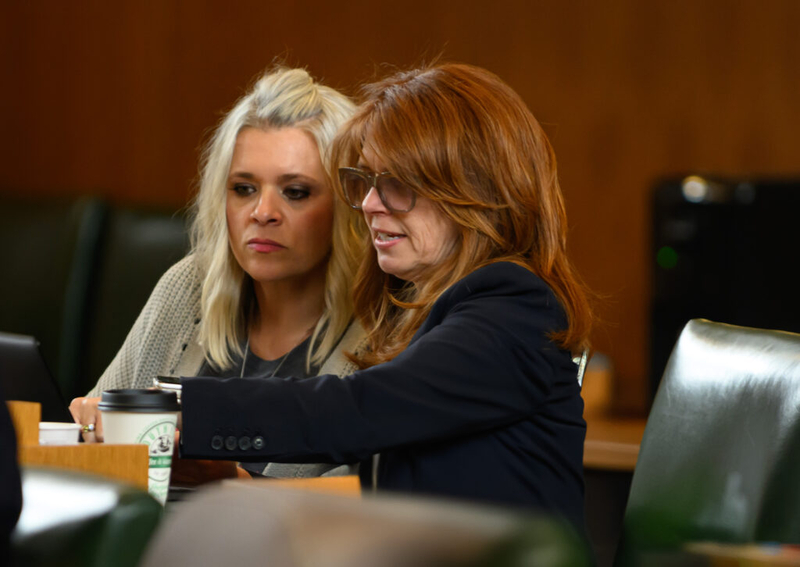
Reps. Shelly Boshart Davis, R-Albany and Christine Drazan, R-Canby, confer on the House floor on Thursday, June 26, 2025. A nonprofit Drazan, now a state senator and the Republican nominee for Oregon governor, founded is facing scrutiny over the nearly $100,000 it paid to her consulting firm. (Photo by Laura Tesler/ Oregon Capital Chronicle)
An Oregon nonprofit founded by state Sen. Christine Drazan, R-Canby, did not maintain a conflict of interest policy when it paid nearly $100,000 to a consulting firm she owns with her husband, missing a key step to help prove the transaction complied with tax law, records show.
The Republican gubernatorial nominee is defending her actions as in alignment with her previous work supporting organizations in the public interest, and there’s no evidence they broke state or federal law. The Wilsonville-based nonprofit A New Direction maintains that it operated with “complete transparency” and the services Drazan provided never overlapped with her time seeking or holding office. That matters because Oregon’s elected officials must comply with stricter ethics laws than other residents.
Although federal law doesn’t bar the organization from paying companies owned by nonprofit insiders, nonprofit experts question whether the organization followed best practices suggested by the IRS and good government advocates say the payments raise questions about the purpose and nature of the nonprofit. They also offer insight into how one of Oregon’s most successful recent statewide Republican politicians handled her finances in the run-up to a new gubernatorial campaign.
“Whenever a nonprofit organization engages in any transactions and decisions that will have a financial impact on its insiders – directors, officers, founders and leaders – or their families and businesses, there is an opportunity for corruption and a kind of insider self-dealing,” David Atkin, senior attorney at the Eugene-based Center for Nonprofit Law, said in a statement.
Drazan launched the social welfare nonprofit A New Direction in 2023 after her 2022 loss to Gov. Tina Kotek in a three-way race, falling short by fewer than 4 percentage points.
At the time, she vowed that A New Direction would push for “policies and ideas that make Oregon a safer, more affordable place to live and raise a family, strengthen checks and balances, improve transparency, empower Oregonians and support the next generation.”
In the meantime, $96,000 in payments from A New Direction went to her consulting firm, state business and federal tax records show. The organization paid the Oregon City-based Drazan Group LLC two payments of $54,000 and $42,000 for “stakeholder engagement” in 2023 and 2024, respectively. State records confirm that Drazan created the LLC in June 2023, the year her husband, Portland-based attorney Daniel Drazan, the firm’s legal representative, served as president of A New Direction.
Paying family isn’t new
Disputes over the flow of money to the families of state lawmakers are not new in Oregon. Rep. Vikki Breese-Iverson, R-Prineville, for instance, faced scrutiny in 2022 for a surge of more than $1.5 million in revenue for the political media firm of her husband, Bryan Iverson, since her ascendance to House Republican leadership, including money from political action committees over which she exercised significant control.
Breese-Iverson stepped down as caucus leader in 2023 and her husband now works for individual candidates, not caucus-affiliated political action committees.
And in a 2019 letter of advice, the Oregon Government Ethics Commission’s former executive director, Ron Bersin, warned Rep. Kim Wallan, R-Medford, that using the money she was given as a state legislator to pay her daughter’s advertising agency for an end-of-session mailer and contracting for office space with her husband’s real estate firm could violate Oregon law by conferring “a financial benefit on those businesses that would not be available but for your position.”
Susan Myers, the current executive director of the Oregon Government Ethics Commission, declined to comment on Drazan, saying she “cannot give an opinion on events that have already occurred.” Commission staff provide advice to elected officials and state employees for compliance with ethics laws in letters publicly posted to the commission website. Those records show Drazan did not seek commission advice on A New Direction.
Unlike the Wallan and Iverson cases, however, Drazan was not an elected official in 2023 or 2024.
Drazan, A New Direction distance from status as public official
A New Direction is a 501(c)(4) nonprofit, a type of tax-exempt social advocacy organization that surged in popularity after gaining significant political spending leeway under the landmark 2010 U.S. Supreme Court Citizens United ruling. Critics have long called them “dark money” groups due to the lack of disclosure requirements for donors.
Susan Gary, professor emerita at the University of Oregon School of Law, said “self-dealing itself isn’t necessarily bad” but that Drazan’s situation presents a “heightened concern” about the use of the nonprofit’s finances to improperly benefit a person with influence over the organization.
“It would be interesting to know the structure of the 501c4,” Gary wrote in an email. “Who are the trustees or directors who are making the decisions about hiring a consultant? Did they consider other consultants to hire? What was the process for determining who would provide the best service for the best price?”
Representatives for Drazan’s campaign and A New Direction didn’t provide such information responding to questions from the Capital Chronicle, and Drazan declined a phone interview through her campaign. Her husband did not respond to a phone call and a voicemail seeking comment.
Trey Rosser, the nonprofit’s executive director in 2023 and 2024 who is listed as its bookkeeper in its 2025 tax filing made in late June, sent a statement on behalf of the board of A New Direction.
The board said that Drazan’s work for the nonprofit never overlapped with when she sought office and that her husband “at no point” voted to approve the payments. The organization’s tax forms show they described the payments to Drazan’s consulting firm under a section for “interested persons” and listed the reasoning as “married.”
“A New Direction has followed all applicable IRS rules and regulations that govern social welfare organizations and has done so with complete transparency,” a New Direction’s board wrote in the statement. “Mrs. Drazan’s work directly furthered its tax-exempt purpose which is to encourage public policies and actions that improve the lives of Oregonians.”
The current board consists of A New Direction’s former treasurer and current board member, Rep. Shelly Boshart Davis, R-Albany, a Drazan campaign chair, as well as Portland-based agricultural attorney and Drazan campaign donor Tim Bernasek, according to Rosser.
Rebecca Wright, Drazan’s 2022 deputy campaign manager, also signed the 2025 tax filing this June as the nonprofit’s president. She reportedly resigned in spring as an aide to former Secretary of Labor Lori Chavez-DeRemer after an inspector general complaint alleged she helped coordinate the secretary’s personal travel with professional trips.
For A New Direction, Drazan has advocated for signature drives to influence state lawmakers and education officials over issues such as repealing the drug decriminalization initiative Measure 110 and protecting high school graduation requirements.
The Internal Revenue Service recommends that nonprofit organizations such as A New Direction take steps to document conflicts of interest, a board vote on the payments, and competing projected costs for similar services. That’s to avoid excise taxes penalizing “excess benefits” when tax-exempt nonprofit insiders are paid more than is “reasonable” for their services.
A New Direction had no documented conflict of interest policies in 2023 or 2024, federal tax forms show, meaning the organization missed an opportunity to follow what experts describe as best practices to avoid concerns of private inurement. One good government advocate said that people who have a history of serving in public office should hold themselves to a higher standard.
“Our expectations should be that anyone who is elected or is running to be elected, at any given time, doesn’t have conflicts, is working in the public interest, and is keeping all of their incentives and the funding and all that completely above board,” said Kate Titus, executive director of Common Cause Oregon. “I think we’ve lost that expectation in this state.”
‘A shadow campaign’
Ashley Quinton, a spokesperson for Drazan’s campaign, said Drazan has a long track record of leading “mission-driven organizations that create lasting change.” She pointed to Drazan’s work as executive director of the Cultural Advocacy Coalition of Oregon from 2011 to 2018.
“After her last campaign for governor, her commitment to making Oregon a better place never wavered,” Quinton said in a statement. “She founded A New Direction to continue shaping public policy, building strong coalitions and advancing solutions that strengthen communities and improve the lives of Oregonians.”
A New Direction’s most recent social media posts with original content date back to March 1, 2024. That was just four days before Drazan made her official announcement that she would be returning to state politics and running for the Oregon House. A New Direction has not made another Instagram post since then, and its most recent post on X was in July 2024.
The organization’s 2025 federal tax filings note: “Due to decreased activity in the entity, we didn’t have financial resources to pay full time staff.”
Titus said it has become more common in recent decades for Oregon politics to see a “shell game” of candidates passing money from one organization to another. She said A New Direction has effectively operated as a “shadow campaign organization.”
“When there’s money passing from one entity to another, it raises a question, ‘Well, why?’” Titus said. “If this is just an extension of your campaign, when you’re doing the work of your campaign and you’re raising money, why do you need to do that through another entity?”
Salem, OR