‘A higher moral law’: Republicans openly defy Arizona’s abortion amendment and their oaths of office
Mar 26, 2026 | 9:09 pm ET
Description
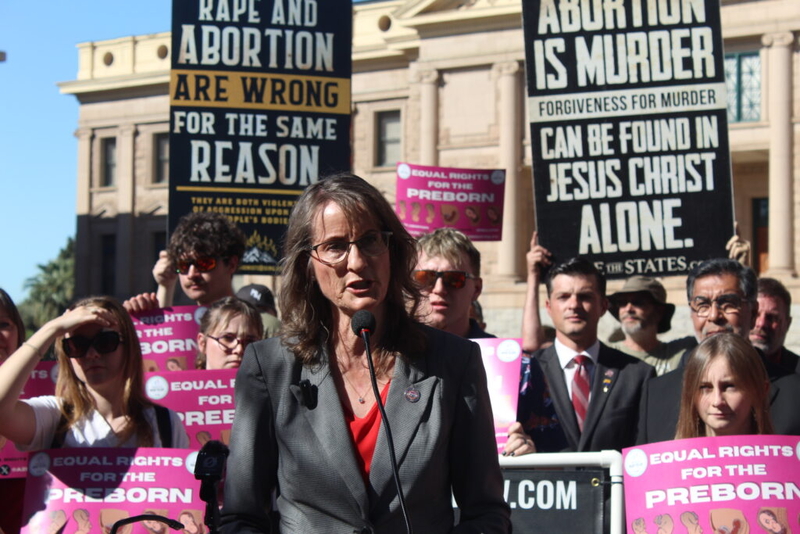
Rep. Lisa Fink, R-Glendale, speaks about the continued efforts from legislative Republicans to regulate abortion care at the state Capitol in Phoenix on Mar. 26, 2026. Fink said she won't uphold Arizona’s constitutional provisions guaranteeing abortion rights because they violate her Christian beliefs. (Photo by Gloria Rebecca Gomez/Arizona Mirror)
More than 60% of Arizona voters chose to make abortion a right two years ago, but Republican lawmakers continue to push ways to ban it — and they say that ignoring the mandate from their constituents is the right thing to do.
In 2024, the landslide victory of Proposition 139 enshrined abortion in the Arizona Constitution. It explicitly prohibits the passage or enforcement of any laws that unnecessarily restrict access to the procedure. Reproductive rights advocates have successfully used the voter-approved initiative in court to overturn a 15 week gestational ban and several laws intended to make it harder for women to terminate a pregnancy during the first trimester, including a mandatory 24-hour delay.
And yet Republicans, who hold a majority in the state legislature, have introduced more than a dozen bills just this year aimed at hindering access to abortion or that seek to create a legal framework endowing fetuses with personhood which could outright ban it in the future.
Prop. 139 isn’t “just”
During a Thursday morning news conference held in partnership with Arizona Right to Life, Republican legislators committed to keep backing and proposing anti-abortion bills, despite the conflict with the state constitution. Surrounded by a crowd of anti-abortion activists holding graphic posters comparing the procedure to murder and rape, Rep. Lisa Fink acknowledged that abortion is now a legal right in Arizona.
But the Glendale Republican waved away the idea that Prop. 139 reflects what voters want, claiming that not every law is “just” or should be followed. Fink, who represents a district in which 72% of people voted for Prop. 139, said that she and other Republicans who took an oath to uphold the constitution won’t actually do that if it contradicts their Christian beliefs.
“There is a higher moral law that does not change based on votes or political outcomes, and that law calls upon us to protect innocent life,” she said.
Every legislator swears to uphold the Constitution
Every elected official and government employee in Arizona is required to take a loyalty oath, in which they pledge to uphold the constitution and state laws. Under state law, that oath is:
I, (insert name), do solemnly swear (or affirm) that I will support the Constitution of the United States and the Constitution and laws of the State of Arizona, that I will bear true faith and allegiance to the same and defend them against all enemies, foreign and domestic, and that I will faithfully and impartially discharge the duties of the office of (name of office) according to the best of my ability, so help me God (or so I do affirm).
Fink, a freshman legislator, sponsored a bill this year that would criminalize employees in medical facilities who fail to report witnessing a so-called partial-birth abortion. Performing one is already punished with prison time in Arizona and is illegal under federal law. But abortion foes frequently weaponize the inflammatory, nonmedical term to vilify abortion, and the rhetoric is part of a strategy whose ultimate goal is to outlaw all abortions.
Fink disagreed that continuing to advocate for restrictions on abortion care undermines the voter mandate issued two years ago. She argued that voters were misled into supporting the abortion rights amendment or confused about what the law would be if Prop. 139 wasn’t passed.
“A lot of them thought that abortion was going to be completely illegal,” she said.
By the time of the election, the Arizona legislature had already repealed the 1864 law that banned virtually all abortions following a multi-day, high-profile political battle. A majority of voters in all 30 legislative districts backed Prop 139.
But for all the talk that voters didn’t really intend to enshrine abortion rights in the Arizona Constitution because they were tricked into doing so, Fink conceded that there is no effort to actually give voters a chance to vote on abortion rights again.
Last year, an effort to put a referral on the ballot that would have carved out permission for state lawmakers to pass abortion restrictions in spite of Prop. 139 was briefly considered. When that failed to move forward, a separate referral that did advance was revised to make it easier to repeal constitutional amendments — which was widely viewed as a direct attack on Prop. 139. That proposal, too, was unable to garner sufficient approval from the GOP-majority legislature, ultimately stagnating in the Senate .
Ignoring judicial rulings
Last month, a Maricopa County trial court judge blocked a state law that forbids patients from receiving abortion pills in the mail. Judge Gregory Como ruled that it should be nullified because it violates the new constitutional protections for women in Arizona who wish to end a pregnancy before viability. But Rep. Rachel Keshel, R-Tucson, wants to pass that law again — with criminal penalties this time. Her proposal would make it a class 5 felony for anyone to mail or ship an abortion pill.
Opponents of the procedure have long sought to chip away at the accessibility of abortion medication, which accounts for more than half of all abortions across the country. In 2024, the most recent year for which there is data, medication abortions made up 49% of procedures in Arizona.
On Thursday, Keshel claimed the effort to restrict how women can get the abortion pill is intended as a safeguard.
“We need to ensure that a woman who is taking such a serious medication that kills her preborn baby is at least under the supervision of a physician,” she said. “We hear that it is ‘safe.’ That is not true. These women are being fed lies about that.”
Keshel didn’t cite any evidence of that, however, and there is robust peer-reviewed research into the safety of abortion medications. Mifepristone, the most commonly used abortion pill, has undergone more than two decades of research trials and studies by multiple medical organizations, including the U.S. Food and Drug Administration and the American College of Obstetrics and Gynaecologists.
Since it first earned FDA approval in 2000 through 2024, only 36 deaths have been reported out of 7.5 million uses. Medical experts estimate the pill’s death rate is miniscule, at 0.0005% and say its safety level compares to over-the-counter drugs like ibuprofen.
Inching towards fetal personhood
Alongside attacks on abortion access, GOP lawmakers are backing multiple proposals that legal experts warn enshrine a statutory framework that could later be used to topple the right to the procedure. Fetal personhood is a legal theory under which phrases like “unborn” or “preborn” broaden the list of who benefits from the rights and legal protections that already exist in state law. And recognizing fetuses or embryos as deserving of those rights and protections ultimately leads to a wholesale ban on abortion.
The Arizona Constitution currently protects abortion as a fundamental right, but reproductive rights advocates fear that continued efforts from Republican lawmakers to enshrine fetal personhood into state law could be used in the future to challenge the validity of Prop. 139, or serve as a trigger ban in the event it is ever overturned.
Rep. Justin Olson sponsored legislation that could do just that. The Mesa Republican’s bill would allow the courts to order retroactive child support payments for “preborn” children, dating back to the mother’s first positive pregnancy test.
During legislative debates, Olson and Republican backers framed it as simply a bid to help expectant mothers. But on Thursday, flanked by pro-life supporters, Olson admitted that it seeks to recognize the personhood of fetuses and went so far as to say it would resolve the problem represented by Prop. 139.
“This demonstrates that dignity exists for all life, no matter how small,” he said. “This is not just opposition to Prop. 139, it’s a solution.”
Olson repeatedly touted the proposal as one that benefits women and criticized Democrats, who have unanimously opposed it, for rejecting an effort to side with women against irresponsible fathers. While he acknowledged that it recognizes fetuses, he claimed that it wouldn’t have the far-reaching impact that Democrats and reproductive rights advocates have warned it could.
“What the Democrats are opposing is the fact that this recognizes that this is a life,” he said “And that has no impact on any other aspect of the state statutes. What it requires is that the father meet his financial obligations in supporting the expectant mother.”
But, like Keshel and Fink’s bills, Olson’s proposal is headed straight for a veto. Gov. Katie Hobbs has consistently rejected legislation that threatens to imperil abortion access. When pressed on the logic behind continuing to push the doomed bill instead of proposals that could similarly support expectant mothers and would earn approval from across the aisle, such as state funding for childcare services or prenatal care, Olson didn’t respond, insisting instead that his bill does help pregnant women and repeating his criticisms of Democrats.
“Why would the Democrats oppose something that requires a father to support the expectant mother, that’s the question that I have,” he said. “The Democrats’ commitment to opposing any recognition that this is a life is so strong that they’re going to oppose requiring a father to support the expectant mother. It’s wrong, and that’s where the Democrats are today.”
GOP won’t make contraception a right
At the same time that Republicans championed their anti-abortion legislation on the lawn of the Arizona House of Representatives, Democratic lawmakers and members of the Arizona branch of Reproductive Freedom for All gathered in the executive tower to celebrate the group’s fifth annual “Reproductive Freedom Day” and speak out against hostile proposals. Republicans, for the first time, dubbed the day “Prenatal Rights Day,” in an apparent snub of abortion rights activists.
In a written statement, Athena Salman, the director of the Arizona chapter, denounced GOP efforts to restrict abortion care and accused them of undermining the wishes of their constituents.
“Instead of respecting the will of the voters, every single Republican legislator has voted to undermine Prop 139 and gut abortion access,” she said.
Democratic lawmakers, meanwhile, have proposed legislation aimed at repealing the dozens of abortion restrictions that remain in state law, protect access to fertility treatment and make contraception a right. But Republicans decide which bills get heard, and none of them have moved forward. Sen. Priya Sundareshan, D-Tucson, criticized GOP lawmakers for failing to so much as discuss the bills.
“We…have done everything possible to try to move this movement forward, to respect the will of the voters of Arizona, who overwhelmingly voted for Prop. 139,” she said. “And, yet, here we are.”
Just hours later, Sundareshan invoked a legislative rule that would have allowed the state Senate to vote on the proposal that would guarantee access to contraception in Arizona. Every Republican in the chamber voted against considering the bill. This is the third year in a row that Democrats have tried, without success, to enshrine that right.
Phoenix, AZ