Here’s why we should pay attention to the Oklahoma State Chamber’s annual survey
Jul 28, 2026 | 6:29 am ET
Description
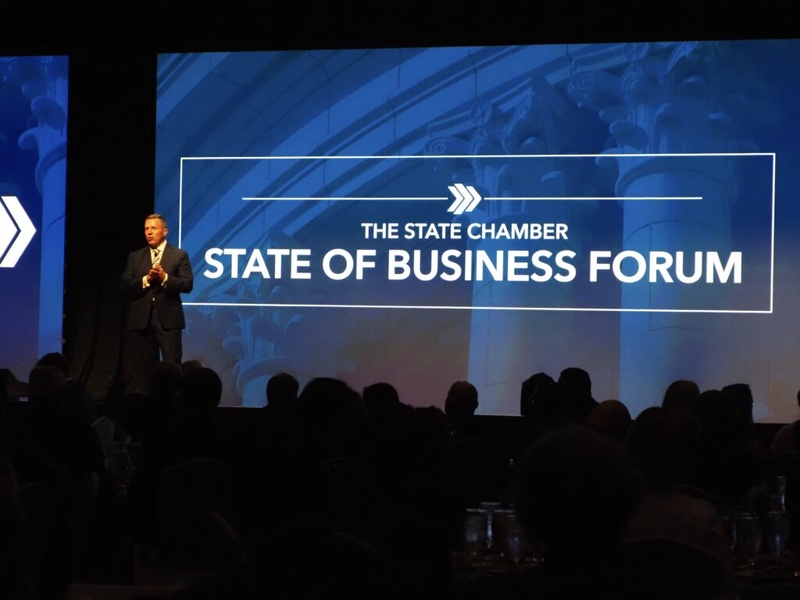
State Chamber President and CEO Chad Warmington speaks at the State of Business Forum, focusing on education initiatives, on Nov. 17, 2025, at the National Cowboy & Western Heritage Museum in Oklahoma City. (Photo by Nuria Martinez-Keel/Oklahoma Voice)
These days it feels increasingly easy to ignore survey results given the bombardment of people attempting to survey everything from most popular video games to most livable cities.
But I find myself hopeful that Oklahomans will pay attention to the 2026 findings of the State Chamber’s annual Oklahoma Business Roundtable survey.
While it’s designed to serve as “a guide for growth to the legislators who shape the state’s economic and business development initiatives,” this year’s report is aptly named “Oklahoma Has Momentum, But Execution Matters.”
This year’s survey of Oklahoma’s business leaders highlights the growing need for conversations between business leaders, educators and researchers. And, it lays out a roadmap for how those could set the stage for “win-win” solutions for both economic growth and provide meaningful learning to prepare students for the 21st century.
The survey found that 64% of the participants “believe Oklahoma is moving in the right direction relative to the national economy, and that 81% of businesses plan to hire in the coming year.”
Most leaders said they “do not see taxes as their top barrier to growth,” and nearly 60% said the state “should invest surplus funds in public priorities rather than return the money through tax cuts.”
Moreover, workforce development and education are the top concerns, with 74% of those surveyed identifying those as one of the top two most important issues facing Oklahoma business growth.
Mark Funke, president of the Business Roundtable, said that “business leaders in the state clearly see education as the foremost issue.”
He said that 89% of respondents “agreed the state should prioritize funding for education outcomes, particularly in elementary reading and math.”
Getting into the details, 91.5% of survey participants agree that Oklahoma’s CareerTech system does a good job preparing students for the workforce, and 76.8% say that universities do a good job preparing students for the workforce.
But not surprisingly, a huge majority find that high schools are falling short in preparing students for the workforce.
Thankfully, they identify childcare as a critical need, writing that “Childcare Is No Longer a Side Issue. It Is a Workforce Issue.”
I hope they also understand that early education is more than a side issue for K-12 education, and that schools cannot be turned around without first investing in efforts that expand access to early childhood education along with mental and physical health services.
When I read the entire survey results, as opposed to the headlines about reading instruction theories, I’m reminded of my experiences in the inner circle of the MAPS for Kids project, which saved the Oklahoma City schools from financial collapse.
I was told from day one that our coalition needed to be completely apolitical and base our recommendations on high-quality education research and listening to the community.
One of the first lessons to be learned from scholarly research is that the key factor for teaching students to read is background information, which comes from reading books and from studying history, science, arts, music, and critical thinking.
It’s most definitely not test prep, teaching to a test or basing the measure of a student’s solely on a high-stakes standardized test.
I expect today’s business people, who are also parents, would support research-based solutions.
Also, I expect that we could agree that we need to come together and think through the rapidly expanding benefits and harms of artificial intelligence.
If we can build better conversations between business people and educators, I believe we could build on that foundation.
When unveiling the survey, Funke said that nearly half of those surveyed said “workforce recruitment and retention is their greatest obstacle to increased profitability and growth.”
Access to high-quality schools at all levels would improve those recruitment and retention rates.
And, a major key to getting there is to create public schools that prepare for success in the 21st century.
That requires schools that teach critical thinking and learning how to learn.
It requires mentorship.
It requires schools that bring kids out into diverse communities and brings a full range of adults into schools.
It requires shared cultures that enhance both an Oklahoma workforce environment that attracts and retains innovators and public schools that provide holistic, thoughtful, and innovative learning environments.

Oklahoma City, OK