Here’s what happens to an Oregon ballot once it hits the dropbox
Oct 28, 2026 | 6:09 pm ET
Description
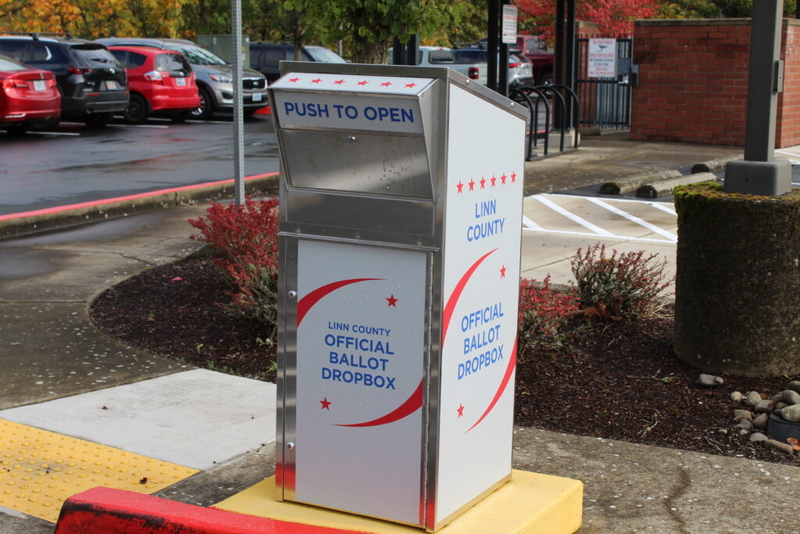
An official ballot dropbox located outside of the Linn County Clerk's Office in Albany, Oregon. (Photo by Mia Maldonado/Oregon Capital Chronicle)
ALBANY — In 1981, former Linn County Clerk Del Riley had a thought: If he was already required to print and mail out sample ballots before each election, why not just mail out real ballots to save money on printing expenses?
He asked the Oregon secretary of state and the Oregon Legislature if he could try a vote-by-mail election and conducted a test run with a school levy that fall. Voter turnout in that election was more than 75%, nearly 20 percentage points higher than voter participation in the primary a year prior.
Local jurisdictions and later the state kept testing mail voting, and by 2000, Oregon was the first state in the nation to run all elections by mail. Today, more than 3.1 million voters receive ballots in their mailboxes and can return them with prepaid postage or drop in one of roughly 300 dropboxes around the state.
A ballot from the 1981 election is displayed in the Linn County Clerk’s Office, where Clerk Marcie Richey has worked since 1993. Located along Albany’s Willamette River waterfront, the office oversees county records and elections for residents of the region known as the “Grass Seed Capital of the World.” Today, most of Linn County’s registered voters are nonaffiliated or Republican.
“I will take vote-by-mail over poll elections any day,” Richey told the Capital Chronicle.
She noticed more mistakes in a polling system than in today’s vote-by-mail system, when previously she’d have to train inexperienced poll workers ahead of each election.
The Oregon Capital Chronicle went behind the scenes with Richey to find out what exactly happens to a ballot once it goes into one of those dropboxes, and to learn more about the security measures in place that keep Oregonians’ ballots safe.
Step 1: Collecting ballots from the mail and dropboxes
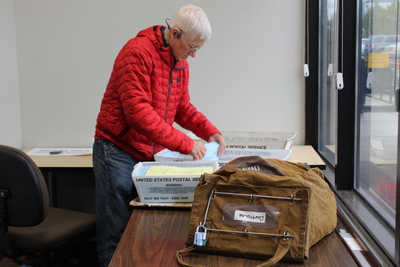
Election workers visit local dropboxes and collect ballots in bags typically twice a day, though in more rural areas only once a day. They carry an affidavit proving their identity and the date they collected the ballots.
Each dropbox is chained into place and most dropboxes have a fire suppression system stored inside. Every ballot collection bag has a lock on it so only the election worker can open it.
After collection, they’ll bring them back to the county clerk’s office where they’ll sort them into trays.
Each tray of ballots is paired with a yellow auditing form that tracks how many ballots there are, any missed signatures or other anomalies. This form stays with the same batch of ballots until the tallying process at the very end.
Step 2: Number of ballots counted and signatures scanned
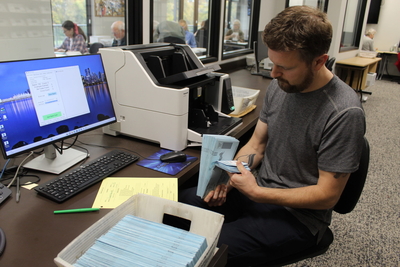
Next, an election staffer will run a tray of ballots through a machine to count the ballots and scan a picture of the signature on each of the blue envelopes holding the ballot.
Verifying signatures
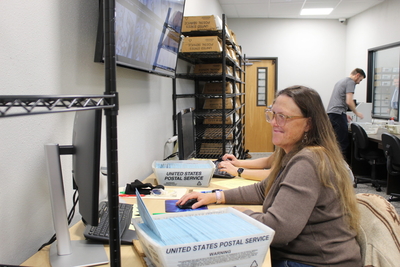
Using a monitor, election workers individually check to see if each envelope’s signature matches that person’s voter registration signature.
If a signature doesn’t match, staff will refer the ballots to several election officials for verification. If an official concludes that the signatures don’t match, then the clerk’s office will mail the voter a note indicating their ballot was not accepted and request a new voter registration signature.
Voters registered with Oregon’s ballot-tracking system, BallotTrax, will also send alters if a voter’s signature doesn’t match.
This process is also when election workers will catch duplicate ballots. It’s not common, but Richey said it’s more common for elderly residents to forget that they’ve turned in their ballot and call later asking for a replacement ballot.
Ballots removed from envelopes
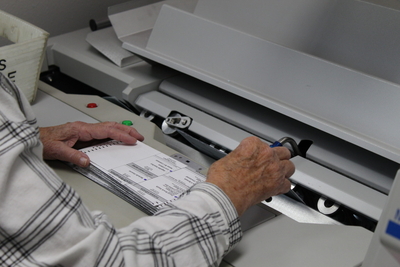
Ballots go through an extraction machine that separates ballots from envelopes and counts blue envelopes.
Once separated, they’re stored until election staff are ready to triple check the number of ballots in the batch.
Election staff hand count ballots and envelopes separately
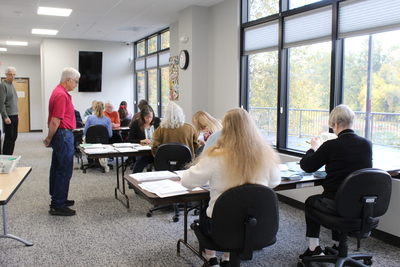
Next, a team of election staff will hand count the ballots. One person separately counts the blue envelopes and another counts the ballots. They’ll write their answers silently then compare once they’ve both finished counting.
Once the number of ballots has been officially verified, each batch of ballots is sent to a holding room where it will be stored until votes are ready to be tallied.
Votes are tallied
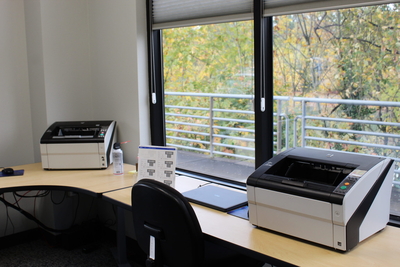
Each batch of ballots goes through a tally machine which uses a software called Clear Ballot. These machines, as well as the room where they’re located, are completely disconnected from the internet.
Once the votes are counted in the system, the ballots are stored in a vault.
Oregon law requires clerks to wait 90 days after the final day permitted for a contest of the election before they can destroy ballots. A March executive order issued by the Trump administration asks states and localities to store ballots cast in primaries and general elections for five years or two years for elections related to special districts. This order is the subject of several lawsuits, including one in which Oregon is a plaintiff.
While counties can begin tallying ballots ahead of the 8 p.m. Nov. 3 ballot deadline, they can’t make any results public until after that deadline.
Results ready on Election Day
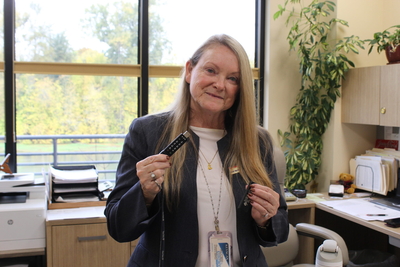
By 8 p.m. Nov 3, clerks can check results from the votes they’ve tallied. Clerks store those results on a private flash drive to send the results to the Oregon secretary of state.
Every county follows the same process under the vote-by-mail manual.
Voter fraud extremely rare in vote-by-mail systems
Every clerk’s office has robust auditing and security measures in place to track and protect ballots.
Anywhere there is a ballot there is a camera, and the windows in the building are made out of thick mesh glass, making it difficult for anyone to break in. Motion sensors are posted throughout the clerk’s office that can detect movement after hours that will immediately notify Richey and local law enforcement.
Until the election results are certified, even county custodial staff cleaning after hours aren’t allowed in any of the rooms where ballots are.
Numerous studies show that fraud cases are extremely rare in a vote-by-mail system.
Researchers at the nonpartisan Brookings Institution examined cases of fraud reported during elections in 2016, 2018, 2020, and 2022, finding that there were about four cases of fraud for every 10 million mail ballots cast, on average.
Oregon completed a similar study in 2020, when the state’s nonpartisan Legislative Fiscal Office found that of the 61 million ballots cast between 2000 to 2019, just 38 criminal convictions of voter fraud occurred. That’s a rate of 0.00006%.
Oregonians can track their ballot at OregonVotes.gov/track.
Salem, OR