Growth woes: Omaha metro ranks 18th among 25 peer regions in 2026 ‘economic scorecard’
Nov 19, 2026 | 1:46 pm ET

Description
A revamped Gene Leahy Mall, looking west, is part of Omaha's riverfront makeover intended, in part, to help attract and recruit talent. But a newly released "economic scorecard" shows young talent attraction remains a problem in the Omaha metropolitan area, compared to peer metros. (Courtesy of MECA)
OMAHA — A newly released “economic scorecard” ranks the Omaha metro area 18th among 25 peer regions, giving it a top mark for fast commute times but nearly the worst for young talent growth.
The 2026 Barometer report, now in its 11th edition, is produced annually by the Bureau of Business Research at the University of Nebraska-Lincoln for the Greater Omaha Chamber. Its aim is to help gauge the Omaha area’s competitive position and to pinpoint where attention is needed.
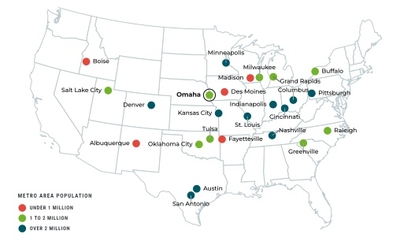
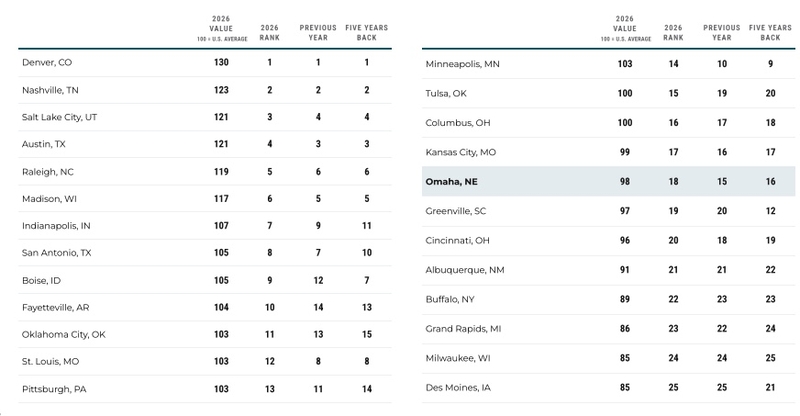
Researchers looked at 51 data points across nine measures of economic competitiveness. Overall scoring showed the Denver metro area retaining its No. 1 crown while Des Moines remained at the bottom of the pack.
The Omaha metro — anchored by Nebraska’s largest city — ranked just above metros of Greenville (South Carolina), Cincinnati (Ohio) and Albuquerque (New Mexico). Omaha ranked just below Kansas City (Missouri), Columbus (Ohio) and Tulsa (Oklahoma).
Good and bad
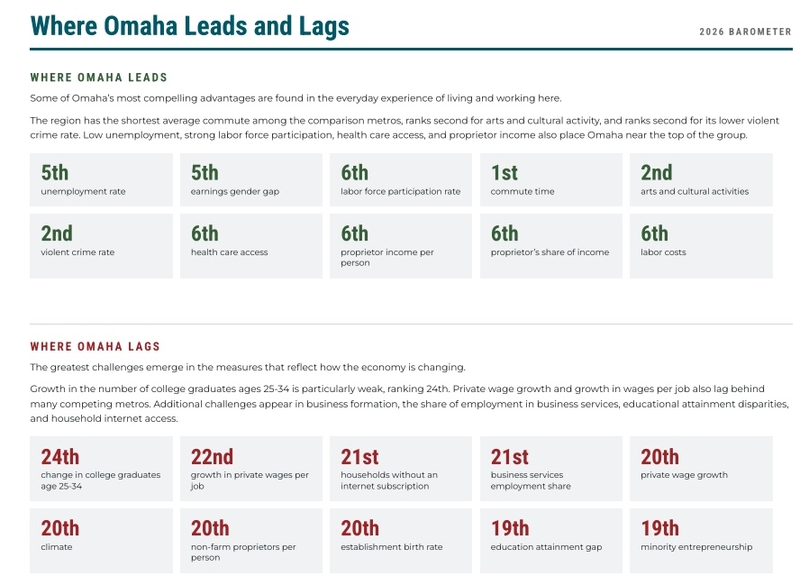
Omaha shone the most in measures related to quality of life. Besides finishing first among peers for commute times, it placed second in both arts and cultural activities and low violent crime rate. It earned top 10 honors in a handful of other data points such as labor force participation, proprietor income and health care access.
But the Omaha area’s performance was relatively lackluster in areas that project economic prosperity, such as wage increases and job creation. Its weakest spot proved to be growth in the number of college graduates ages 25-34 — where it ranked second to last.
The Omaha region’s population of young college graduates increased 4.2%, compared with 12.7% nationally, chamber officials said.
“The challenge the data highlights is growth,” said Eric Thompson, a UNL economist with the Bureau of Business Research. “The region added jobs at nearly the national rate, but wages per job and the number of young college graduates are growing much more slowly here than in competing markets.”
Last year’s scorecard also prompted chamber officials to lament persistent “brain drain”— the exodus of young educated talent from Nebraska. The business group voiced criticism that Nebraska had “stepped back” from its award-winning focus on economic development.
Heath Mello, president and CEO of the Greater Omaha Chamber, told the Examiner Thursday that reversing long-term trends such as brain drain takes time and that the past year has been about “laying the foundation for sustained growth.”
He views the chamber’s recent support for Nebraska’s “Grow the Good Life Act” business incentives as a move toward strengthening competitiveness. Legislative Bill 1165, which was introduced on behalf of Gov. Jim Pillen, was approved earlier this year but not without controversy. State Sen. Danielle Conrad of Lincoln led opposition to what she called a “sweetheart deal for Union Pacific.”
But the Barometer makes clear that we need to grow faster to secure our economic future.
Mello said the latest Barometer findings reinforce how important it is to “stay focused on this work.”
“Other regions have made growth their top priority for many years and we have some ground to make up,” he said.
2026 slippage
Thompson’s research team this year added two metro areas to the comparison group and adjusted previous years’ rankings accordingly. The updated data shows metro Omaha losing ground, dipping to No. 18 from 15 last year and 16 five years ago.
Authors of the 42-page report said the slippage largely reflects how quickly other metros are advancing — particularly markets like Boise, Idaho; Austin, Texas; and Denver, where they said increasing wages draw young talent at a faster pace.
New Omaha Chamber report urges state business incentives overhaul, ways to stem ‘brain drain’
Metro Omaha this year also slipped in the “inclusivity” category, declining to 16th from last year’s 13th, and underperforming in educational attainment across racial and ethnic groups, poverty rate gap and share of households without an internet subscription.
In the “growth” category, metro Omaha’s ranking dropped five positions to No. 17. Researchers said that while the area continues to add jobs and unemployment remains low, the broader growth picture is less rosy. For per-job wage increases in private industries, for example, the Omaha area ranked 22nd among the 25 peer metros.
Local chamber officials said private wages grew 9% during the Barometer reporting period, compared with 16% nationally.
Metro Omaha’s overall index value in the analysis registered at 98, which is below the national benchmark of 100.
Mello said the annual scorecard offers an “important measure of where we stand.” He said the Omaha area has tremendous strengths, performing well in quality of life, innovation and entrepreneurship.
“But the Barometer makes clear that we need to grow faster to secure our economic future,” Mello said.
Chamber officials expect to use the findings to guide a “coordinated approach” to improving the region’s economic competitiveness.
Nebraska-wide impact
Mello referred to the chamber’s “All in Omaha,” initiative as another way the business community hopes to promote the area and spur investment in workforce development.
The Barometer report repeats alarms also sounded last year by the Aksarben Foundation, a more than century-old statewide Nebraska business organization. Aksarben’s research showed “lack” of job growth performance from the Lincoln market as well as Omaha, a scenario it said threatens the economic health and tax base of the entire state.
Aksarben, the chamber, City of Omaha and others subsequently launched efforts to help turn brain drain into “brain gain.”
Meanwhile, the Nebraska Department of Economic Development has seen a continued drop in the number of full-time employees in the state agency charged with helping to spur business growth and talent. A DED spokesman has said the downsizing was part of an intentional winding down of pandemic-era programs.
Mello said he was optimistic about where metro Omaha is headed.
He was pleased with the improvement in the quality of life category, from No. 8 rank to No. 7. The region rose two positions, to No. 9, in entrepreneurship.
“We also recognize that building the momentum necessary to compete with those communities will take sustained effort,” Mello said.
Lincoln, NE