Gov. Kay Ivey calls special legislative session as Alabama seeks legal permission to redistrict
May 01, 2026 | 12:39 pm ET
Description
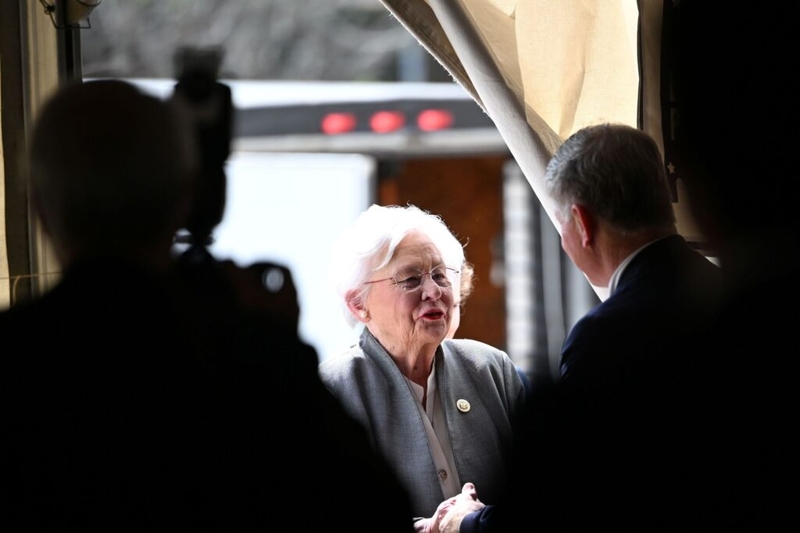
Alabama Gov. Kay Ivey is greeted by Gordon Stone, executive director of the Higher Education Partnership of Alabama, prior to a speech on Higher Education Day at the Alabama Statehouse on Feb. 19, 2026 in Montgomery, Alabama. Ivey Friday called a special session of the Alabama Legislature to move back the May 19th primary in at least some districts if the U.S. Supreme COurt lifts an injunction against the state redrawing its legislative maps. (Brian Lyman/Alabama Reflector)
Gov. Kay Ivey Friday called a special session of the Alabama Legislature for Monday, aiming to move the May 19 primary in at least a handful of districts and allow the Republican-controlled House and Senate to use congressional and legislative maps federal courts had previously rejected.
The move came a day after Alabama Attorney General Steve Marshall Thursday asked the U.S. Supreme Court to lift an injunction preventing the Alabama Legislature from redrawing the state’s congressional map before 2030. As of early Friday afternoon, the nation’s high court had not ruled on the motion.
“By calling the Legislature into a special session, I am ensuring Alabama is prepared should the courts act quickly enough to allow Alabama’s previously drawn congressional and state senate maps to be used during this election cycle,” Ivey said in a statement Friday. “If the court-ordered injunction is lifted, Alabama would revert to the maps drawn by the Legislature for congressional districts in 2023 and state senate districts in 2021.”
Ivey’s call would set special elections “in districts whose boundary lines are altered by a court issuing a judgment, vacating an injunction, or otherwise ordering or permitting an alteration in the boundaries of such districts.”
Reverting to a 2023 congressional map would effectively redraw the 2nd Congressional District, currently represented by U.S. Rep. Shomari Figures, D-Mobile and which has a near-majority Black population. The map approved by the Legislature that year would have drawn a 2nd Congressional District with a Black population of less than 40%. It would also likely alter the boundaries of the 25th and 26th Senate districts, both in the Montgomery area.
Federal courts had previously rejected both proposals as violations of Section 2 of the Voting Rights Act. Figures said in a statement Friday that he “fully expected” Republicans to make their move, and noted the three-judge panel that found the state’s map unconstitutional included two judges appointed by President Donald Trump.
“The judges unanimously found that the State of Alabama intentionally discriminated against Black voters when they drew the district maps after the 2020 census and subsequently refused to follow court orders to correct the issue,” the statement said. “Now, the state is essentially asking the courts to close their eyes and forget what they already saw. This same Supreme Court has already upheld the findings in this case once, and we are confident the courts will uphold the law again.”
Alabama is currently blocked from redrawing its maps before 2030. However, in Louisiana v. Callais, decided on Wednesday, the U.S. Supreme Court ruled a Louisiana congressional map unconstitutional and made it considerably harder for future plaintiffs to challenge congressional maps as racially discriminatory under Section 2.
“Because the lower court’s injunction cannot stand in light of the Supreme Court’s ruling, we have asked the court to lift the injunction,” Marshall said in a statement in a news release on Thursday. “Alabama deserves the right to use its own maps, just like every other state.”
A ‘power grab’
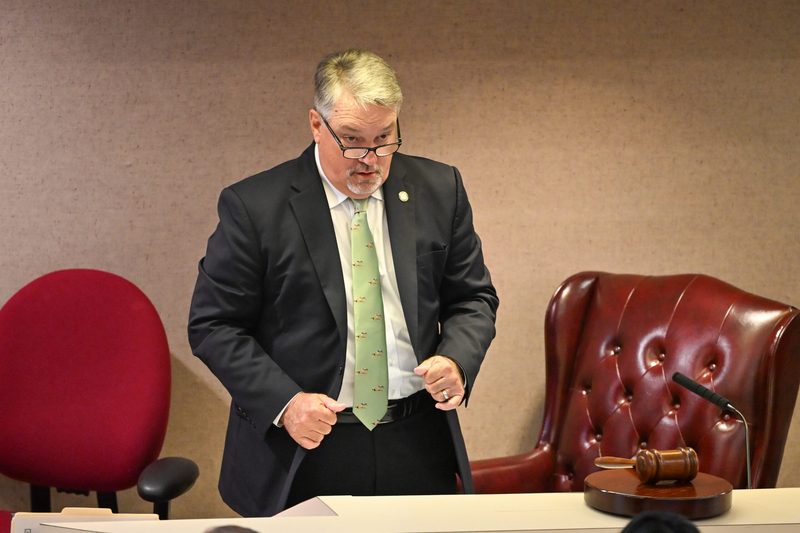
In a joint statement with Senate President Pro Tem Garlan Gudger, R-Cullman, Speaker of the Alabama House Nathaniel Ledbetter, R-Rainsville, said that the Alabama Legislature had the chance to send seven Republicans to Congress, which would mean redrawing districts held by Figures and U.S. Rep. Terri Sewell, D-Birmingham. Ledbetter said in the post that the state remains under court order, but the session will redraw its map in case the U.S. Supreme Court weighs in on the issue.
“With that said, we can and will set a contingency plan in place for our state’s primary elections should the U.S. Supreme Court remand Alabama’s current case to a lower court with clear instructions to apply the Callais ruling,” the statement said. “While there are no guarantees that Alabama’s now unlawful, court mandated roadblock will be removed in time, we have a responsibility to give our state a fighting chance to send seven Republican members to Congress.”
Writing for the majority in the Callais decision, Justice Samuel Alito wrote that the decision was consistent with the court’s ruling in Allen v. Milligan, the 2023 case that led to the creation of the new districts, saying the Alabama decision had to do with an evidentiary standard.
Former U.S. Sen. Doug Jones, a Democratic candidate for Alabama governor, called the special election a “power grab” by Republican leadership.
“This attempt at voter suppression is an affront to all those who have fought so hard for voting rights in Alabama and across America,” Jones said in a statement Friday. “The Callais decision has emboldened those who are too afraid to compete for votes to gerrymander their way into even greater power. We have to fight against those who are trying to effectively silence any voice that disagrees with them. And with the May 19 primary only weeks away, a vote is your voice.”
Robyn Hyden, executive director of Alabama Arise, a nonprofit that advocates on behalf of low income residents, called the most recent U.S. Supreme Court decision a “travesty.”
“Alabama Arise will stand on the front lines with voting rights advocates across our state to fight any maps that remove fair representation,” she said in a statement Friday. “We encourage all Alabama voters to check their voter registration and polling place, and to make sure their friends and family are ready to vote. To build a better, more inclusive Alabama for all, we must ensure everyone’s voice is heard in our democratic process.”
Jerome Dees, Alabama state policy director for the Southern Poverty Law Center, said in a statement Friday that the nonprofit would defend the voting rights of Black Alabamians “should lawmakers choose to move forward with plans to gerrymander and disenfranchise Alabama’s Black communities.”
“Any efforts to revive maps that would likely target Alabama’s Black state and federal representatives continue to be discriminatory regardless of the Louisiana v. Callais decision,” the statement said. “Lawmakers should not get to carve out districts that protect them from facing fair elections. And voters — particularly Black voters who have faced a history of discrimination at the ballot box — deserve the opportunity to elect voices in government who will represent their best interests.”
In response to Marshall’s filing, Marina Jenkins, executive director of the National Redistricting Foundation, which opposes the motion, said in a statement that Alabama was “once again trying to move the goalposts to suit its own partisan interests, showing a blatant disregard for the very legal principles it once championed.”
“The court should not entertain this transparent attempt to subvert the rule of law,” the statement said. “After flailing at every level of the federal judicial system, Alabama seeks to short-circuit ordinary procedures while citizens are already casting their ballots. Granting such an extraordinary request would be a head-spinning reversal of precedent and a direct assault on the fairness of our elections.”
A legal odyssey
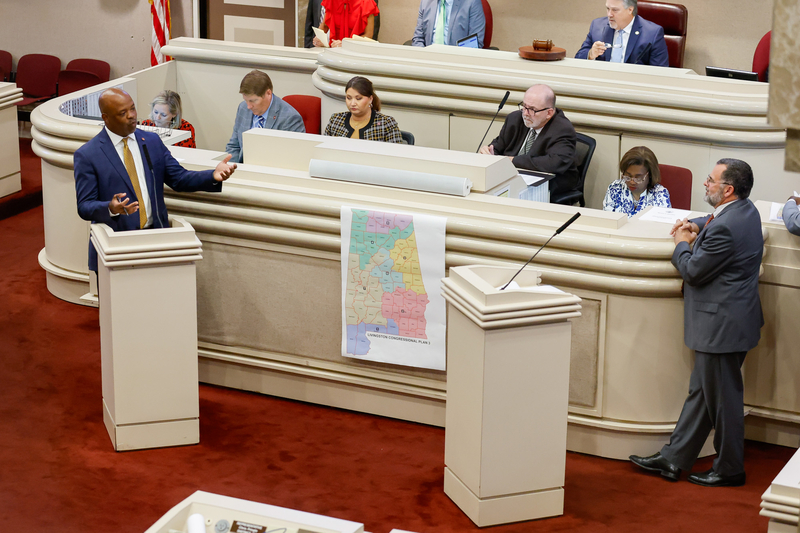
A three-judge federal panel in January 2022 ruled that a congressional map approved by the Alabama Legislature in 2021 violated Section 2 of the 1965 Voting Rights Act that prohibits voting practices that discriminate based on race, color or membership in specific groups. The panel cited Alabama’s racially polarized voting — in which white voters tend to support Republicans and Black voters tend to support Democrats — in making its ruling, saying a map with a single majority-Black congressional district did not allow Black Alabamians, who make up 27% of the state, an adequate opportunity to choose their preferred leaders.
The U.S. Supreme Court upheld the lower court ruling in June 2023.
Ivey convened a special session the following month, which approved a map that still had only one majority-Black district. The lower court rejected that map and the Supreme Court upheld the ruling, leading to a specially-appointed master approving a new congressional map. In 2024, Alabama voters elected two Black U.S. representatives in the same election, a first in the state’s 200-year history.
Ivey announced hours after the Louisiana v. Callais case was decided that she would not convene a special session to reconfigure the state’s congressional maps, but on Thursday said she supports both Marshall and Allen’s efforts to reverse the lower-court ruling.
“As I have said time and again, Alabama knows our state, our people and our districts better than the federal courts or activists group,” she said in a statement. “I remain hopeful that Alabama receives a favorable ruling from the Supreme Court.”
On Friday, Ivey said she was “hopeful Alabama will receive a favorable outcome from the U.S. Supreme Court, which is why I am now calling a special session of the Alabama Legislature.”
Updated at 1:44 p.m. with comments from the Southern Poverty Law Center and at 2 p.m. with comment from U.S. Rep. Shomari Figures, D-Mobile.
Montgomery