Gov. Josh Shapiro cruises to a second term in Pennsylvania
Nov 03, 2026 | 8:03 pm ET
Description
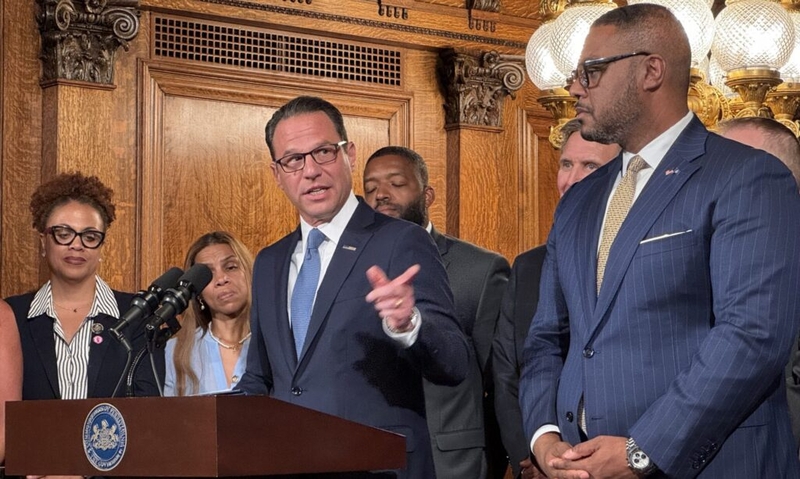
Gov. Josh Shapiro speaks after state lawmakers approved a $50.8 billion state budget Sunday, July 12, 2026. (Photo by Ian Karbal/Pennsylvania Capital-Star)
This story will updated throughout the night.
Gov. Josh Shapiro and Lt. Gov. Austin Davis handily defeated their Republican challengers in Pennsylvania’s gubernatorial election, securing a second term.
The Associated Press called the race within two minutes of the polls closing. With only 3% of the vote counted, Shapiro had 85% of the vote compared to Garrity’s 14%. Libertarian candidate Ken Krawchuk had less than one percent of the vote with many more ballots to be counted.
It was an outcome long-expected by most pundits and political analysts in the commonwealth, based on polls, as well as campaign fundraising and spending.
Shapiro, a national figure in the Democratic Party who was briefly considered as a running mate for former Vice President Kamala Harris in 2024, has maintained a strong approval rating among Pennsylvania voters, even as Republicans won statewide elections while he was in office.
Throughout the campaign, Shapiro held a substantial fundraising advantage over Garrity, who easily earned the GOP nomination in the spring primary.
Democrats are attempting to win the coveted “trifecta” in Harrisburg. Along with retaining control of the governor’s residence, the party hopes to win a majority in the state House and Senate, allowing Shapiro to more easily enact a number of long-promised policies.
Shapiro campaigned with embattled Democrats around the state and made the pitch to give his party control of the three branches of state government a key part of his campaign. Currently, Democrats have a narrow majority in the state House. Republicans have controlled the Senate, where they hold a 27-23 majority, since 1994.
If given a trifecta, Shapiro has said he first plans to raise the state’s minimum wage to $15 an hour from $7.25. He has also advocated for legalizing recreational cannabis since his first year in office, though Republicans in the Senate have halted any efforts to follow through with a plan.
House Democrats have also pushed for a paid family leave policy, which would require employers to give workers time off to take care of sick family or when they become new parents. They have also pushed for election reform. In the past, they’ve passed legislation that would establish early voting as it exists in other states, allow what’s called pre-canvassing of mail-in ballots before election day,
How the race unfolded
In 2024, Garrity won the race for state treasurer, breaking Shapiro’s previous record for most votes received in a statewide election in Pennsylvania.
That made her a frontrunner to challenge Shapiro in 2026 before the campaign had even begun in earnest. She ran unopposed in May’s Republican primary, earning the endorsement of a number of prominent Republicans before any other candidates had even announced.
But her selection was not without controversy. Supporters of state Sen. Doug Mastriano, who was defeated by Shapiro by nearly 15% in 2022, accused party leaders of putting their thumb on the scale. While Mastriano declined to run after mulling the option, some of his supporters mounted a write-in campaign.
And Shapiro quickly went on the offensive.
Shapiro tried to tie Garrity to her support for President Donald Trump, whose approval rating has cratered throughout his second term. In 2020, Garrity supported Trump’s efforts to overturn the results of the election that he lost to Democrat Joe Biden, though she later tried to distance herself from the “Stop the Steal” movement.
In the final hours of the campaign, Trump endorsed Garrity in a social media post.
He and Democrats also painted her as extreme, pointing to her previous stances on abortion. In the past, Garrity called herself “100% pro-life” and after Roe v. Wade was overturned, she sold anti-abortion merchandise.
Garrity, meanwhile, attempted to tie Shapiro to previous controversies. In a series of unconventional campaign videos designed in the style of an episodic thriller, Garrity’s campaign highlighted a taxpayer-funded settlement over a sexual harassment complaint against one of Shapiro’s top advisors in 2023 and invoked allegations that he was involved in an alleged cover up of the murder of a Philadelphia teacher as Attorney General.
She also ran an ad made with artificial intelligence featuring a computer-generated Shapiro bragging about supporting data centers. Deepfake ads are currently permitted under Pennsylvania law, though some state lawmakers have said they want to ban or regulate them.
And she accused Shapiro of being more focused on his rumored 2028 presidential ambitions than the state of Pennsylvania.
One of the first major flashpoints to emerge in the campaign was over data centers.
Garrity accused Shapiro of hypocrisy on the subject, having previously supported the development of hyperscale data centers in the state. But Garrity herself had supported the same projects and had called for deregulation, so the Shapiro campaign threw the accusation back at her.
In August, Shapiro signed an executive order creating requirements for local approval of new data center projects, clean energy standards and local job creation.
Garrity went on a listening tour, meeting local officials around the state, and called for an indefinite pause on the development of new data centers.
With a second convincing election win under his belt in a swing state, Shapiro is hoping his coattails can deliver the Democratic “trifecta” in state government and a Democratic majority in the Pennsylvania U.S. House delegation. If one or both occur, he would be positioned as a potential candidate in his party in 2028.
Harrisburg, PA