Montanans head to the polls with affordability top of mind
Nov 03, 2026 | 9:05 pm ET
Description
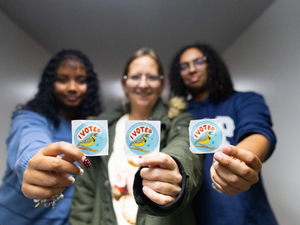
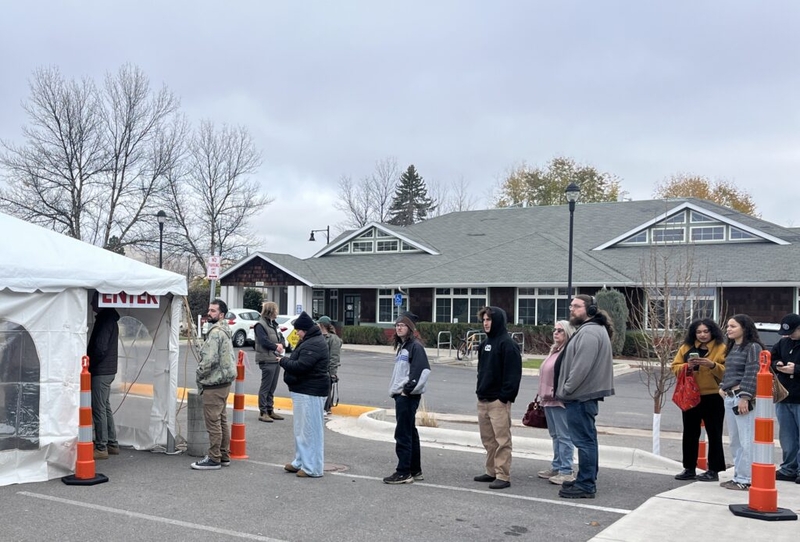
Astoria Beckstrom, second on the right at the Missoula County Elections Center, is registering to vote for the first time. She expected to wait for roughly an hour. (Keila Szpaller/Daily Montanan)
Astoria Beckstrom estimated she’d wait roughly an hour to register to vote at the Missoula County Elections Center.
To Beckstrom, a University of Montana student who uses Montana Medicaid, the wait was worth it.
Beckstrom said she’d been fighting to prove she really did still qualify for Medicaid, and remained a low-income Montanan after working a two-day event, earning $500.
Her student loan payment also had been delayed, and Beckstrom said many of her family members have lower incomes and face similar difficulties.
Affordability is a top priority for voters in the midterms this year, and on Election Day in 2026, Beckstrom, 22, was registering to vote for the first time.
“I need something to change,” Beckstrom said.
Montanans were heading to the polls to choose state and federal candidates in a midterm that has many Americans concerned with the direction of the Trump administration.
Many people also are worried about costs — of groceries, gasoline and utility bills.
Luke Scannell, a 25-year old in Helena, said he was thinking about government corruption and cost of living after he filled out his ballot on Tuesday evening.
Before Election Day, the Montana Secretary of State’s Office sent 533,647 absentee ballots, and as of 2 p.m. Tuesday, 66% had been received.
Some election judges said there were initial fears of voter intimidation, but those dissipated and security around ballot boxes was normal. Few lengthy lines were reported around the city, as many had already cast absentee ballots.
Longtime election judges in Helena, including city commissioner Julia Gustafson, reported the polls were busy in the morning and tapered off into the afternoon. Tuesday afternoon saw a slow but steady trickle of voters into the polls at the city’s library, Civic Center and the Lewis and Clark County Fairgrounds.
“Everything has been really smooth, especially from our perspective,” Gustafson said on Tuesday around noon.
‘Lesser of two evils’
For some college students, election day meant classwork in the field. Kate Wilkins and Thomas Derden, both students at Carroll College in Helena, were doing voter data analysis for a class. Wilkins is a political science major, while Derden is writing about the impacts of social media on partisanship and politics.
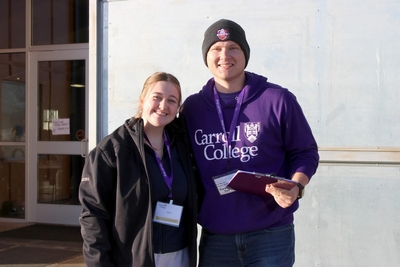
Mostly, it’s learning more about voters and voter habits. Wilkins described politics as “the air we breathe” and said it impacts everyone’s daily lives.
“It affects how you get up, the kind of job you can go do, the kind of education your kids can get, how easy or hard it is for you to put food on the table. All of that is dictated by the political climate in which we live,” Wilkins said.
She added it was important for people to educate themselves, and those around them on how politics impacted their daily lives.
“The first step is recognizing that politics is the mechanism by which we change,” Wilkins said.
In Whitefish, a reliably blue spot in deep red Flathead County — both the state senator and current state representative are Democrats — a lone figure stood at a main downtown intersection waving a “Vote Republican” flag.
Randy Simpson, a lifelong conservative, said he had stood on the same corner Monday as well as Election Day morning, and received a good amount of interaction from passing drivers — about a 10-to-1 ratio of thumbs up to middle fingers — which he said made it fun.
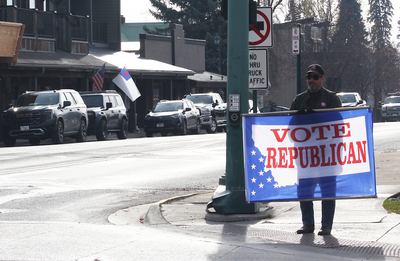
Despite holding a clear sign that he wants his neighbors to vote for Republicans, he said he wasn’t actually excited about any of the Republicans on the ballot this year. Instead, he said he thinks the Democratic party is corrupt and while the Republicans might be too, he still leaned more conservative.
“It’s the lesser of two evils, right?” Simpson said.
Candidates hit home stretch
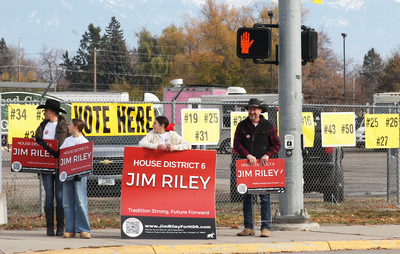
Several local candidates spent their election days holding signs and waving at voters near polling places.
In Kalispell, Jim Riley, a first-time Republican candidate running for House District 6, turned out with his whole family at the Flathead County Fairgrounds, where a majority of the area’s precincts vote.
Further south in Polson, another first-time candidate, 21-year-old Finley Warden, hit the streets at 5 a.m. with supporters, covering parked cars with signs for several blocks surrounding the city’s polling location.
“I feel really good about today,” Warden, running for House District 13, told the Daily Montanan.
He said if he ends up in Helena, he is looking forward to working on legislation that will fix that affordability crisis he says his generation is facing — he saw his own rent hike $150 recently — and being a reliably conservative voice for the community.
Despite the pre-dawn start to his last day of campaigning, Warden said he plans to stay out until polls close at 8 p.m.
DOJ monitors in Montana
A news release from the U.S. Department of Justice said federal election monitors would be in Yellowstone County on Election Day. The DOJ was dispatching monitors to all 50 states.
The monitors would be checking for compliance with voting laws, including the Voting Rights Act and the Civil Rights Act.
“Today, the DOJ will further this mission by engaging in its largest monitoring effort in history — with approximately 1,000 election monitors and observers deployed, and, for the first time, in all 50 states,” the news release said.
No monitors had reported to Missoula County elections officials, but a longtime pollwatcher said the scene at the elections center was exciting.
Susan Campbell Reneau, going on 75, said she’s been watching polls in Montana since 1992 when she moved to the Treasure State.
Reneau said she gets emotional seeing the excitement and even the people coming to the elections center with their dogs.
“Everybody is in good spirits,” Reneau said.
Mary Giuliani, who dropped off a ballot at the elections center, said she always votes, but this election was crucial.
“This election and our next federal upcoming election are going to be really critical to upholding democracy,” Giuliani said.
Helena, MT