Gov. Greg Abbott orders Texas water agency to penalize data centers that don’t report their water usage
Sep 14, 2026 | 5:03 pm ET
Description
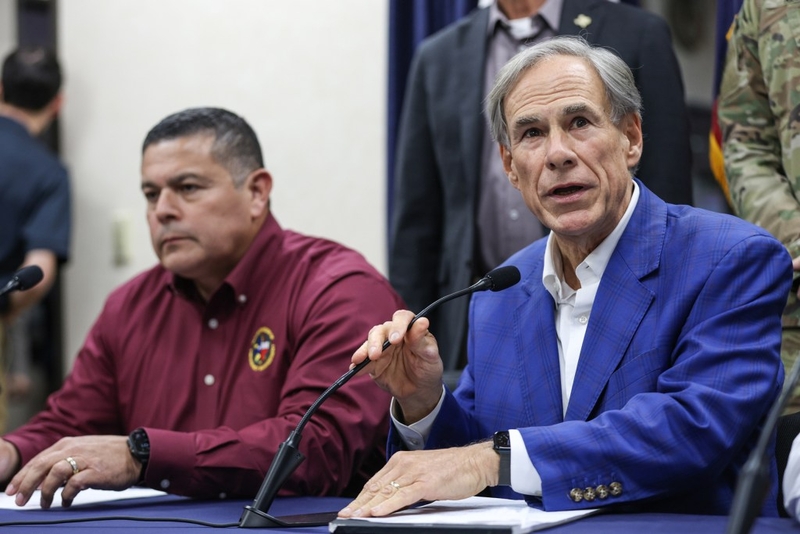
Gov. Greg Abbott speaks at a press conference at the Texas Department of Emergency Management headquarters in Austin on Aug. 31, 2026. (Jacob Lujan/The Texas Tribune)
Gov. Greg Abbott has directed the Texas Water Development Board, the state agency tasked with overseeing the state’s water planning process, to penalize data centers that do not report their water usage.
The directive comes as Texas grapples with rapidly growing demand for water from data centers and other large industrial users — and as few as 28% of data centers have responded to a state-mandated water usage survey in the last three years. The water agency collects the information from the annual survey to help determine how much water the state will need in the future.
“Data centers must share the duty to protect Texas water,” Abbott said in a news release on Monday. “The Texas Water Code requires a complete and accurate water use survey. I direct the Texas Water Development Board to use its enforcement authority to penalize past failures and to impose legal consequences for any future failure to comply.”
Abbott is asking for an update on compliance and enforcement from the water board by Oct. 14. The board said it will follow the governor’s directive and “compel all water users” to fill out and submit the survey.
Since 2020, the water board has asked for monthly water use information from data centers annually. The law requires data centers to submit their survey responses to the agency or face a Class C misdemeanor, which Abbott is asking the water board to enforce, but the water board has said it does not have authority to prosecute anyone because it is a non-regulatory agency. And when The Texas Tribune asked in July how many fines have been issued, agency officials said the staff does not track this information and instead enforcement authority lies with local officials like district attorneys and local law enforcement.
Abbott directed the water board to refer any failure of submitting a survey response to the appropriate county or district attorney and to provide notice to the state’s environmental agency, his press secretary Andrew Mahaleris wrote in an email on Sept. 16.
However, there are other reasons why a data center would want to respond to the survey. In a recent interim hearing focused on data center’s water use, Temple McKinnon, director of the Water Supply Planning Division at TWDB, said entities must submit a response if they want to receive state financial assistance or for certain environmental permits.
Data centers can consume millions of gallons of water per year, necessary to cool their equipment. While one of the primary criticisms of data centers is how opaque data centers’ water usage is — and the risks that it could pose to local residents — publicly available information is often difficult to find. The water board releases survey compliance information only by public information request. It also only provides compliance information to law enforcement upon request, Kaci Woodrome, the board’s chief communications officer, said in an email over the summer.
Water planners say this data is important because the annual survey helps inform state water demand projections for the next 50 years as part of the state’s water planning process. But not all data centers are complying with the survey. And the survey is not sent to planned facilities that are not yet completed.
“TWDB is charged with developing a state water plan that meets the needs of Texans and cannot perform that task if it is denied detailed information on existing and anticipated water consumption,” said the release.
The water survey
The survey is sent by mail to roughly 4,700 municipal public water systems and 3,200 industrial facilities, including operating data centers. The survey captures annual water volume used and basic facility details, including whether the facility self‑supplies or purchases water, the source of that water like surface water or groundwater, and whether they have on‑site power generation. It does not collect information on the type of technology data centers use to cool down their very hot servers. That technology is traditionally the biggest use of water for facilities.
The water board survey targets operating facilities that use more than 10 million gallons per year, which it considers “a significant industrial user.”
Records from the TWDB show that for the first three years of doing the survey the agency got a 100% completion rate. Between 2020 and 2022, the state was only surveying fewer than five data centers.
When the board surveyed 22 data centers in 2023, only 32% of them responded. The next year, 67 data centers were surveyed and 28% submitted the survey. And last year, 329 data centers were surveyed and nearly 30% submitted responses.
According to 2025 survey results, some of the biggest water users are a Bitdeer facility in Rockdale, a Google facility in Midlothian, a QTS facility in Fort Worth and a Meta facility in Fort Worth. Bitdeer uses more than 300 million gallons a year — equivalent to the total annual water usage of a small Texas town with about 3,500 residents. Of the current data centers, the large share of them are located in North Texas and they use the most water.
While more data centers are being surveyed each year, overall compliance remains low, driven mainly by new facilities. Of the 329 facilities TWDB surveyed in 2025, 267 are new to the agency’s tracking, and only 22.5% of them responded.
Abbott specifically instructed the TWDB to address both past and future failures to comply with the reporting requirement. He also directed the agency to coordinate with the Public Utility Commission of Texas, the agency that oversees the state’s power grid operator, as well as its water utilities, and the Electric Reliability Council of Texas on a separate audit of data centers wanting to connect to the state’s power grid.
The audit, which Abbott ordered in August, is intended to gather information about data centers’ water consumption, water sources and cooling technologies. Projects that fail to complete the ERCOT audit are to be denied interconnection, according to the governor’s directive.
Ryan Kellus Turner, the executive director of Texas Municipal Courts Education Center, said that the organization, which provides legal resources and professional training for municipal judges, prosecutors, and court personnel in Texas, has no dedicated training on the water survey enforcement of the state water code. However, he anticipates that as public policy evolves on data center development, he would not be surprised if local courts see an ”increased attention given to regulatory statutes of this nature,” he said.
Alex Ford contributed to this reporting.
Disclosure: Google has been a major financial supporter of The Texas Tribune. Meta has been a financial supporter within the past five years. The Texas Tribune is a nonprofit, nonpartisan news organization that is funded in part by donations from members, foundations and corporate sponsors. Financial supporters play no role in our journalism. Find a complete list of them and more information about our financial and disclosure policies here.
Austin, TX