Gov. Evers joins criminal justice advocates at EXPO gala
Nov 09, 2026 | 4:45 am ET
Description
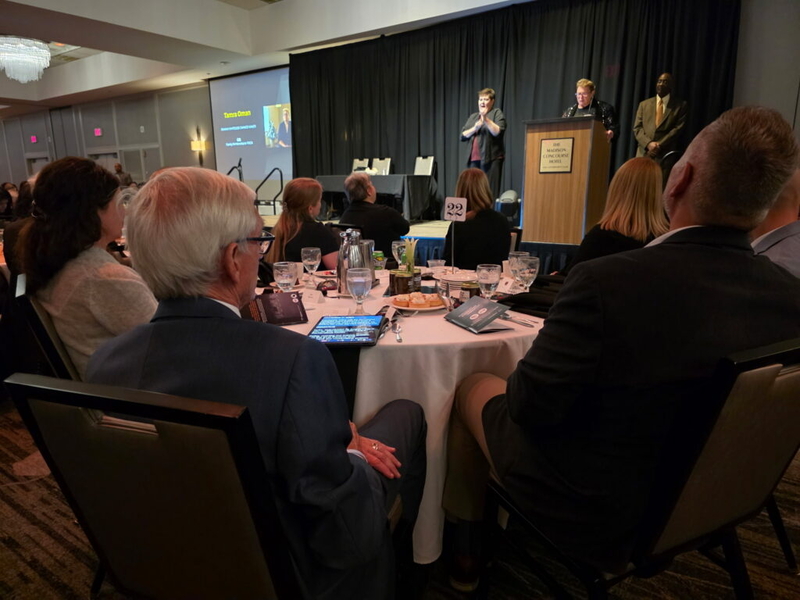
Gov. Tony Evers listens to EXPO honoree Tamra Oman, a formerly incarcerated person who now works helping people currently incarcerated in Wisconsin prisons. (Frank Zufall/Wisconsin Examiner)

Tamra Oman, the recipient of the Ramiah Whiteside Changemaker Award at the EXPOnentially Correcting the Narrative 2026 gala in the Madison Concourse Hotel ballroom on Saturday night, recalled her first meeting with Jerome Dillard, the former executive director of Ex-incarcerated People Organization (EXPO) in 2003. They met in a basement with 30 people and raised $35 for a group called Voices Beyond Bars.
She contrasted that small start with the large gathering Saturday of criminal justice advocates and those they represent, along with Wisconsin Gov. Tony Evers, Wisconsin Secretary of the Department of Corrections Jared Hoy and Evers’s chief legal counsel and chair of the newly created Commutation Advisory Board, Mel Barnes.
“We have formerly incarcerated leaders,” she said of those in attendance. “We have Department of Corrections leaders. We have the governor of the state of Wisconsin. We have family members,” Oman said, adding, “30 people in a room to a 450 count.”
The Saturday event was a collaborative effort between EXPO, an organization of formerly incarcerated people working for a better future for those impacted by incarceration, and The Community, a statewide organization assisting people inside prisons and after their release.
Both EXPO and The Community, each founded in 2014, were celebrating their sixth anniversary, so the two organizations decided to hold a joint event.
“Bringing two organizations together for anything can be difficult, especially something that is much of our identity as an annual celebration,” said Shannon Ross, the executive director and founder of The Community. “We all have our own practices and our own traditions and our own ideas, but if we can’t come together on things that are large and difficult like this, how can we ask the system and ask society for criminal legal system change?”
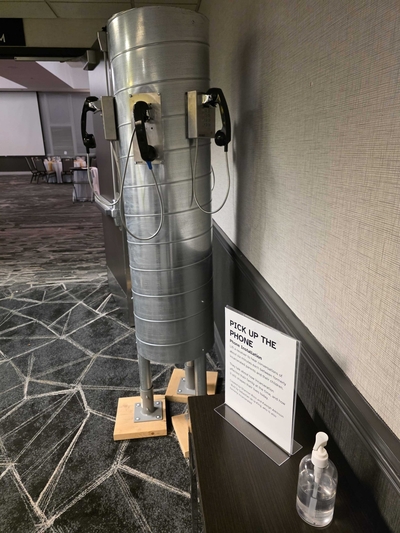
The event included a phone tree where attendees could listen to recorded conversations between people in prison and their family members. There was also artwork by artists who had been incarcerated, and a large display of framed posters of people who had served their time in prison but, after years of supervision and being responsible members of society, were still facing more years of parole or extended supervision. The exhibit questioned supervision over five years.
Ross said crime survivors are not helped in the criminal justice system because it is built to be adversarial and doesn’t lean toward healing but “fear-based mannerisms.”
“Tonight we are going to hear from someone who is very familiar with both sides of the criminal culture,” said Ross, introducing crime survivor Melissa Ludin.
“Today I come into this conversation as someone who has caused harm, and someone who has lost a loved one to violence,” said Lundin.
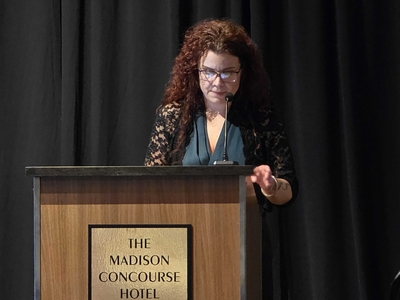
She recounted how at age 19 she attempted suicide because of the grief of losing her father. She drove her car into an intersection and, she said, “caused devastating harm to other people and many families.”
She received a 25-year sentence and said in six months she would finish 20 years of supervision.
“Over those years, I’ve made amends, including with the person I harmed,” she said, “and I’ve worked to become someone that my children can look up to and depend on. Then I found myself on the other side of violence.”
She recounted the death of Chad Wilson, a criminal justice advocate who worked with Lundin and with whom she had a child. He was killed on Dec. 21, 2021, intentionally run over by a woman he had only known for 24 hours.
Lundin recounted how she struggled with wanting the woman to receive justice but also suffer.
“Justice meant she needed to answer for what she had done,” she said. “Vengeance was part of me that wanted her to hurt because we were hurting, and I felt both.”
She recounted speaking at the Wisconsin Resource Center, and knowing that the woman who had killed Wilson was in the audience. She questioned whether she wanted to be there, but then finally asked to shake the hand of every woman in attendance, including Wilson’s killer.
“I don’t know her full story, but people who cause harm can also have been victims themselves, and I know what it is to carry pain without knowing what to do with it,” Lundin said. “Understanding that matters if we want to prevent harm and accountability matters, too.”
Marriane Oleson, co-executive director of Expo, thanked Gov. Evers for bringing back commutations, a reduction or modification of a criminal sentence under the state’s constitutional authority, using his authority to issue executive orders.
“Thank you for the hope of being seen for who a person has become,” she said. “Shannon and I, with others in this room, hear every day from people holding that hope very carefully, people who have spent years understanding the harm they cause, who are preparing to come home. They are trying to imagine where they could belong. We also recognize the people who have been harmed. Their healing deserves support, and every decision about someone’s future carries real responsibility. I know something about rebuilding a life. I began as an EXPO fellow less than two years after coming home from prison, and today I stand here as the co-executive director. It’s given my life purpose.”
Ross noted the special exhibit for those on supervision who are hanging by a thread, and their photo spinning represents the tenuous nature of being associated with anyone who violates their supervision and also being vulnerable to having their freedom revoked and being sent back to prison just on an allegation.
“Many people on paper (supervision) try to stay out of getting involved and participating in a lot of things in the public and civic space because they don’t feel they’ll be given the benefit of the doubt if something happens when we’re trying to just help people,” he said.
The family of Alejandro Silva, an incarcerated man, was given an award for supporting him while he is still incarcerated.
“I’m just, so you know, grateful and thankful and appreciative for everything that they do for me,” Silva said on a recorded phone call.
Delilah Franklin, wife of Dennis Franklin, the co-executive director of EXPO, and a member of the Silva family, spoke of her admiration for the family.
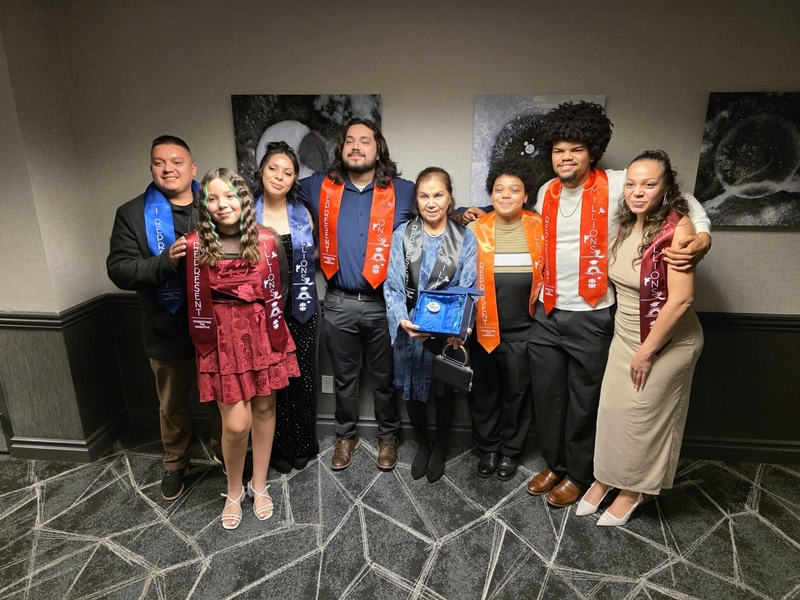
“When someone is sentenced, their family serves a sentence, too,” she said. “They may not be behind those walls, but they carry the heartache, the worry, the sleepless nights, and the silent pain comes, to see someone they love in prison. And somehow they still have to get up every morning, go to work, take care of their families, and carry on with a life while a piece of their heart is somewhere else. That is exactly what the Silva family does. They travel for visits, sometimes multiple times a week. They make the video calls, answer the phone, include Alejandro in family decisions, and make sure even the youngest nieces and nephews know him, love him, and build memories with him. They refuse to let incarceration erase Alejandro’s place in their family.”
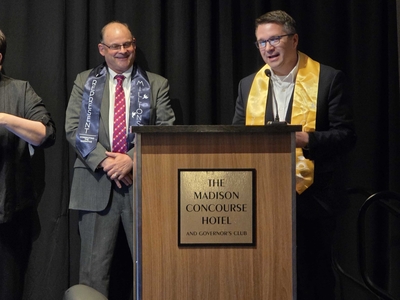
Former Assembly representatives Michael Schraa (R-Oshkosh) and Milwaukee City Attorney Evan Goyke, who previously served as a Democratic state representative, were honored for their bipartisan efforts to advance criminal justice legislation, including making vocational training part of the state’s earned release program.
Schraa and Goyke both said that, even though they were on opposite political sides, they became friends and found common ground on legislation.
Goyke celebrated the recent wave of midterm election victories by Democrats, but cautioned that legislation passed without bipartisan support can be repealed. He offered the example of a “package of criminal justice reform bills called justice reinvestment” passed between 2006-10 by a Democratic Legislature and governor, only to be rescinded under the Republican administration of Gov. Scott Walker.
Marty Dunmore, the founder of the Dunmore Project was honored for creating an organization that collaborates with other groups to promote safety and healing.
Dunmore lost a daughter to cancer in 2019 just before her 18th birthday, and then subsequently two other daughters were injured, one fatally, in an accident caused by a fifth-time drunk driver, and then a year later the daughter who survived the vehicle injury died by gun violence.
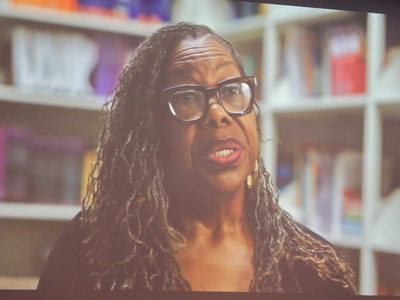
“And at the end of the day, I am just a mother who has lost three children, two of which were so preventable,” said Dunmore on video. “So we have to go back to the preventive measures, restorative justice, to meeting people, meeting the youth where they are.”
Marian Wasierski of the citizen’s group Enough is Enough, addressing reckless vehicle driving, said Dunmore was an inspiration.
“Marty refuses to remain frozen in the moment of shock to be seen only as that mother broken by cruel death and immobilized by profound grief,” said Wasierski. “Marty refuses to allow her sorrow to undo her bottom line, her non-negotiable tenet that the goodness of her girls will never be lost or forgotten.”
Dunmore said she had experienced unimaginable grief, and the Dunmore Project was one place to focus her love for her daughters and share it with others, hoping it will make a difference.
Ronald Watson, another honoree, was nominated by Focused Interruption, a volunteer group that addresses gun violence in Dane County.
In his video presentation, Watson recounted his successful efforts to reintegrate into society after leaving prison in 1993, including working in the restaurant industry, making connections in the community, getting married, starting a family, and staying accountable to his support system.
“I just want to continue to do the work and help other people, no matter how small it be,” he said. “I just want to help others,”
Anthony Cooper, CEO and founder of Focused Interruption, said of Watson, “This brother here is a man of integrity. He continues to want to do the right thing for the right reason, and not just sometimes, but all the time. He wants to make sure he continues to honor his family, continues to honor the work that he’s doing, and continues to honor the community that he’s attached to.”
“Tamra has touched thousands of lives,” said Dillard, introducing Oman for her award. “That’s no exaggeration.”
Oman said she had met Ramiah Whiteside, the namesake of her award, while he was still in prison, and he impressed her because he advocated for others, not knowing if he would ever gain his freedom.
“When I think about what it means to be a change maker, I don’t think about grand gestures,” she said. “What I think about is someone who refuses to accept the world as it is because it can be better. Yes, a change maker sees the possibilities, but other people see just problems. A change maker sees people for who they are, not what they did, but what they can be. Most of all, change makers believe that every single person has value, and every life has the power to create something meaningful.”
Gov. Evers was the last to be honored for restoring the pardon advisory board and pardoning over 2,400, offering commutations and pursuing criminal justice reforms.
“We’ve also expanded the successful earned release program, and we provided the highest level of funding ever for the state’s treatment and diversion program to help reduce recidivism and get folks the resources they need to use,” said Evers. “We also expanded the popular Windows to Work program, enabling more folks to participate in programming that increases general work skills, financial literacy, and work search abilities that will help them to be successful after they’re released.”
He noted the recent opening of the Type One Southeast Regional Care System for Youth in Milwaukee, which he said, “represents nearly a decade of work to transform a failed juvenile correction system.”
He added, “last year I introduced a corrections reform plan to modernize our deteriorating prisons, stabilize our population, and expand evidence-based programming to improve public safety and efficiency in the system. This includes expanding community-based options for alternatives to revocation. As well as providing meaningful supports for those facing housing instability, substance use recovery, reentry programs, and more.”
“Unfortunately, Republicans have rejected these common-sense proposals without offering any comprehensive alternatives of their own; my plan is still the safest, fastest, and cheapest option to overhaul the state’s dated correctional system. Every day of delay or inaction makes projects costlier and the goalposts that much harder to reach.”
He encouraged the audience to keep pressure on state leaders to pursue reforms that “keep our communities safe while giving folks the second chance that they deserve.”
Madison, WI