Gen Z women want politicians who can make the 'American dream' feel attainable
Oct 05, 2026 | 10:35 am ET
Description
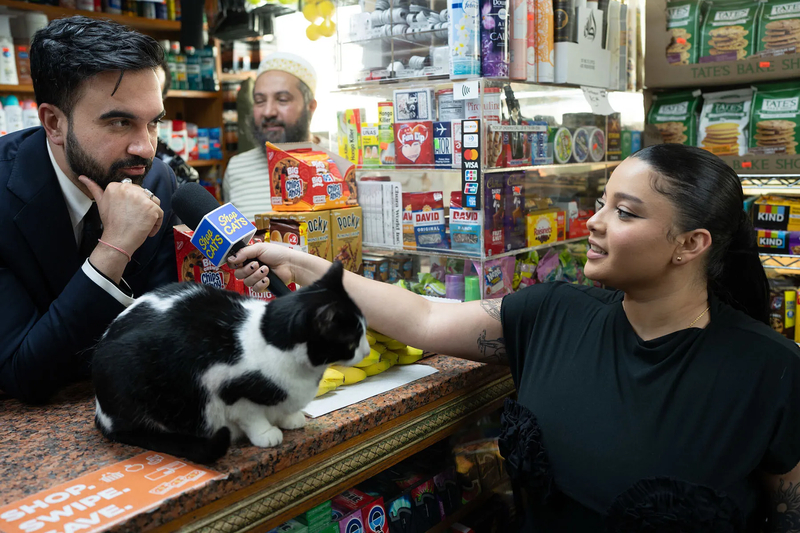
Comedian Michelladonna interviews New York City Mayor Zohran Mamdani visits Court Side Deli in the Bronx on April 7, 2026. (By Michael Appleton/New York Mayoral Office)
Editor's note: This story is part of Gen Z at the Ballot Box, a collaboration between States Newsroom and The 19th.
Strike up a conversation with a Gen Z woman about politics, and affordability will likely come up within the first 30 seconds.
The cost of doing anything, whether it’s renting a home, staying in college or getting a drink, is the top issue motivating young women this election cycle. In a new The 19th/YouGov poll, a majority of Gen Z women said they were worried about paying for the cost of healthcare, housing, groceries and utilities — and in each category Gen Z women were more worried than Gen Z men. Last year, 90% of Gen Z women said the cost of housing and everyday expenses was a critical or important issue — ranking it just above healthcare, abortion and immigration issues, according to a September 2025 poll by the Public Religion Research Institute and the Brookings Institution.
For politicians, it should be an easy way in — affordability is the top issue for just about every group of voters this year. But organizers around the country say the messaging around affordability is not breaking through with Gen Z women.
Reach is important if candidates want to tap into this group of engaged voters ahead of the next presidential election. Gen Z women turn out to vote at consistently higher rates than young men and in the last presidential cycle turned further to the left, creating an opportunity for Democrats.
But instead, the prevailing feeling among Gen Z women is one of disillusionment with a political establishment rarely willing to get radical with their solutions to a growing affordability crisis, young women told The 19th.
“They are fed up, I think, with the way that the political system is kind of just not doing anything for them,” said Molly Metz, a 19-year-old student leader with the political organization NextGen America at Penn State. “Especially for Gen Z women, candidates need to be more direct, and they need to take action — very concrete, very immediate action.”
When Metz talks to students on campus, they bring up how hard it is to live in State College, Pennsylvania, where the school is located. They talk about how rent averages about $2,000 for a one-bedroom apartment, and how they stock up on food when they go home during break to save on groceries.
Standard-issue political messages around lower taxes — “that does not appeal to us. It has no reason to appeal to us. We are not concerned about taxes. We're concerned about the fact that we can't afford to eat or pay rent,” Metz said.
There’s evidence Democrats have been trying to get less ideological and more practical when it comes to economic issues. This midterm cycle, they’ve been focusing more on tangible day-to-day issues, like the cost of groceries, because it’s an area where President Donald Trump’s approval rating has been tanking. Republicans, too, have tried to center affordability in their campaigns, but the message has been mixed; at one point, Trump called affordability a fake narrative and a “con job by the Democrats.” The problem for both parties is that so little of that affordability message is breaking through to young people.
“A lot of candidates just kind of talk about affordability, but it's all in very loose terms,” Metz said.
At college campuses across her state, recent graduate Sydney Ball, an organizer with the Ohio Student Association, said students bring up the cost of gas, weighing things like if it’s cheaper to commute from home and pay for the gas or live on campus. They talk about the cost of medical treatments and getting an internship. In some of the majors Gen Z women dominate, like education, students are required to do an internship to graduate but many are unpaid.
“They're having to choose between: ‘Do I take the unpaid internship on top of the other jobs and the school that I'm doing and sacrifice some other costs in my life, whether that's food or gas or whatever it is, or do I set myself up to not get a job post-grad?’” Ball said.
Unemployment rates for young women ages 16 to 24 have been ticking up since 2024, according to data from the Bureau of Labor Statistics.
In January 2024, the unemployment rate for young women got as low as 5.9% but then rose until it peaked at 10.3% in August 2025. As of September 2026, the rate was 9.9%; for working women over the age of 20, the rate is 3.6%
Over the past several years, young men have had higher unemployment rates than young women, but theirs has been coming down all year, from 11.5% at the end of 2025 to 10% in September.
Under those conditions, young women, who attend college at higher rates than men, have started to wonder if they can even bank on a good education giving them a secure future.
Cheyenne Hunt, one of the first Democratic Gen Z women to run for Congress, said for women of her generation it feels like the American Dream that was promised is slipping away, but “it doesn’t seem like people actually care.”
“We're living the nightmare that was always used to fearmonger in politics for generations before, which was the idea that there could come a generation that is less prosperous than ours, and that is our lived reality,” said Hunt, 29. She lost in the primary for California's 45th Congressional District in 2024, when she was 26. She is now the executive director of a nonprofit against gender bias called Reckoning Action.
In Hunt’s view, political messaging is failing to address the unique ways that young women are being affected by the current economic climate. It’s the young women bearing the majority of student loan debt, entering a labor market with a persistent gender pay gap, who are now becoming a generation of women that feels much more anxious about its financial future than men of the same age.
“They are feeling [the economic slowdown] in a unique way, and yet there's this really strange unwillingness to acknowledge that,” Hunt said.
Affordability feels like an existential issue that politicians must address because even the simple things feel under attack, said Jessica Siles, a spokesperson for Voters of Tomorrow, a Gen-Z-led advocacy organization that promotes civic engagement.
“It really is like the cost of a drink,” said Siles, who is also Gen Z. “Young people are just really feeling priced out of day-to-day life, a night out with their friends, a concert ticket.”
On campuses, students say they want candidates who are willing to meet with young people, hear their concerns — and then meet those concerns with really specific policies. It’s much more about the individual candidate’s message than it is about the party they represent.
“This is a generation that doesn't really believe in just blind party loyalty, and I think the two-party system has to get comfortable with being a little bit uncomfortable,” said Mary-Pat Hector, the CEO of Rise, a student-led organization focused on lowering tuition costs and expanding voter turnout.
This election cycle, there is some excitement among Gen Z women around candidates including Abdul El-Sayed, who is running to represent Michigan in the Senate on a platform that lists Medicare for All as a key pillar, and Angie Nixon, who is running to represent Florida in the Senate on a platform that includes universal childcare. Both are Democrats. But one name came up again and again over more than a dozen interviews The 19th conducted with young women and organizers: Zohran Mamdani.
What New York City’s mayor did to capture the support of 82% of young women voters in the 2025 mayoral election, compared with 65% of young men, came up repeatedly as an example of how to excite a disillusioned group.
“Mamdani is on my timeline every day. Whether it be social media or just the things he’s saying — childcare for all, that type of thing — he's really setting an example for what people should be thinking about,” said Jasmin Lopez, 29, who works at Cisco Systems and is based in New Jersey.
Key to his success was his ability to be chronically online and reach young people on the platforms they were on. But the other part was directness: People outside New York City could cite what Mamdani wanted to do. Free buses. Free childcare. A rent freeze. His policies were not only clear, they were tangible. And he spread his message by being out in the park, on the subway, on street corners. He flew past his goal of knocking on 1 million New Yorker’s doors (with the help of volunteers). The final count was more like 3 million.
“Mamdani went to neighborhoods of people who don't vote frequently, talked to them about issues they cared about, like how they're going to pay their rent, how they're going to pay their bills, how they're going to get to work — but with free buses,” said Mariah Ross, the ballot initiative director at One Fair Wage, an organization working to raise the minimum wage to at least $25 an hour.
That is what young women want, Ross said, rather than a crop of Democratic candidates that are “trying to appeal to everyone.”
“They want to hear: ‘I have a solution for you to be able to ultimately help take care of your family,’” she said.
Of course, young women are not a group of single-issue voters, nor are they a monolith. They care about other things, like reproductive health and climate, but many can’t put their focus on other causes until their own livelihood feels secure.
When Ross talks to Gen Z women about the national push for a $25 or $30 an hour minimum wage, up from the federal wage floor of $7.25 an hour, the response is resounding, she said.
“People are like, ‘Hell yeah. Yes. I need that.’”
This story has been updated.
All States Newsroom content is free to republish. Read our republishing policy for more information.