Florida Supreme Court sides with state panel in feud with abortion-rights amendment sponsors
Aug 21, 2024 | 2:45 pm ET
Description
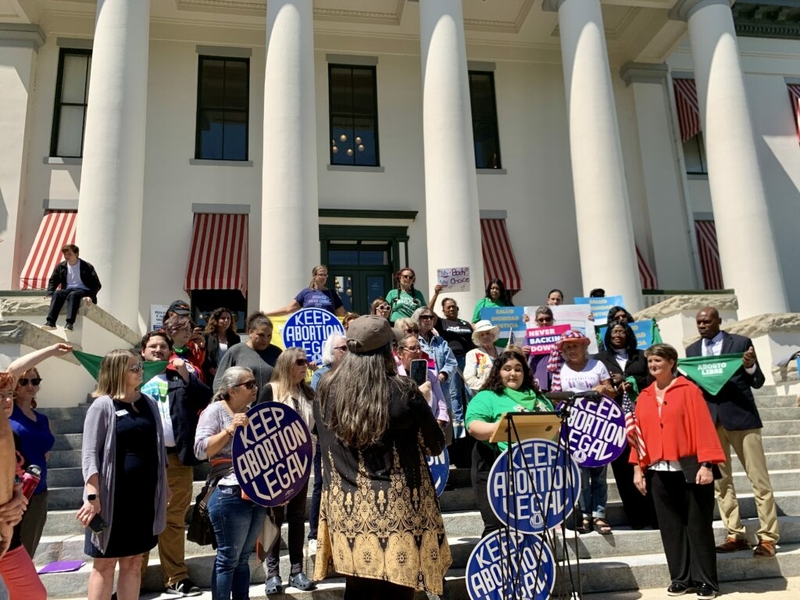
Abortion rights activists rally in protest against six-week abortion bill at the old Florida Historic Capitol on March 29, 2023. Credit: Briana Michel
The Florida Supreme Court on Wednesday rejected a petition from the sponsors of the abortion-rights amendment involving claims that a state panel improperly inflated the measure’s projected costs in drafting ballot language for the November elections.
This decision deals a blow to Floridians Protecting Freedom and the ACLU of Florida, which wanted the justices to throw out the state panel’s financial analysis, citing the inclusion of hypothetical lawsuits as a reason why Amendment 4 might increase costs for the state government.
The ACLU warned that the court’s action puts the integrity of future citizen ballot measures at risk.
Panel decides abortion-rights amendment would increase litigation costs for FL
“The politicization of these financial impact statements erodes public trust in our institutions and threatens the integrity of every future ballot measure,” ACLU Michelle Morton said in a press release.
“The implications of this decision are dire — the Court has effectively granted the State unchecked authority to manipulate voter information without any meaningful oversight, setting the stage for future abuses of power where state officials can sidestep the courts and the law with impunity.”
In its ruling, the court said the sponsor gave up the opportunity to challenge a revision of the financial analysis ordered by Florida Legislature leaders, reasoning that its participation in the process implied consent. The amendment, which would protect abortion access up until the point of viability, needs 60% approval from voters.

“The petitioners never questioned the Estimating Conference’s authority to voluntarily adopt a revised financial impact statement. Instead, they actively participated in every step of the revision process without objection,” Chief Justice Carlos Muñiz wrote.
“They offered oral and written presentations at each of the Estimating Conference’s three July meetings, thoroughly and forcefully advocating their position on what the revised financial impact statement should say.”
In fact, the legislative move effectively undermined ongoing court proceedings regarding the sponsor group’s request for a rewrite of an original version of the financial statement, drafted before the Supreme Court ruled last spring that the measure could go before voters.
Intervention from the legislative branch

Justice Jorge Labarga delivered a damning dissent, siding with the ACLU’s warning that the ruling could undermine the public’s right to amend the Florida Constitution via citizen initiative.
“Despite the majority’s focus on the actions of the Estimating Conference, make no mistake that today’s decision opens the door to the legislative branch leadership to intervene in the citizen-driven constitutional amendment process — even in the midst of ongoing legal proceedings such as were taking place here,” Labarga wrote.
Labarga, appointed by former Gov. Charlie Crist, acknowledged that Amendment 4’s sponsor was in an unusual legal position and should not be punished for exercising it’s rights.
“As the sponsor of the amendment, Floridians Protecting Freedom was entitled to contribute to the process of reconsidering and revising the financial impact statement,” Labarga wrote. “Had the petitioners not engaged in the process, they would have lost their opportunity to participate and to potentially influence the finished product. Because they did participate, they are now penalized, and their arguments are deemed waived or forfeited.”
‘Yes on 4 no matter what’
The final language will appear on the ballot during the November General Election.
Gov. Ron DeSantis and House Speaker Paul Renner placed members on the estimating conference who steered the July revision process toward a negative outcome for the abortion-rights amendment sponsors. Together with Senate President Kathleen Passidomo’s appointee, they outvoted Amy Baker, coordinator of the Office of Economic and Demographic Research, who has chaired the conference since 2004.
All three leaders oppose Amendment 4.
Baker argued that the panel traditionally has not factored the uncertain outcome of hypothetical litigation into financial impact statements and that to do so would be straying from neutrality.
Despite the ruling, recent polls from the University of North Florida and Florida Atlantic University show support for Amendment 4, though the FAU poll suggested it wasn’t meeting the passing threshold.
“Adding a deceptive financial impact statement to deliberately confuse voters is a shameful attempt to hide the fact that Florida law currently bans abortion before many women know they are pregnant with no exceptions for rape, incest or a woman’s health,” wrote Lauren Brenzel, Yes on 4 Campaign Director’s, in a press release.
She urged: “It’s ‘Yes’ on 4 no matter what, because Amendment 4 will provide critical health care protections to limit government interference so doctors can do their jobs and provide abortion care to their patients.”
Tallahassee, FL