Florida sues NY Times over alleged anti-Israel bias; demands internal records
Sep 23, 2026 | 3:15 pm ET
Description
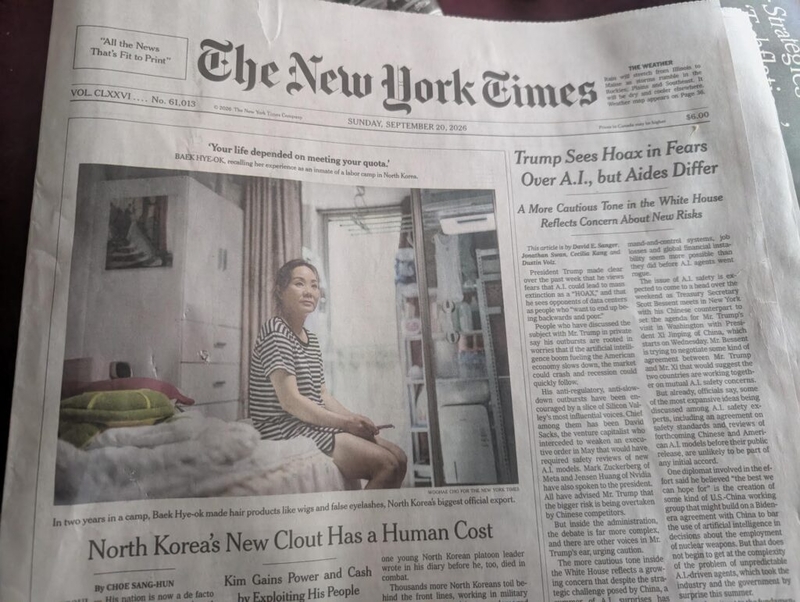
Photo of copy of NY Times on Sept. 23, 2026. (Photo by Mitch Perry/Florida Phoenix)
The state of Florida filed a shareholder lawsuit Wednesday against The New York Times in a Manhattan state trial court, arguing its coverage of the Israel-Hamas conflict would harm shareholder value for the state’s agencies and public sector retirees.
The named plaintiff is the Florida State Board of Administration (SBA), which oversees more than $276 billion in assets for state and local government entities. Along with the National Center for Public Policy Research, the suit asks a judge to force the Times’ board of directors to hand over internal records pertaining to the paper’s coverage of the events.

Florida Attorney General James Uthmeier said during a press conference in Miami-Dade County that the state was not suing the Times because of a specific news article or editorial discretion, but over corporate governance, saying that as a publicly traded company the newspaper holds “legal responsibilities and duties to your shareholders.”
The Florida SBA invests and administers its assets and owes fiduciary duties to more than 1.2 million members and beneficiaries. It holds 161, 375 shares of Times stock.
A spokesperson for the paper said it would fight the request for internal records.
“This lawsuit has no merit and was brought for an improper purpose,” said Charlie Stadtlander, executive director for media relations and communications for the Times.
“Although it is positioned as a corporate governance petition to inspect the company’s books and records, it is a transparent attempt to exert agenda-driven pressure against an independent media organization, level false allegations of bias and chill journalism protected by the First Amendment. We will defend against the suit vigorously.”
The lawsuit comes about six weeks after the attorney general sent a 28-page letter to Times executives, questioning the accuracy of news articles going back several years, declaring they were “publicly documented failures.”
He requested records showing whether and how the paper’s board of directors have been briefed about specific news stories, most notably a May column by Nicholas Kristof alleging Israel used dogs to rape Palestinian prisoners.
The Times never sent those documents. Attorneys for the paper said on Aug. 21 that the request “does not serve a proper purpose and violates the First Amendment” while constituting “coordinated harassment,” according to the lawsuit.
Records sought
In a press release, the attorney general’s office says that the SBA narrowed its request on Aug. 26 to board-level governance records from 2020 going forward, including:
- Any charter provision, escalation protocol, or reporting line by which editorial-standards compliance, journalistic accuracy, corrections practice, or defamation exposure reaches the board or a board committee.
- Board and committee agendas and calendars sufficient to show whether those subjects have appeared as agenda items.
- Versions of the audit committee charter and the company’s editorial standards, and documents showing who approved them.
- The reporting line of the standards editor.
“The company’s repeated publication of materially false or baseless factual assertions, many later admitted internally or disproven externally, supports a reasonable inference that the Board has not only failed in its obligation to monitor the Company’s internal controls, but it has allowed such flagrantly selective application of the internal controls to support the conclusion that in the absence of any Board-level oversight, journalistic standards have been weaponized within the Company to serve the personal agendas of unchecked editors,” the lawsuit says.
As a publicly traded company, Uthmeier said, the Times bears legal duties to its shareholders.
“And we saw some very dangerous trends that appeared to call into credibility the sound business sense of what that company is doing,” he said. “We counted 72 recent errors where the company admitted in its own correction column in a very single coverage area in just eight months. All pro-Hamas-style reporting that had to be clawed back as incorrect.”
Uthmeier added at one point that the Times had “retracted” the Kristof column, but there are no reports of the paper having done that. On May 21, Kathleen Kingsbury, the opinion editor of the Times, declared that the paper stood by the column.
Whistleblower
The lawsuit relies on information from a whistleblower who raised concerns about the reporting of “many instances of anti-Israel bias.” The suit says the whistleblower on at least 15 occasions raised concerns about broken editorial standards between 2019 and March 2026, when she left the paper.
That whistleblower went on to say that “the staffers who engaged in public advocacy on the war in favor of Palestine, which she reported through the same channels, received, so far as she is aware, no such request to edit or delete their support,” the lawsuit says.
The lawsuit also notes the Times last month suffered its first defamation lawsuit loss in more than 50 years. That’s when the U.S. District Court for the Northern Division of Alabama awarded $9.25 million dollars to a former University of Alabama basketball player named Kai Spears, because the paper had mistakenly placed him as a passenger in a car that was at the scene of a shooting death.

Tallahassee, FL