Flock backlash growing in some Western NC communities
Aug 27, 2026 | 12:00 pm ET
Description
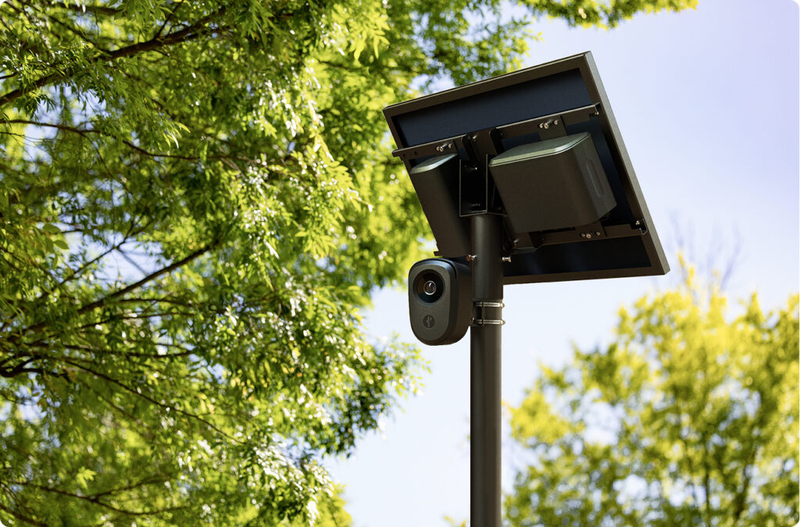
Flock Safety license plate readers are typically mounted on tall poles, with a camera and solar panel on top. The company says its technology is used in more than 6,000 communities across 49 states in partnership with thousands of law enforcement agencies nationwide. (Photo courtesy of Flock Safety)
Law enforcement agencies across North Carolina have been using automatic license plate reader, or ALPR, technology quietly for the past several years to little knowledge of residents. But this technology has become controversial nationwide and synonymous with Flock cameras, which take images of license plates at a singular point in time and enter them into a database where artificial intelligence catalogs vehicle characteristics, like a vehicle’s make, model and color.
Communities in rural parts of Western North Carolina, who are used to the kind of privacy that comes with winding mountain roads, have been surprised to find that their local governments may have a contract with Flock and several of Flock’s cameras installed on roadways. Some say the technology is a violation of the Fourth Amendment.
In Madison County, about 50 community members came to speak about their sheriff’s office’s contract with Flock during the public comment period of a Board of Commissioners meeting in June. Madison is a mountainous county that touches the Tennessee border. It is home to the towns of Marshall, Mars Hill and Hot Springs.
[Subscribe for FREE to Carolina Public Press’ Daily, Weekend and Election 2026 newsletters.]
Privacy advocates were met with Council Chairman Michael Garrison telling the dozens of county residents who wanted to speak on Flock that only one of them could talk about the issue. Though it was disappointing for those who wanted to speak, allowing one person to speak for a large group during a public comment period for the purpose of time is acceptable under the North Carolina Open Meetings Law.
Members of Madison for Privacy, a local advocacy group, told Carolina Public Press that they are also having a difficult time receiving records requests from the sheriff’s office about contracts with certain surveillance technologies. Members of the group, Joe Stanis and Sean Phillips, said the group isn’t inherently political — they are just wary of outside surveillance in their community.
“Most Republicans, at least in Madison County, have libertarian values and don’t want to be surveilled,” Stanis said.
Local governments like Madison County are actively debating the use of the technology and some disgruntled citizens have even taken to removing Flock technology from their local street corners. Earlier this month, someone removed a camera in Asheville’s Carrier Park, prompting the city police to reinstate it. Flock cameras are having a national reckoning right now — and Western North Carolina is no stranger to it.
What is Flock?
Atlanta-based tech company Flock Safety is by no means the only company that provides this kind of technology — other ALPRs across the country come from vendors such as Axon and Motorola — but Flock is unique. The company has a network of data on every car it has detected, allowing law enforcement agencies across the country to search for a specific vehicle’s location history across thousands of camera feeds.
Because of this, Flock and ALPRs have only become more synonymous as the cameras have become a point of contention across the country.
Agencies can access and search data from others across the more than 120,000 Flock cameras in the country. Madison County, for example, has access to a network of more than 1,500 law enforcement agencies and shares its data with 725 of them, according to records obtained by CPP.
Though Flock denies a direct partnership, Immigration and Customs Enforcement and the Center for Border Patrol sometimes receive data from local law enforcement agencies through indirect sharing.
Flock was founded in 2017 and originally served HOAs and neighborhoods that wanted to prevent petty crimes like break-ins, but quickly contracted with law enforcement agencies. The company also makes audio detection technology called Flock Raven that can sense gunshots and loud noises.
Cameras store information in audit logs, which track who in an agency searched for a license plate and the reason for the search. Different types of audit logs include those of an agency’s own Flock cameras and network audits, which show searches conducted by other agencies through network sharing agreements. Some agencies have transparency portals where they release redacted audit logs to the public.
On Aug. 13, Flock announced that its cameras will now only store information for seven days, unless the data is related to a criminal investigation. Previously, the number was 30 days.
Flock in NC
Some communities in North Carolina are actively debating ending their contracts with the tech company because of public concerns. Some already have. But, a number of sheriffs are reluctant to give up the technology. Many say Flock is a necessary evil for catching criminals, especially in rural areas with smaller numbers of law enforcement personnel.
A number of cases have also involved law enforcement misuse of the cameras. An officer in Mooresville, in Iredell County, searched for her boyfriend’s ex-wife over 30 times in the Flock database, according to reporting from The Charlotte Observer. The officer was arrested and charged with misuse of the technology “for purposes other than official law enforcement duties.”
Macon County, which is in the southwest corner of the state, let its Flock contract expire without renewal in a unanimous vote by county commissioners on July 14. Six cameras installed in public schools across the county will remain, but all others will be removed this month.
In the Piedmont, Chatham County and the town of Hillsborough also canceled their contracts with the tech company earlier this year. Davidson County is also set to vote on its Flock contract this week.
“I feel the Flock cameras are a necessary evil, but due to paranoia and uncertainties about people’s motives, we group to protect ourselves via our US Constitution,” Macon County Commissioner Gary Shields said in an email statement to Carolina Public Press.
Some 85% of the 2,819 ALPRs in North Carolina are operated by Flock, according to DeFlock, an advocacy group that has created a crowdsourced database of surveillance technology nationwide. Wake County has the most cameras.
Asheville Mayor Esther Manheimer called on the City Council to end the area’s contract with Flock in a video statement posted on social media last week. The council voted to cancel the contract during its meeting Tuesday. Right now, the city of Asheville operates 11 Flock cameras, but more cameras are operated by other entities, like the public school system, inside the city limits.
“We need to do this to make sure that this technology is not moving faster than we are,” she said in the video. “We need to protect our citizens and our civil liberties.”
But Manheimer, along with every City Council member except for Kim Roney, voted to approve a 24-hour Real-Time Intelligence Center for the Asheville Police Department worth $1.4 million earlier this year. The center would synchronize license plate readers, public and private surveillance cameras in the city and police dash cameras. The City Council also approved a new contract with Axon in May, so just voting out the Flock contract wouldn’t be likely to rid the city fully of ALPRs.
Asheville Police Department Lieutenant Josh Meindel said private entities like homeowners’ associations can also purchase Flock cameras that local law enforcement agencies wouldn’t have access to.
“There are a lot of people on social media who have misinformation about Flock and this technology,” he said. “Other states have different rules and different laws.”
Sheriff’s offices double down
Many counties and municipalities have adopted contracts with Flock, or other ALPR companies, without the approval of local governments.
“The sheriff asked for the funding, and the county manager signed the contract with Flock,” Mark Spencer Williams, an attorney who founded the Wilmington-area DeFlock ILM, said. “It’s just hard to believe that you could put a mass government surveillance system in place, monitoring a quarter of a million people based on a signature.”
Williams has sent demand letters for stonewalled records requests about Flock in other North Carolina counties. DeFlock ILM is an independent group, though it mirrors the national DeFlock organization, which has built an open-source database of ALPR technology across the country.
There are currently 12 Flock cameras in Madison County, according to records obtained by Carolina Public Press. There were initially 17 cameras, but in June, the sheriff’s office amended its contract with Flock to remove five of them, according to the amendment, which was also obtained by records requests. Flock costs Madison County $30,000, according to an April information release from the sheriff’s office.
The Madison County Sheriff’s Office did not respond to interview requests for Carolina Public Press.
The sheriff’s office only adopted Flock cameras this year, but has had a contract with the tech company Rekor Systems, which also supplies ALPRs, since 2021. Rekor does not provide physical cameras, but tracks vehicles by way of software that can be integrated with existing third-party cameras. Stanis said Madison for Privacy was already wary of Rekor cameras, but Flock poses a different challenge because of its network.
Stanis said Madison for Privacy requested records from the sheriff’s office, which were only partially fulfilled. When the group requested the county’s Flock contract, they only received the signature page. In response to a records request filed by Carolina Public Press, the sheriff’s office said Flock was the holder of some of the requested records, not the sheriff’s office.
Similarly, some Henderson County residents are aggravated by the use of Flock. But like in Madison, the sheriff’s office is standing firm, saying technology is crucial in solving crimes. After a popular petition circulated in Henderson County, the sheriff’s office doubled down on its support of the technology.
In a press release, Henderson County Sheriff Lowell Griffin referenced crimes in the county that were solved with the help of ALPRs. He also emphasized that Flock deletes data after 30 days unless it is involved in a criminal case.
“Our agency has maintained an ALPR policy for years, and the use of Flock is specifically addressed within that policy,” the statement read. “We are committed to ensuring technology is used responsibly, lawfully, and in a manner that protects both public safety and individual privacy.”
‘The range is stark’
While there does not look to be an end in sight to the use of surveillance technology and artificial intelligence tools by local authorities, privacy advocates like Williams want departments to be upfront about their contracts with Flock. To him, this means local governments that respond to records requests and allow public discussions about the technology at local meetings.
“Some municipalities and state entities have responded extremely quickly and been very transparent; others have not provided any information whatsoever,” Williams said. “The range is stark.”
Williams said he has found that most of the searches in the North Carolina network are done by law enforcement agencies in Texas, Florida, Georgia, Kentucky and the federal government. Williams has sent demand letters to local governments, state agencies and UNC System schools. He sent one to the Madison County Sheriff’s Office on behalf of Madison for Privacy’s records requests.
Federal government agencies are stalling records in unforeseen precedent because of personnel cuts in privacy departments, according to recent reporting from ProPublica. In North Carolina, Chapter 132 of the General Statutes says agencies must respond to records requests as promptly as possible without unreasonable delay.
Last week was the ‘National Week of Action Against ALPRs’ for DeFlock, a group that has created a national database for Flock cameras across the country. Madison for Privacy held two social events called “Popsicles for Privacy” last week, which were intended to inform community members about the technology. Stanis said County Commissioner Alan Wyatt expressed interest in learning more about the technology.
“We, the people in Madison County, do not want Flock here,” Stanis said.
This article first appeared on Carolina Public Press and is republished here under a Creative Commons Attribution-NoDerivatives 4.0 International License.

PARSELY = { autotrack: false, onload: function() { PARSELY.beacon.trackPageView({ url: “https://carolinapublicpress.org/80427/flock-backlash-growing-in-some-we…”, urlref: window.location.href }); } }
Raleigh, NC