Firebrand former SC senator wins back Upstate seat in special election
Oct 22, 2025 | 9:00 am ET
Description
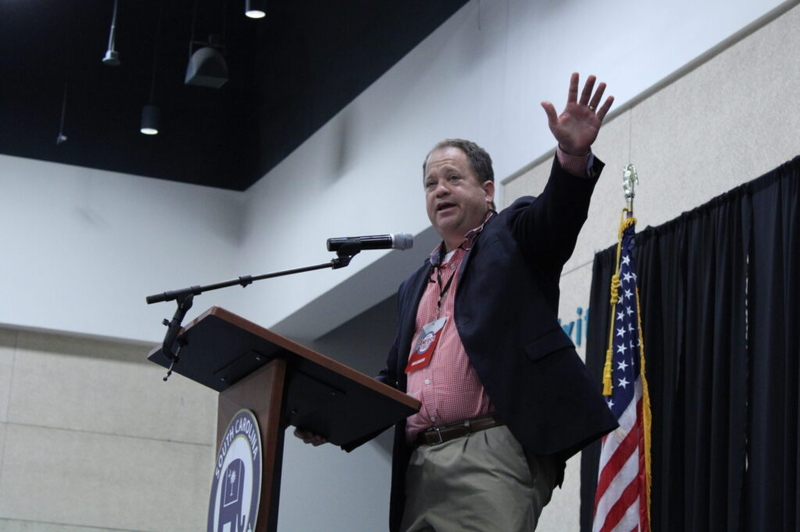
Upstate Republican Lee Bright eked out a win for his former seat in one of three special GOP primary elections held Tuesday, Oct. 21, 2025, in South Carolina. He's seen above at the state GOP convention May 3, 2025, when he tried unsuccessfully to win the job of state Republican Party chairman. (File photo by Shaun Chornobroff/SC Daily Gazette)
A former South Carolina GOP senator appears to have reclaimed the Upstate seat he lost nine years ago.
Firebrand Republican Lee Bright eked out a majority win over two opponents — with just shy of 51% of the 5,008 votes cast, according to uncertified results posted by the state Election Commission — in one of three primary elections held Tuesday to fill vacancies in the Legislature.
With no Democratic opponent to face in December, Bright is in line to win the special election in December, to be held two days before Christmas.
Meanwhile, the contests for two other Statehouse seats are headed for a runoff Nov. 4. In South Carolina, primary candidates need at least 50% plus one vote to avoid a runoff.
Former Rep. RJ May pleads guilty to sending ‘disgusting and depraved’ child sex abuse videos
That includes the Lexington County race to replace ex-Rep. RJ May, a founding leader of the uber-conservative Freedom Caucus who resigned in August ahead of pleading guilty to distributing videos of children being sexually abused. May’s sentencing is set for January.
In the Upstate, Bright sought to replace state Sen. Roger Nutt, whose resignation following an Alzheimer’s disease diagnosis happened to coincide with the day May’s jail-written letter reached the House speaker’s office.
In June 2024, Nutt beat Bright in a GOP primary runoff to win the deeply red seat representing chunks of Greenville and Spartanburg counties between their two major cities. Nutt, an engineer from Moore, became a freshman senator after two terms in the House.
Then at the state GOP convention in May, Bright unsuccessfully challenged state GOP Chairman Drew McKissick to lead the state’s dominating party.
With Nutt’s resignation, Bright tried again for the Senate and this time trounced his competition. In the three-way race, the closest contender was nearly 24 percentage points behind.
He again beat out Hope Blackley, a former district director for U.S. Rep. William Timmons and former Spartanburg County clerk of court, who placed third in last year’s four-way GOP primary. She received about 27% of the vote Tuesday, according to unofficial results.
Justin Bradley, a former Spartanburg County Council member, was supported by the state’s more mainstream GOP but took third place with about 22%.
Senate Majority Leader Shane Massey said the caucus supported Bradley because its members believe “he is a very strong conservative problem solver, and we need people interested in solving problems rather than creating them.”
But ultimately Bright succeeded in rallying his supporters to come out to the polls in a special election, which typically sees lower voter turnout, Massey said.
“The decisions are made by the people who show up,” the Edgefield Republican said.
In Tuesday’s Senate race, just over 6% of the district’s registered voters participated, according to the state Election Commission.
Last year, the hardline Republicans in the House hoped a win by Bright would expand the Freedom Caucus across the lobby. But Bright said Wednesday he intends to stick with the majority party in the Senate.
“I’d just end up being a caucus of one,” he told the SC Daily Gazette about launching a Freedom Caucus in the Senate. “I plan on going in representing people and participating in the GOP caucus just like I did before and saying my piece there.”
That will include opposing big incentives packages to lure manufacturing to the state.
“A $1.3 billion deal for an electric car company is something that needs to be on ash heap of history,” he said, referencing the state’s deal with Scout Motors for its Blythewood assembly plant. “I’m all for people coming to South Carolina but I’m not for paying them to come here.”
‘Bathroom bill’ senator
Voters first elected Bright, who runs an insurance company, to the Senate in 2008.
In a 2016 bid for a third term, Bright lost the seat to attorney Scott Talley amid opposition from then-Gov. Nikki Haley and the state Chamber of Commerce over what was dubbed the “bathroom bill.”
Introduced two months ahead of the 2016 primary, his bill didn’t really stand a chance of passing. But it got him lots of attention, as it mimicked a North Carolina law requiring people to use public bathrooms corresponding to their sex at birth. National blowback for North Carolina included losing major business deals for a law eventually repealed.
Not wanting a repeat in the Palmetto State, South Carolina’s Chamber of Commerce’s political committee ran radio ads against Bright calling the transgender bathroom bill a time-wasting political stunt. Haley opposed Bright and his bill as unnecessary.
Eight years later, legislators adopted a similar law for bathrooms in public schools.
Bright also fought unsuccessfully to keep the Confederate flag on Statehouse grounds.
In the wake of the June 17, 2015, massacre at Mother Emauel African Methodist Episcopal Church in downtown Charleston, when a white supremacist gunned down nine Black worshipers following a Wednesday prayer service, the Legislature voted to permanently remove the flag from the Statehouse’s front lawn. Bright was among three senators voting “no.”
Bright was ousted from the Senate in a 2016 primary runoff with Talley, then a former state House member from Spartanburg.
After Talley decided not to seek a third term, he asked Nutt to run in 2024 to be his successor.
Upstate House race
As Talley had done with Nutt, so Nutt turned to Rep. Bobby Cox, asking the Greer Republican to enter the non-election year race for the vacated seat.
Cox resigned from the House representing parts of Greenville County to make the Senate bid — triggering another special election in the House — only to drop out altogether weeks later.
The race to replace Cox is the other GOP runoff set for Nov. 4, after none of the four Republicans in the primary surpassed 50%.
Dianne Mitchell, a former teacher with the backing of the state’s House Freedom Caucus, will take on Steve Nail, dean of Anderson University’s College of Business and Economics. Nail won about 39% of the 2,212 votes cast in the race and Mitchell earned about 37%.
“After seven years, it was weird not to see my name on the ballot,” Cox said after he was the 90th person in his precinct to cast his vote in the House race Tuesday.
Cox told the SC Daily Gazette he stepped down from the seat he’d held in the House on the same day Nutt resigned to save taxpayers the expense of yet another special election, as well as to avoid leaving voters in his district without representation at the start of the 2026 legislative session.
Cox, a former Army Ranger, said he then dropped out of the Senate race due to an unexpected uptick in his workload as the head of government relations for Sig Sauer, a gun manufacturer headquartered in Germany.
“While I regret pulling out, I did not have the time to make the effort that was needed to be a present candidate,” Cox said.
He said business travel has taken him to four countries in the last month and a half.
“And providing for the livelihood of my family comes first,” Cox said.
Cox, who served four combat tours in Iraq, first won the House seat in 2018 after making national news by skydiving into his campaign announcement. He called his decision to leave the House “bittersweet” but said the same busy work schedule that kept him from campaigning also would have impacted his role at the Statehouse.
Still, Cox said he’s “not going to give up on politics” and plans to run again in some capacity when the time is right.
Replacing RJ May
In the Midlands, a man who launched a write-in campaign last fall following news of the federal investigation into May — who had no ballot opposition — will face off against a candidate backed by another Lexington County legislator in the Freedom Caucus.
The former write-in candidate, Brian Duncan of Red Bank, received 38% of the 1,488 votes counted Tuesday. He will take on John Lastinger, who received 40% of the vote in the four-way race, according to the unofficial tally.
Lastinger, lead pastor at The Edge church, has the support of Rep. Jay Kilmartin of Irmo. Kilmartin said Lastinger has been an active member of the Lexington County GOP and Kilmartin’s wife worked on Lastinger’s campaign.
Kilmartin did not know whether Lastinger would join the Freedom Caucus.
“I just think he’s solid,” Kilmartin said.
And Lastinger indicated he may not join the caucus May helped launch. Lastinger told the Gazette he hasn’t decided what caucuses he might join.
“I’m not going up there to divide,” he said of a potential win.
Both Duncan, who will square off with Lastinger, and the third-place candidate in the race, Lorelei Graye, had the support of the majority House GOP caucus, House Majority Leader Davey Hiott told the SC Daily Gazette.
The GOP runoffs are expected to determine the winners of both House special elections.
No Democrat is running to replace Cox in Greenville County. No primary was needed for the Lexington County seat, since just one Democrat is running. But the district is ruby red.
Another special election
One more special election remains — this one in the Lowcountry.
Six candidates — three Republicans and three Democrats — are vying to fill the vacancy created when Summerville Republican Rep. Chris Murphy, a former chairman of the House Judiciary Committee, resigned in August.
“That’s a district that’s drastically changed over the years; it’s more purple,” Hiott said.
President Donald Trump won the district in 2024 by only about 6 percentage points, Hiott said. That compares to Trump’s statewide winning margin of 18 points.
Early voting is open now through 5 p.m. on Halloween. The primaries will take place Nov.4, the same day as the runoffs in two of the other races.
The final election for the Dorchester County seat will be on Jan. 6, 2026.
Columbia