Fifteen pages of public records reform. McKee’s administration doesn’t like any of it.
May 27, 2025 | 1:45 pm ET

Description
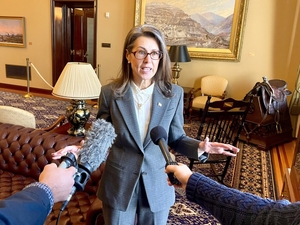
The perennial push to reform Rhode Island's public records law faces opposition from Gov. Dan McKee's administration. (Photo by Alexander Castro/Rhode Island Current)
Lawsuits, federal funding cuts, organizational chaos and a workload that could “grind government to a halt” are among the dire predictions given by state agencies, including the governor’s office, in response to proposed reform to Rhode Island’s public records law.
Advocates expected the administration to come out in force against the Access to Public Records Act reform bill this year, which is nearly identical to the iteration that died in committee in 2024. They were not wrong.
A dozen state agencies, including Gov. Dan McKee’s office, flooded the Senate Committee on Judiciary with letters of opposition ahead of a May 22 hearing on legislation by Sen. Lou DiPalma, a Middletown Democrat.
McKee isn’t budging on changes to public records law. Neither are reform advocates.
To Steven Brown, executive director of the American Civil Liberties Union and part of the ACCESS/RI coalition championing records reform, the administration’s protest exposes not-so-pure intentions.
“I don’t think we can give them any longer the benefit of the doubt that these objections are in good faith,” Brown said in an interview Tuesday. “So many of them are bogus. It’s a misreading of the bill that’s incredibly disingenuous.”
The legislation at its core aims to clarify and update the 1978 law, which was last revised in 2012. The 15-page omnibus bill encompasses 48 changes, from minor language tweaks to major updates meant to protect and expand access to affordable public information. The legislation also integrates new data sources like traffic accidents, police body-worn camera footage and text messages between officials, into what’s subject to public scrutiny.
Among the chief concerns by McKee’s administration is a proposed requirement that public bodies “shall” waive fees to retrieve and hand over public records when a requester can prove the records are in the public interest. The existing law says the records “may” be provided for free if they benefit the public.
State agencies defended fees as a way to recoup a portion of the substantial time and effort it takes state workers to find and collect data. The prospect of waiving fees, while simultaneously requiring state officials to document the specific legal explanation for redacted portions of documents in a “privilege log,” threatens to “grind government to a halt,” Jonathan Womer, Rhode Island Department of Administration director, wrote in a May 22 letter to lawmakers.
Claire Richards, executive counsel for McKee’s office, also took issue with this provision.
“Since every request made by a member of the public could be considered ‘in the public interest’ the provision could result in a fee waiver for every request,” Richards wrote in her May 22 letter. “The ability to impose fees for the search, retrieval and redaction of documents searches is an important function in the APRA process.”
Brown countered that the bill, as well as federal law under the Freedom of Information Act, offers a specific definition for what meets the public interest standard. He also debunked state agencies claims that expanding public records could violate attorney-client privilege, and expose confidential personal information for residents served through state health and human service programs. Similar privacy concerns accompanied proposed reforms meant to hold law enforcement accountable, specifying that internal investigations be subject to public disclosure, though identifying information can be redacted.
Public safety officials remained vehemently opposed.
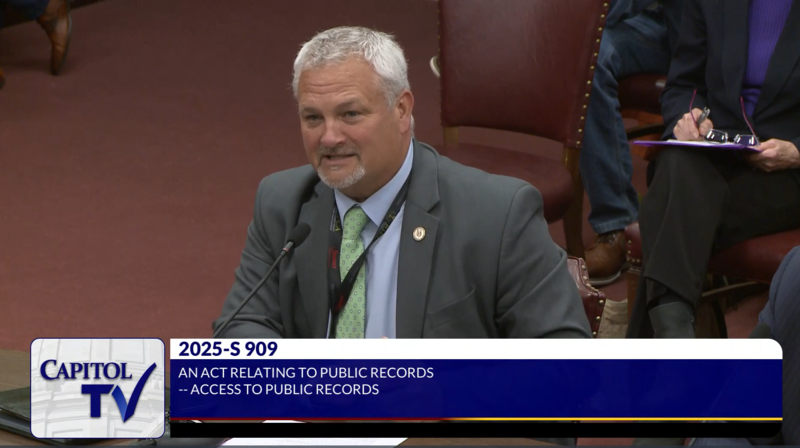
“Often, these are minor infractions for violations of policy,” Sid Wordell, executive director of the Rhode Island Police Chiefs’ Association, told lawmakers during the May 22 hearing. “If we make every single one of those available, that’s going to be the next big thing on social media.”
Wordell continued, “discipline is meant to correct the behavior of the individuals we still feel are an asset to the agency.”
Compromise elusive
But opponents have not offered an alternative way to incorporate internal police investigations into the state’s public records law.
“All we heard when we met with them last year was ‘no no no,’” said DiPalma, sponsor of the Senate bill. The House companion is led by Rep. Patricia Serpa, a West Warwick Democrat.
Only two of the 16 groups representing state agencies, educational institutions, and cities and towns pitched solutions to their concerns.
Jennifer Harrington, general counsel and legislative liaison for the Narragansett Bay Commission, the quasi-public agency that oversees wastewater collection and treatment for 350,000 state residents, suggested striking two pieces of contention related to posting meeting documents online ahead of time and requiring a requestor agree to extending a records fulfilment beyond the standard 20-days.
Randy Rossi, executive director of the Rhode Island League of Cities and Towns, offered amendments for each of the 10 sections of concern to local municipal officials in his May 22 letter.
While John Marion, executive director for Common Cause Rhode Island, acknowledged concessions might need to be made for some type of reform to advance, he was not willing to concede all of the provisions under scrutiny.
“We’re not going to disembowel the bill,” Marion said in an interview Tuesday. “We’re not going to water the bill down so much that it’s meaningless just to find compromise.”
Womer’s letter identifies opposition to 15 individual clauses of concern, while Richards’ six-page letter attacks seven provisions, some of which constitute entire sections of the 15-page piece of legislation.
DiPalma said he was disappointed by the continued opposition from McKee’s office, which he blamed for leading the administration-wide criticism.
An ‘orchestrated’ takedown?
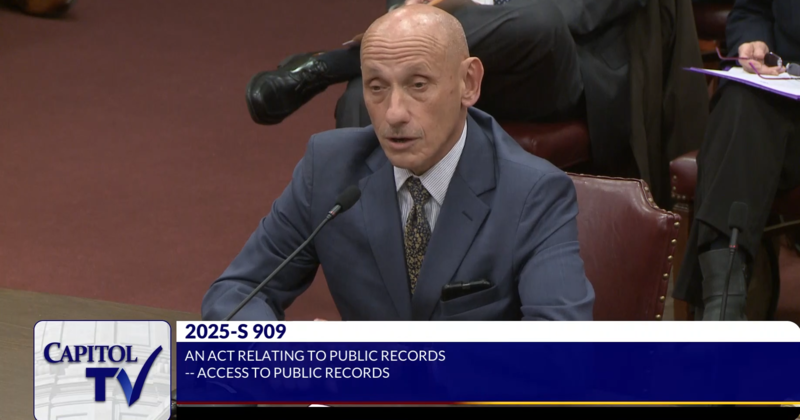
“I have no facts and data to support this, but it seems like it was completely orchestrated by the governor’s office,” DiPalma said in an interview Tuesday.
Brown shared DiPalma’s suspicions.
“I don’t think it’s an unreasonable assumption,” he said.
Laura Hart, a spokesperson for McKee’s office, did not respond to specific questions regarding DiPalma’s allegations. Instead, Hart pointed to privacy risks and taxpayer costs as reasons for concern.
“Transparency is in the public’s interest — that’s not in dispute — but the state must balance transparency with privacy rights and costs to the taxpayer,” Hart said in an emailed response Tuesday afternoon. State and municipal experts who do this work every day have brought up numerous privacy concerns… As to cost, APRA was designed with the ability to charge fees to cover the costs of document collection, review, and redactions–and to discourage overly broad requests that take staff time and taxpayer dollars to complete. Requiring public records officer, instead of the courts, to determine fee waivers based on ‘public interest’ or when there is a ‘denial’ will add significant risk and expense, both in staff time and in unnecessary litigation, all financed by taxpayer dollars.”
DiPalma was also disheartened that a new section meant to assuage municipal government concerns about “vexatious requests” — those submitted by bad actors solely to disrupt government operations — was seemingly dismissed by the governor’s office, acknowledged only in a footnote of Richards’ letter.
The newly added section of the bill, the only change made to this year’s version compared with last year, lays out a court process for chief executives of public bodies to challenge and, potentially not fulfill or be reimbursed for the cost of fulfilling, disruptive requests as determined by a Superior Court judge.
But Richards wrote that forcing public bodies to initiate legal action to get out of fulfilling vexatious requests was an “unworkable solution” requiring more time and resources than available.
“I was a little taken aback by that,” DiPalma said. “It almost seemed like it was dismissive.”
DiPalma’s usual optimism and ever-insistent promise of getting his legislative priorities “over the goal line” was noticeably absent when asked about public records reform.
“We have to be realistic about what’s possible and what’s probable,” DiPalma said. “It’s a tough hill to climb.”
DiPalma held a kernel of hope that forthcoming meetings with Senate President Valarie Lawson and Senate Majority Leader Frank Ciccone, both of whom are cosponsors on the legislation, might yield progress.
However, a hearing on Serpa’s companion bill in the House State Elections and Government Committee has not yet been scheduled and House Speaker K. Joseph Shekarchi has remained noncommittal.
Who’s against the public records reform bill?
These groups and state agencies wrote to lawmakers to express concerns with proposed updates to state public records law.
- Peter Alviti Jr., Rhode Island Department of Transportation directer
- Terrence Gray, Rhode Island Department of Environmental Management director
- Megan Jackson, legislative liaison for the Rhode Island Office of the Public Defender
- Dr. Jerry Larkin, Rhode Island Department of Health director
- Richard Leclerc, Rhode Island Department of Behavioral Health, Developmental Disabilities and Hospitals director
- Kimberly Merolla-Brito, Rhode Island Department of Human Services director
- Claire Richards, executive counsel for Gov. Dan McKee’s office,
- Wayne Salisbury Jr., Rhode Island Department of Corrections director
- Liz Tanner, Rhode Island Commerce secretary
- Thomas Verdi, Rhode Island Department of Revenue director
- Col. Darnell Weaver, Rhode Island Department of Public Safety director and Rhode Island State Police superintendent
- Jonathan Womer, Rhode Island Department of Administration director
The committee also received written opposition from The Association of Independent Colleges and Universities of Rhode Island, Narragansett Bay Commission, the Rhode Island League of Cities and Towns, and the town of Lincoln.
Updated to include a response from Laura Hart on behalf of Gov. Dan McKee.

Providence, RI