Few competitive legislative races will decide if Oregon voters more frustrated with Trump or Salem
Oct 07, 2026 | 9:00 am ET
Description
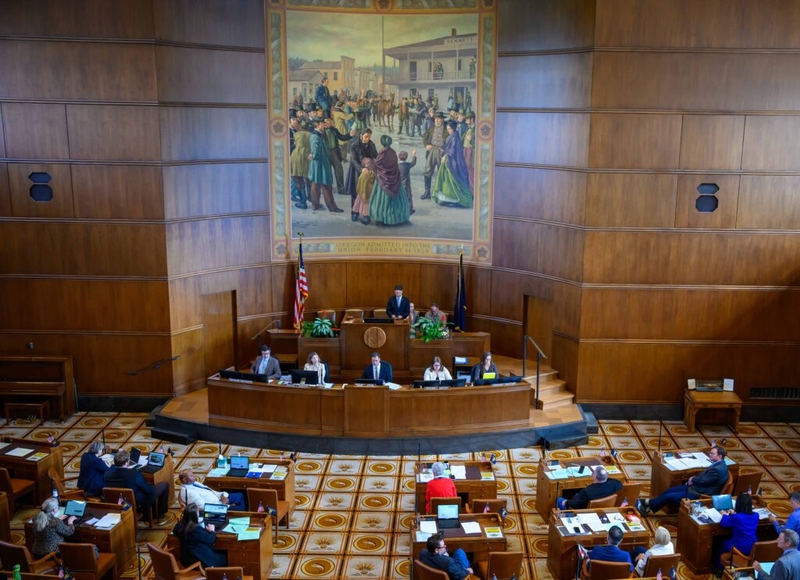
The Oregon Senate floor on Thursday, June 26, 2025. (Laura Tesler/Oregon Capital Chronicle)
A handful of competitive Oregon House and Senate races will determine whether voters are more frustrated with Republican President Donald Trump and his administration or with the Democratic majority in Salem, according to political analysts.
Those races are unlikely, however, to determine a new balance of power in the Oregon Legislature, where Democrats hold majorities in both chambers and are widely expected to hold, if not grow, that share in the Nov. 3 election.
All 60 state House seats and 15 of 30 state Senate seats will be on Oregonians’ ballots. Democrats currently hold 37 House seats and 18 Senate seats, giving them the three-fifths supermajority necessary to pass new taxes or increase existing ones without Republican support.
Few of Oregon’s House or Senate districts are competitive, as the Legislature drew district maps in 2021 that largely favored incumbents and their political parties. Geographic differences in voting patterns — rural areas in eastern and southern Oregon tend to favor Republicans and cities including Portland and Eugene support Democrats — also contribute to the lack of strong competition in most parts of the state.
But analysts expect voters in Salem, Springfield, the North Coast, Southern Oregon and Clackamas County to wield outsized power in the November election. Democrats see potential for gathering Senate seats being vacated by Republicans, while Republicans are eyeing House seats.
In Oregon and across the U.S., dissatisfaction with Trump — whose approval ratings reached a record low of 32% this week according to a Reuters/Ipsos poll — a host of his policies, and the rising cost of living as a result of his war in Iran are expected to bolster Democrats’ chances.
“I think that Oregonians are deeply disturbed by what they’re seeing from the Trump administration, by Republicans nationally, and from a legislative standpoint I think we anticipate seeing Oregonians rejecting the party of Trump,” said Oliver Muggli, a political strategist working with Oregon Democrats running for the state House.
Longtime Oregon Republican consultant Rebecca Tweed, who is not working for any current legislative candidates, said she agrees that Trump ire will influence races, particularly in suburban districts that might otherwise have been more of a toss-up. But it would be unwise for candidates to assume voters will carry that entirely down ballot, Tweed said.
“I don’t think either gubernatorial candidate, or candidates underneath them, should assume voters are going to vote a straight slate,” she said. “Voters can be unhappy with Trump and also unhappy with Democrats in Salem. Candidates who establish their own identity and localize their races have room to build a coalition independent of the top of the ticket.”
Most competitive Senate races
Some of the most competitive Senate races are for Republican-held seats being vacated by state Sens. Suzanne Weber of Tillamook, Cedric Hayden of Fall Creek and Kim Thatcher of Keizer, all of whom are barred from running for reelection after participating in a six-week walkout in 2023 over Democratic bills.
Although the three districts lean Republican, Democrats in November are hoping to take Weber’s seat in the 16th Senate District and Thatcher’s 11th Senate District seat. Democrats represented both areas in the Senate as recently as 2022.
Tweed said Republicans have “a reasonable opportunity to hold their current seats,” but noted that those two races are “genuinely competitive.” Former Republican state Rep. Tracy Cramer of Gervais is running against Democratic former Salem City Councilor Virginia Stapleton in the 11th District, while Republican Clatsop County Commissioner Courtney Bangs is running against former Democratic state Sen. Rachel Armitage in the 16th.
“I would not take either seat for granted. Losing both would be significant for an already small Republican caucus, and these are exactly the kinds of districts Republicans need to remain competitive in the long term,” Tweed said.
Republican and former California Democrat Jack Tibbetts is running against Democrat Sierrah Williams, a dietician, for Hayden’s 6th Senate District seat. Tibbetts, a farmer and small business owner who served as a Democrat for five years on the Santa Rosa City Council in California before moving to Oregon in 2021, upset state Rep. Jami Cate, a farmer from Linn County, in the May primary, creating uncertainty over who could win between Tibbetts and Williams as political newcomers. Hayden, then a state representative, won the district with 65% of the vote in 2022.
Senate Republicans, meanwhile, are hopeful they can flip southern Oregon’s 3rd Senate District, now represented by retiring Democratic Sen. Jeff Golden. Health care consultant Denise Krause won the five-way Democratic primary in May and faces Republican Brad Hicks, a former longtime executive of the Chamber of Medford and Jackson County. Registered Democrats outnumber Republican voters by 20% in the district, though non-affiliated voters still make up the majority — more than 36,700 — of 102,000 registered voters in the district.
Oregon GOP PAC hires same group Elon Musk used to canvass across swing districts
But the presence of a third candidate complicates the race. Clay Bearnson, a former Medford city councilor and bar owner, is running under the Independent Party of Oregon and the Pacific Green Party, and his stances are more aligned with Democrats.
Hicks has received nearly $1.5 million in donations to his campaign, including nearly $789,000 from the GOP’s Bring Balance Back to Salem PAC, whose largest contributors include Nike cofounder Phil Knight and lumber producer Sierra Pacific Industries. Krause has received more than $860,000 in contributions, mainly from Democratic PACs and committees, unions and individuals. Bearnson has raised just more than $4,000.
Most competitive House races
Republicans see the House as the chamber where they can make the greatest political gains, according to Tweed.
The party hopes to snag two Willamette Valley seats being vacated by incumbent Democrats: the 7th House District held by state Rep. John Lively, a Springfield Democrat, who has served in the Legislature for 14 years, and the 40th House District currently held by Rep. Annessa Hartman, D-Gladstone, who is not running for reelection.
West Linn High School teacher Michael Sugar is running as the Democrat for Hartman’s seat against Republican police officer Adam Baker, who narrowly lost to Hartman in 2022. And Springfield City Councilor Kori Rodley is running as a Democrat against Republican Adam Wilson, a wealth adviser, for Lively’s seat.
Muggli said he believes the two seats will ultimately remain in the hands of Democrats, arguing that Sugar has amassed bipartisan support and Rodley is appealing to voters seeking a candidate who understands affordability issues firsthand.
“Kori Rodley worked at a food bank. She grew up with people who had been left behind by politicians both in D.C. and in Salem, and she’s running against a wealth manager. It’s going to be, I think, a relatively straightforward choice for voters there,” Muggli said.
Republicans, for their part, believe they have a chance to oust two Democratic incumbents from their seats: state Reps. Lesly Muñoz, of Woodburn, and Cyrus Javadi, of Tillamook.
Javadi, a two-term Republican who last year switched parties and who is now running as a Democrat for reelection, will face off for the 32nd House District seat against Republican Max Sherman, a retired high school teacher who taught agricultural sciences in Tillamook and Canby. Javadi left the Republican party due to “extreme politicians in today’s Republican Party,” whose values he no longer aligns with, he said at the time.
Tweed said it will be a test of “whether voters see Javadi’s party switch as independence or whether Republicans can make it about trust.”
In the 22nd House District, Republicans hope to propel mental health counselor and former Woodburn School Board member Noemi Legaspi to a win, unseating one-term Democrat Muñoz. Legaspi and Muñoz, both Latinas, have campaigned hard to win over voters in the district with the state’s highest Hispanic population: nearly 48% of residents.
Tweed said Muñoz’s pitfall has been a focus on messaging as opposed to Legaspi’s on-the-ground outreach.
The most competitive race in the House is likely to be in the Gorge-based 52nd House District, where Republican Scott Hege, a 16-year county commissioner and former executive director of the Port of The Dalles, is running against political newcomer Hank Sanders, a 25-year-old Democrat, former journalist and legislative aide to his mother, Portland-area Sen. Lisa Reynolds.
The House seat is one of the only truly competitive and unpredictable ones in the state each election, where roughly 38% of voters are nonaffiliated, 30% are Democrats and 25% are Republicans.
Data centers take center stage, spur mudslinging, in competitive Gorge-based Oregon House race
Two wildcard races with entrenched Republican incumbents that could move to the left, according to Muggli, are in Salem and Albany. Occupational safety professional Michael Welsh is running in the 21st House District against incumbent Republican Rep. Kevin Mannix, R-Salem, who has spent a decade-plus in the state Legislature during the last three decades. And in the Albany-based 15th House District, where Republican Rep. Shelly Boshart Davis is up against Democrat Joanna Robinson, a project coordinator for a behavioral health consultancy.
Muggli said Mannix represents a career politician and Welsh a “blue-collar working dad” at a time when voters want to see their elected leaders have authentic experience dealing with a generational affordability crisis.
“I think that what people are really hungering for right now, and this is going to sound like a platitude but I actually don’t think it is, is authenticity,” Muggli said. “They want to hear people like them grapple with the concerns that they’ve got, and not mince words about going to fight for them.”
Salem, OR