Fenton teach-in honors John Lewis, urges defense of voting rights and getting into ‘good trouble’
Jul 18, 2025 | 7:55 am ET
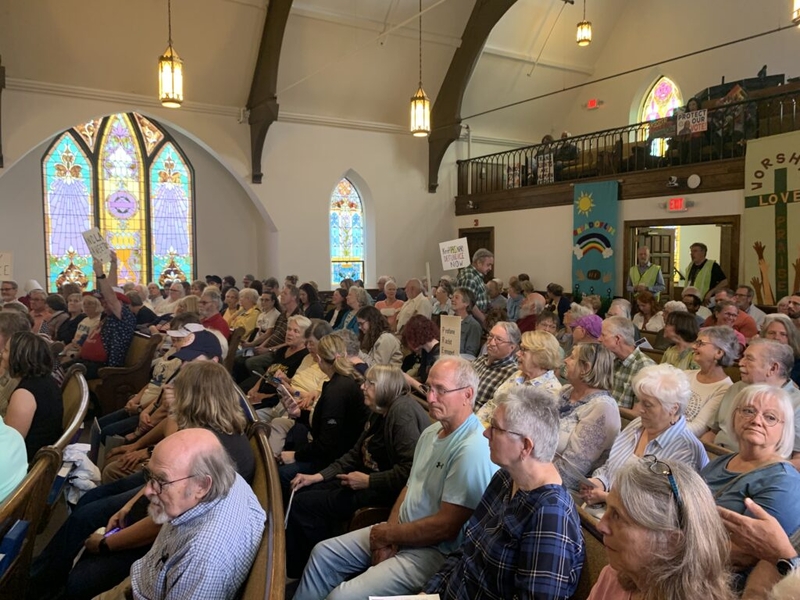
Description
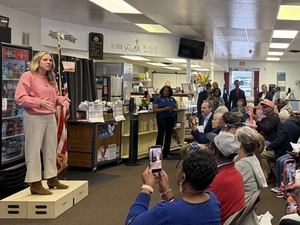
Attendees at the "Good Trouble Lives On" gathering at Fenton’s First Presbyterian Church to honor the legacy of civil rights icon John Lewis. July 17, 2025 | Photo by Leah Craig
Community members and elected officials gathered at Fenton’s First Presbyterian Church Thursday for a teach-in celebrating the work, life, and legacy of civil rights icon John Lewis.
Lewis, who represented Georgia’s 5th district for 34 years, is best remembered for his role as a Civil Rights leader who fought relentlessly for racial justice and voting rights while advocating nonviolence. Lewis was first elected to the House of Representatives in 1986, and, until his death in 2020, he was the “de facto representative of the Civil Rights Movement.”
Now, five years after his passing, groups around the country convened for a day of action honoring Lewis’ philosophy: the fight for good trouble.
Good Trouble Lives On is a nationwide day of peaceful, nonviolent action rooted in the legacy of the civil rights movement, aimed at bolstering civic engagement. More than 1,600 events were held across the country to mark the occasion, as well as highlight the ongoing attempts to restrict civil rights by the Trump administration.
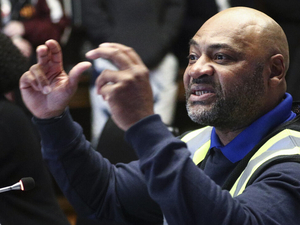
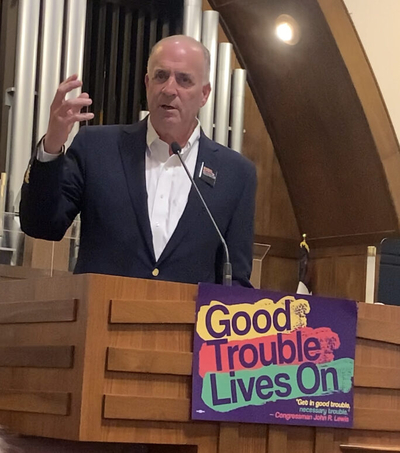
The Fenton teach-in was one of several throughout the state, and was hosted by Indivisible Genesee, Livingston, and Oakland Warriors (GLOW). Speakers included former U.S. representative Dan Kildee (D-Flint), state Senator Mallory McMorrow (D-Royal Oak), Genesee County Clerk Domonique Clemons, and Harold Ford, a teacher and community advocate.
Kildee spoke highly of his friend and colleague, sharing stories of Lewis’ “incredible wisdom, incredible intellect, [and] incredible goodness.”
Lewis is perhaps best known for his role in the 1965 Selma to Montgomery marches. At 25 years old, Lewis led 600 peaceful protesters across the Edmund Pettus Bridge, where they were met with overwhelming brutality from the police. The imagery of that day– March 7, 1965– galvanized the public and ultimately led to the passage of the landmark Voting Rights Act, which was signed into law five months later.
Kildee recalled being invited to attend the annual reenactment of the march across the Edmund Pettus Bridge along with Lewis. With the mayor and city manager out of town, the highest-ranking city official– the one tasked with welcoming the marchers at Brown Chapel AME Church– was Montgomery’s chief of police.
“When John had arrived in Montgomery a few decades earlier, that Chief of Police, who was tasked to protect the Freedom Riders, wasn’t wearing that blue police uniform,” Kildee pointed out. “That police department had traded in their police uniforms for a different kind of uniform. They were clothed in white with masks over their faces, and they nearly beat John Lewis to death.”
Almost fifty years later, Montgomery’s Chief of Police removed his badge and gave it to John Lewis.
“What I remember so much about it is how gracious John was,” Kildee added, noting that Lewis wanted to make sure that the officer would be able to get another badge. Moreover, Kildee explained, Lewis forgave that police chief’s predecessor.
“His kindness poured out into that church in a moment that could have been a reminder of ugliness. It was a reminder that we can all be good to one another, and John represented that more than anything.”
This was just one of many moments that revealed John Lewis’ patient, unshakeable spirit. Kildee noted that Lewis would carry that spirit– and the unwavering dedication to creating change– until the end of his life.
At the height of the COVID-19 Pandemic, Congress adopted a rule that allowed a member of Congress to designate another representative to carry their vote to the floor of the House at their direction and cast it on their behalf.
Lewis, who had been diagnosed with stage IV pancreatic cancer in December 2019, asked Kildee to carry his vote.
The gravitas of this task was not lost on Kildee.
“I knew John and I had become friends, but I guess I didn’t understand quite how close we had become,” Kildee explained. “Because the man whose name and life is most associated with what he would call ‘the precious right to vote’… asked this kid from the west side of Flint to carry his vote to the floor for the last few months of his life.”
Five years later, Kildee continues to shoulder that legacy.
“John asked me to carry his vote. His vote was his voice. He didn’t tell me that I should stop when his life ended,” said Kildee. He then implored the audience to do the same: “Act as John would have– fight hard, never give up, never ever quit. But do it with joy, with love and compassion.”
Clemons shifted the focus from Lewis’ legacy to the present, contextualizing his fight through the lens of contemporary voting rights struggles.
“Since the Voting Rights Act has passed, we have not seen ever, until now, more attacks on the very basic fundamental right to vote across the country,” said Clemons. “We’ve seen time and time again, efforts to strip away people’s rights to vote.”
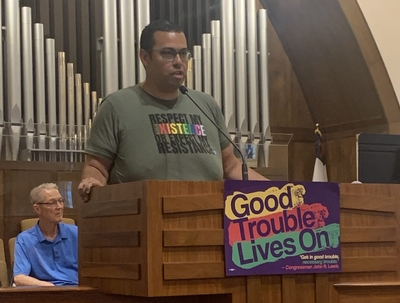
However, he also pointed out that, while voting rights are being targeted across the nation, Michigan has bucked the trend. With initiatives like early voting, no-reason absentee voting, the permanent absentee ballot list, pre-registration for 16-year-olds, and automatic registration through the Secretary of State, Michiganders tend to support the expansion of voting rights and access.
The reason, Clemons asserted, is simple: your vote is your power.
“If you had something so powerful that could change the entire course of history, why would you not use it?” Clemons asked.
In addition to being Genesee County’s first African American clerk, Clemons is both the youngest and the first openly LGBTQ+ clerk in Michigan.
Through a series of anecdotes, McMorrow, who is also a candidate for U.S. Senate, emphasized that everyday people have the power to lead, organize, and create lasting change. Among those she spoke of was Brandon Wolf, who never expected to become an activist but, after surviving the Pulse Nightclub shooting, testified before Congress and went on to become national press secretary for the Human Rights Campaign; and Judge Damon Keith, who used his platform to speak out against secret deportations because “democracy dies behind closed doors.”
McMorrow’s comments highlighted a critical juxtaposition: a single voice can spark lasting change, but lasting change doesn’t come from a single voice alone.
“We can’t look for a quick fix or the political messiah,” she told the audience. “I know that so many of us want to find the next Barack Obama, the next shiny new thing, the next one person who’s going to fix it.”
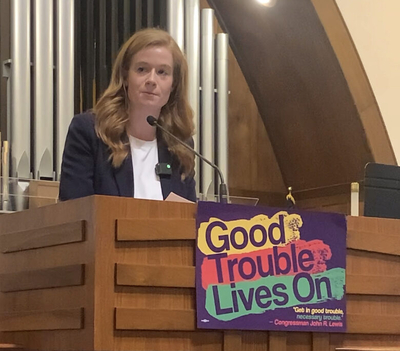
The truth, McMorrow added, is that no single person holds all the answers. A president is not a panacea, a congressman is not a cure-all. On the contrary, she elaborated, it falls to the people– each and every individual– to “rise up, come together, and meet this moment by doing the work.”
“That’s what John Lewis showed us how to do,” she concluded. “And I think he’d be the first to tell you that it’s not going to be easy and it’s not supposed to be. But if we want to protect our freedoms, if we want a government that works for the people, not millionaires and special interests, then we’ve got to show up, dig in, and stay in this fight.”
Lansing, MI