Federal judge permanently blocks Arkansas laws restricting direct democracy process
Aug 21, 2026 | 6:39 pm ET
Description
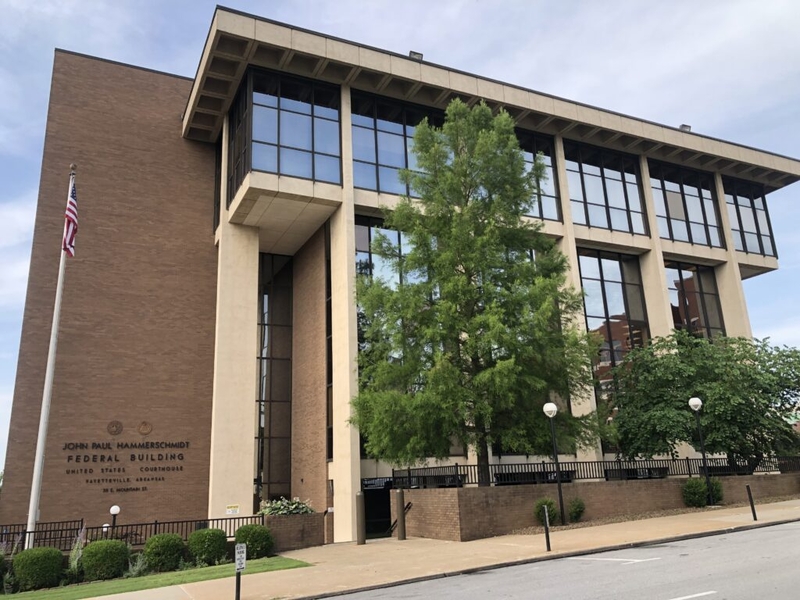
The John Paul Hammerschmidt Federal Building in Fayetteville on July 18, 2025. (Antoinette Grajeda/Arkansas Advocate)
A federal judge on Friday declared laws restricting Arkansas’ initiative and referendum process unconstitutional and permanently blocked their enforcement.
U.S. District Judge Timothy Brooks wrote Friday that laws requiring all canvassers to be Arkansas residents and paid canvassers working on a statewide initiative petition or referendum to be residents living in the state violate the First Amendment of the Constitution.
He also declared unconstitutional a prohibition on paying canvassers based on the number of signatures obtained.
The decision resulted from a lawsuit filed against Secretary of State Cole Jester in 2025 by the League of Women Voters of Arkansas. Two ballot question committees, Protect AR Rights and For AR Kids, were later allowed to intervene in the case.
Judge hears testimony in case over Arkansas’ initiative process restrictions
Jeff LeMaster, a spokesperson for Attorney General Tim Griffin, said the state intends to appeal the ruling.
“This is a good day for the voters of Arkansas,” said Kristin Foster, Executive Director of the League of Women Voters of Arkansas. “The power to make our voices heard belongs to the people. The ballot initiative process gives Arkansans a direct say in their government, and we’re proud to stand with voters and defend that right.”
The three ballot measure groups involved in the case have argued the statutes challenged in the lawsuit make it nearly impossible for Arkansans to propose their own constitutional amendments and laws and place them before voters. Supporters of the laws have said they’re needed to protect the process.
The League of Women Voters and For AR Kids did not collect sufficient signatures for the November ballot, while Protect AR Rights had their signatures tossed because the incorrect ballot measure name was printed on petitions, according to Jester. The Arkansas Supreme Court on Wednesday denied the group’s request to reverse Jester’s decision.
Brooks, who was nominated to the bench by former President Barack Obama, issued a preliminary injunction in November that temporarily blocked the state from enforcing some of the challenged laws against parties involved in the lawsuit. The challenged laws include two that require canvassers to request a photo ID from potential signers and inform them that petition fraud is a criminal offense.
Friday’s ruling focused on arguments made during a July trial and in briefs submitted after the hearing.
Samantha Boyd, a spokesperson for the secretary of state’s office, said that while the trial concluded with Friday’s order, the 8th U.S. Circuit Court of Appeals will hear the state’s appeal of the preliminary injunction this fall. Ten of the 11 active judges on the 8th Circuit were nominated by Republican presidents.
“These petition laws are basic safeguards to prevent fraud,” Boyd said. “Without them, it makes our electoral system vulnerable to bad actors.”
Protect AR Rights called Friday’s ruling “a major win for Arkansas voters and the First Amendment.” Both the preliminary and permanent injunctions issued by Brooks “preserve a vital path forward for Arkansas voters to make important decisions and hold politicians accountable through the citizen ballot initiative process,” the group said in a statement.
While the state asserted the Arkansas resident requirement for all canvassers doesn’t implicate the First Amendment because it doesn’t affect the communication of ideas, Brooks argued in his 45-page opinion and order that Americans have the right to speak about and advocate for political change in all states, not just the one where they live.
“The residency requirement implicates the First Amendment by making 99% of Americans effectively unavailable as messengers for Plaintiffs’ and Intervenor-Plaintiffs’ ideas, thereby limiting their ability to select what they believe to be the most effective means for advocating for their petitions,” Brooks said.
The domicile requirement implicates the First Amendment for the same reasons as the residency requirement, he said. Though the domicile requirement only applies to paid canvassers on statewide initiative and referendum petitions, the burdens imposed “remain severe.”
Arkansas Supreme Court dismisses lawsuit challenging rejection of direct democracy ballot measure
Because most professional canvassers aren’t Arkansas domiciliaries, ballot measure sponsors are unable “to hire the best, most experienced, or most reputable canvassers from around the nation,” Brooks said. Instead, they must choose from a smaller pool of candidates who are likely less experienced.
“Less skilled, less experienced canvassers are less effective and less efficient than more skilled, more experienced canvassers, which increases the cost and decreases the efficacy of the sponsor’s campaigns,” he said. “Those less experienced canvassers also receive worse training because they cannot watch experienced professional canvassers at work.”
The pay-per-signature ban also implicates the First Amendment because it restricts how ballot measure sponsors pay for political speech, Brooks said.
Like the residency and domicile requirements, Brooks wrote, “the pay-per-signature ban is limited to initiative and referendum petitions and therefore imposes a content-based restriction on speech because it defines the category of regulated speech by its content.”
Even though Brooks said there was not enough evidence that the pay-per-signature ban imposed a severe burden, the judge said the state “provided no evidence connecting payment on a per-signature basis to even a single instance of fraud.”
“While the weakness of the evidence on both sides makes this a close case, the Court must err on the side of protecting political speech,” Brooks wrote.
Little Rock