Federal court denies restraining order in ACLU lawsuit challenging Tennessee’s new congressional map
Jul 23, 2026 | 5:16 pm ET
Description
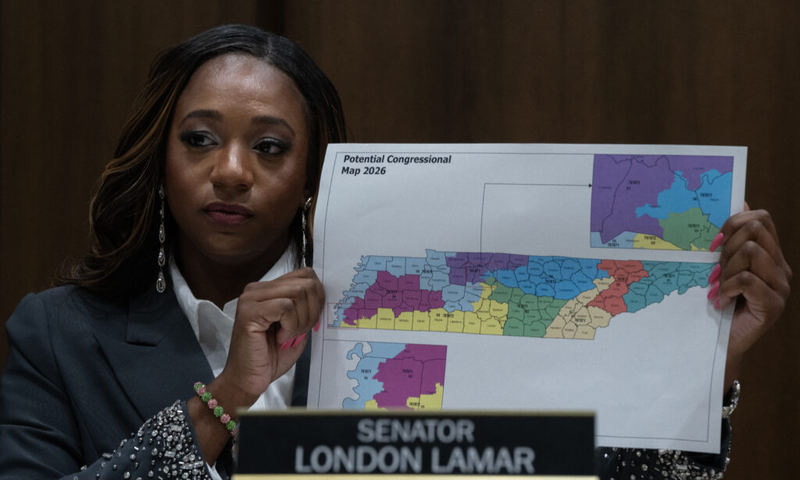
State Sen. London Lamar, a Memphis Democrat, holds a photo of the new U.S. House map passed by Tennessee Republicans during a special legislative session in May. (Photo: John Partipilo/Tennessee Lookout)
A panel of federal judges on Thursday denied an injunction aiming to stop Tennessee’s redrawn congressional map — which splits majority-Black, majority-Democratic Memphis into three U.S. House districts — from going into effect before the August primary election.
The American Civil Liberties Union filed the lawsuit on behalf of voters, clergy and nonprofits in Memphis after Tennessee’s Republican-led legislature passed its new map in May. The lawsuit alleges lawmakers drew the map to dilute the votes of Black people, while lawmakers said they drew the map to give Republicans the advantage in all nine of Tennessee’s congressional districts.
The ACLU sought a preliminary injunction to halt use of the new map for the 2026 election cycle while the lawsuit continues to move through the court. Early voting for the August primary began on July 17.
A three-judge panel stated that the court presumes that lawmakers acted in good faith, and the lawsuit failed to show that “racial discrimination was a ‘substantial’ or ‘motivating’ factor behind the new map.” Without “direct evidence of racial motivation,” the plaintiffs “aren’t likely to succeed” on the merits of their case and therefore don’t meet the threshold for a preliminary injunction.
“The road to a reliably 9-0 map runs through Memphis,” the judges’ opinion states, “Thus, political motivations readily explain the map’s dilutive effects.”
While the court denied a preliminary injunction, the lawsuit itself remains pending.
Amber Sherman, a Memphis voter and one of the lawsuit’s plaintiffs, said in a statement that the court’s ruling continues to “further the disenfranchisement of Black voters in Memphis,” and she intends to continue fighting for equal representation.
“It’s painful to know we’ll head into another election under a map that was designed to weaken the voices of Black voters in Memphis,” Sherman stated. “We deserve the same opportunity to shape our future as anyone else.”
The three-judge panel includes Chief U.S. District Court Judge William Campbell Jr. (a Trump appointee), U.S. District Court Judge for the Western District of Kentucky Gregory Stivers (an Obama appointee) and 6th Circuit U.S. Court of Appeals Judge John Nalbandian (a Trump appointee).
Campbell was assigned this case and two separate but similar federal lawsuits brought by the NAACP and League of Women Voters and by Democratic candidates and voters in districts affected by the new map.
Tennessee Democrats voluntarily dismissed their challenge in June shortly after Campbell denied their request for a temporary restraining order.
A fourth lawsuit filed by the NAACP in state court was dismissed by a separate three-judge panel in May.
Nashville, TN