Federal bill seeks to award Artemis II astronauts Congressional Gold Medals
Jun 25, 2026 | 12:42 pm ET
Description
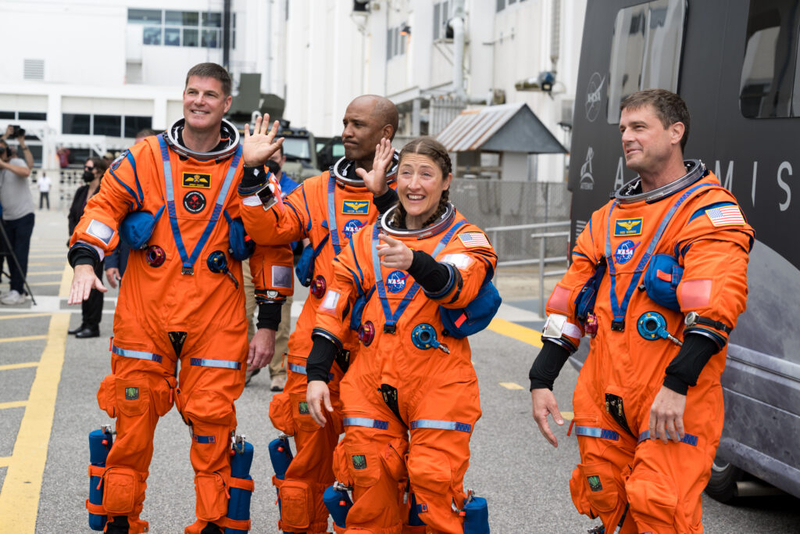
From right to left, NASA astronauts Reid Wiseman, commander; Christina Koch, mission specialist; Victor Glover, pilot; and CSA (Canadian Space Agency) astronaut Jeremy Hansen, mission specialist wave to family and friends as they prepare to depart the Neil A. Armstrong Operations and Checkout Building to board their Orion spacecraft atop NASA’s Space Launch System (SLS) rocket at Launch Complex 39B, Wednesday, April 1, 2026, at NASA’s Kennedy Space Center in Florida. NASA’s Artemis II mission will take Wiseman, Glover, Koch, and Hansen on a 10-day journey around the Moon and back aboard their Orion spacecraft from Launch Complex 39B, with a two hour launch window opening at. (Photo courtesy of NASA/Aubrey Gemignani)
The historic astronauts behind the recent Artemis II mission could soon receive one of the highest civilian awards under a new federal bill from a former astronaut and a retiring Nebraska representative.
Arizona U.S. Sen. Mark Kelly, a former astronaut and a Democrat, and Nebraska U.S. Rep. Don Bacon, a Republican, on Wednesday introduced the “Artemis II Congressional Gold Medal Act.” The bill would honor the four crewmembers aboard the historic Artemis II mission, which was the first crew to leave low Earth orbit and fly near the moon in more than 50 years.
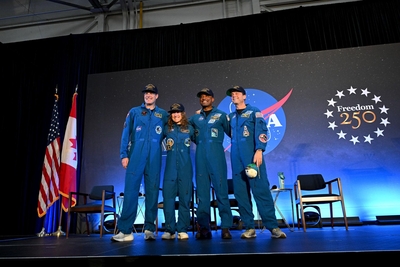
NASA astronauts Reid Wiseman, Victor Glover, Christina Koch and Canadian Space Agency astronaut Jeremy Hansen embarked April 1 and returned to Houston April 10.
If passed and signed into law, the astronauts would be the first crew to receive a Congressional Gold Medal since 2009. The last honor went to the crew of the Apollo 11 mission, 40 years after that mission.
Kelly, in a statement, said the astronauts “carried human space exploration farther than it has ever gone before” and reminded Americans “what we’re capable of when we work together.”
“I’ve flown on four missions to space, and I know how hard that crew and the teams on the ground worked,” Kelly said. “They made something incredibly complex and difficult look easy.”
The astronauts set a new record distance for human spaceflight from Earth: about 252,756 miles. It was the first crewed mission to travel beyond low Earth orbit and around the moon since the Apollo 17 mission in December 1972.
Bacon said from Apollo to Artemis, America’s “pioneering spirit has long defined our leadership in space exploration.”
“I am grateful to our friends at Space for Humanity for bringing this idea to us, and to Sen. Kelly and our co-leads for working together to recognize these extraordinary astronauts,” Bacon said in a statement.
Nebraska GOP Sens. Deb Fischer and Pete Ricketts are among cosponsors of the effort, which would give each astronaut a gold medal depicting the crew of four astronauts.
The U.S. secretary of the treasury would also be authorized to sell duplicate bronze medals.
The federal bill also names multiple mission contributors who made history of their own from the ground, plus multiple other “firsts” for space travel, such as the first crewed launch of NASA’s Orion spacecraft on the Space Launch System, the first ship-to-ship voice call between a lunar mission and the International Space Station and the first mission to confirm Orion’s life support, navigation, propulsion and reentry systems in deep-space conditions.
“Artemis II laid the groundwork for future lunar landings and missions to Mars, in partnership with United States industry,” the federal bill states.
NASA earlier this month announced the crew of the next Artemis III mission, including three NASA astronauts and another from the European Space Agency. That mission will undertake a “series of challenging tests in Earth orbit” next year, NASA said in a news release, which will be “essential” for Artemis IV, the first planned crewed mission to the lunar South Pole in 2028.
More on each of the Artemis II astronauts, according to the Bacon-Kelly bill:
- Wiseman, the first Artemis mission commander and a naval aviator, has spent 175 days in space, including his time as a flight engineer aboard the International Space Station. He is the most experienced astronaut to command a crewed lunar mission.
- Glover, the Artemis II pilot, previously piloted the SpaceX Crew-1 aboard the Dragon Resilience in 2018. He has spent 178 days in space, including four spacewalks. He is the first person of color and first Black astronaut to travel beyond low Earth orbit and around the moon.
- Koch, a mission specialist, holds the record for the single longest spaceflight by a woman, at 328 days, and participated in the first all-female spacewalk on the International Space Station. She is the first woman to travel beyond low Earth orbit and around the moon.
- Hansen, also a mission specialist, was the first Canadian and non-U.S. astronaut to travel beyond low Earth orbit and around the moon.
Said Kelly: “They inspired the next generation of scientists, explorers, and engineers. For pushing the boundaries of human achievement, the Artemis II crew deserves this honor.”
Lincoln, NE