Failed bill to repeal South Dakota’s death penalty came from Republican former head of prison system
Feb 19, 2026 | 10:00 am ET
Description
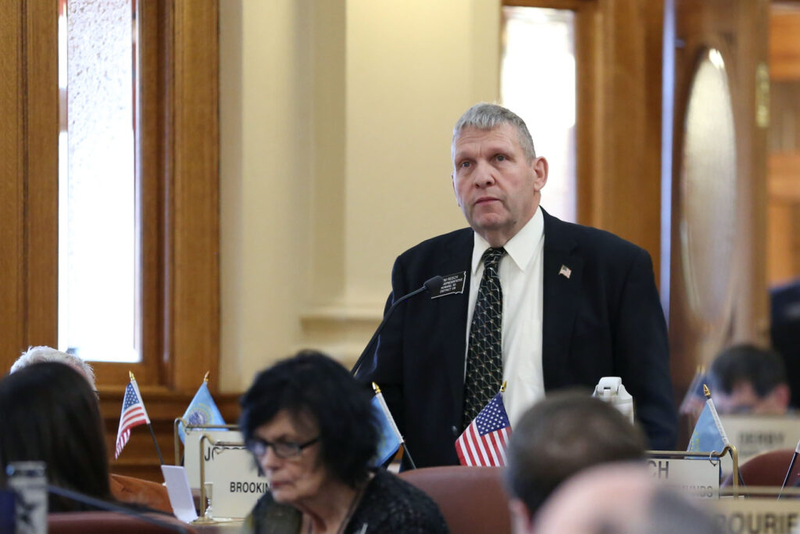
Rep. Tim Reisch, R-Howard, speaks in the South Dakota House of Representative in January 2026 at the Capitol in Pierre. (Photo by Makenzie Huber/South Dakota Searchlight)
PIERRE — The latest push to repeal the death penalty in South Dakota came from a Republican lawmaker who formerly led the state prison system and served as a county sheriff.
State Rep. Tim Reisch, R-Howard, introduced a bill that, in recent years, had been brought by Democrats. The bill failed Wednesday in a legislative committee, with only Reisch voting to support it.
There’s one person on South Dakota’s death row, Briley Piper, who was sent there for his role in a murder 26 years ago. His sentence would not have been impacted by the bill’s passage. South Dakota has executed five people in the past 50 years, according to data from the Death Penalty Information Center.
Reisch led the Department of Corrections when the state carried out its first execution in 60 years in 2007. Elisha Page was executed by lethal injection that year. Prior to that, the state had carried out one death sentence by electrocution and 14 by hanging.
“It was a very somber event,” Reisch told a House committee Wednesday. ”Everyone who had a role in carrying out the execution did so because it was the law.”
Reisch said he filed the bill as a “direct result” of Pope Leo XIV’s opinion that supporting capital punishment was in conflict with pro-life beliefs.
“Those words landed on my heart last fall,” Reisch said.
Mary Ihli, who said she served on a jury in a death-penalty case, testified in support of the bill.
“It wasn’t just stressful, it was traumatizing. I realized that I was being asked to decide on the life of another human being,” she said. “No one, not the court, not the state, not the government, should expect a juror doing their civic duty to end a life.”
Denny Davis, who leads South Dakotans Opposed to the Death Penalty, said the cost for prosecuting cases with the death penalty is 10 times higher than when the defendant faces a life sentence.
“I’d ask myself the question,” he said, “do we lead with fear, or do we lead with the protection of human beings?”
South Dakota Republican Attorney General Marty Jackley spoke in opposition to the bill. He said the punishment exists only for the highest of crimes.
Jackley prosecuted two people who received the death penalty for the murder of South Dakota Corrections Officer Ronald Johnson. The two men, Rodney Berget and Eric Robert, were both serving lengthy sentences when they murdered Johnson.
“They still chose to kill another individual,” Jackley said. “If you don’t have the death penalty, there would have been no punishment for their acts.”
For broadcasters:

Pierre, SD