Eversource CEO tells industry conference he expects Healey to turn down the ‘volume’ on utility criticism post-election
Oct 09, 2026 | 9:52 am ET
Description
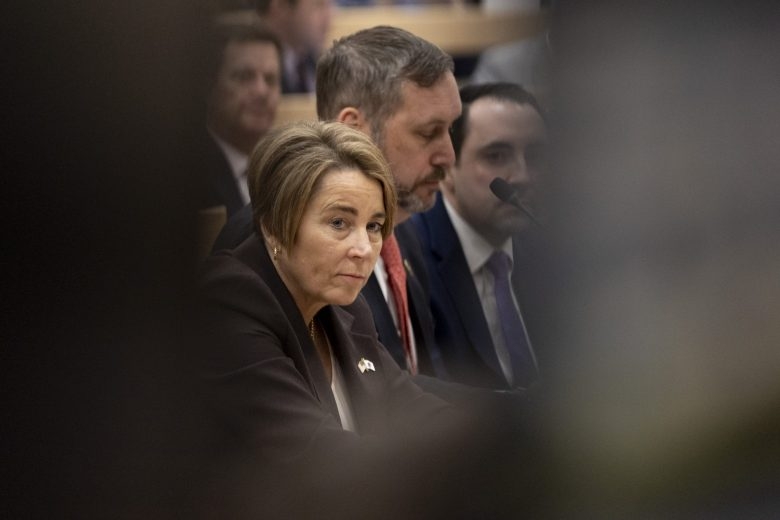
Gov. Maura Healey listens at a legislative hearing on February 11, 2026.
AS GOV. MAURA HEALEY has sought to tackle soaring energy costs in an election year defined by cost-of-living issues — and increasingly attacked the utility companies for “greed” and corporate profits at the expense of ratepayers — the top executive at the state’s largest electric and gas company doesn’t sound too concerned with the rhetoric coming from the corner office.
Joe Nolan, who has served as CEO of Eversource since 2021, said during an industry conference on September 30 that he had a friendly chat with Healey and Lt. Gov. Kim Driscoll a week prior.
“It’s only 37 more days to go” until the election, Nolan recalled telling the duo, according to a transcript of his remarks acquired by CommonWealth Beacon.
“We have good relations with all of them,” Nolan continued, referring to the governors of Massachusetts, Connecticut, and New Hampshire, the states in which Eversource operates. “As much as you might hear them maybe take a whack or a knock at us or me or at certain things, I will tell you if I had $1 for every time they say, ‘Hey, nothing personal, Joe. You know you’re our friend.’ But they have to do that. Obviously, they’re getting attacked, utility issues are front and center. Rates are front and center. But all that noise in 37 days, you’re going to see the volume is going to go right down and you won’t hear much of that.”
And the harsh rhetoric from Healey, who is seeking reelection, also hasn’t blunted Nolan’s financial support for her.
A week earlier, on September 21, right around the time he said he spoke with Healey and Driscoll, Nolan donated $1,000 – the annual legal maximum – to each of their campaigns, according to records from the Office of Campaign and Political Finance.
Between September 10 and October 6, 14 Eversource executives donated to Healey’s campaign, adding a total of $4,500 to her campaign coffers. The same number of Eversource executives gave Driscoll $4,875 in roughly that same timeframe. Those donating include the president of the company’s gas distribution business, the vice president of transmission, the chief financial officer, attorneys, and lobbyists.
By contrast, Healey’s GOP challenger Mike Minogue only received two donations from Eversource employees during the months of September and October – neither of which are from Nolan – totaling $150.
About a week after Nolan’s conversation with Healey and the day after his remarks at the industry event, the governor fired off a letter to the Trump administration asking them to move faster to approve a small gas pipeline expansion proposal. Healey had already publicly thrown her support behind the project, but the letter represented a concrete step to advocate for federal approvals and a rare attempt from the Democratic governor to appeal to the Trump administration on a fossil fuel project.
Healey previously touted her opposition to gas pipeline expansions in Massachusetts during her time as attorney general.
This past January, state regulators approved contracts for Eversource to purchase that gas, a step that gives the pipeline company some assurance that their investment in the expansion will be recouped. In her letter to the Trump administration, Healey estimated the project would save 600,000 customers about $40 million per year over 10 years.
William Hinkle, an Eversource spokesperson, said the company’s leadership consistently takes “any available opportunity to emphasize the need for bringing more energy supply – including natural gas – into New England.”
“We are also supportive of Governor Healey and have been for a long time,” Hinkle said. “We also respect our elected officials too much to believe that political donations can sway them from acting in what they believe is in the best interests of their constituents – whether from Eversource leadership, anti-utility advocates or business leaders in other industries.”
There is nothing illegal about Healey accepting political contributions from Nolan, who has donated $1,000 to her nine out of the last 11 years, or the governor meeting with the chief executive of a utility company, or writing a letter to express a policy position that happens to align with Eversource’s.
But Nolan’s comments that Healey will tone down her rhetoric after the election stand in stark contrast to Healey’s pitch to voters that Massachusetts will take on utility profits and go to bat for ratepayers. They also speak to the delicate balance for the governor, given the significant influence the utilities have over energy affordability and the ability to meet ambitious climate targets.
Kerry Lyons, a Healey campaign spokesperson, said in a statement that Healey “has spent her career standing up for ratepayers and standing up to the utilities.”
“She’ll continue to pursue an all-of-the-above energy strategy to lower bills, while President Trump and Mike Minogue continue to try to kill wind and solar projects that increase supply and create jobs,” he said.
Costas Panagopoulos, professor of political science at Northeastern University, noted the timeline of events doesn’t mean that there was a quid pro quo.
“It’s not unusual for CEOs, like any other individual, to decide to support politicians in the heat of an election cycle, especially when they know that they’ll be doing business with them and when their prospects for victory look promising,” he said.
Healey, who has criticized utilities like Eversource and National Grid for “repeatedly forcing ratepayers to pay even more” while earning record profits for investors, is confronting a complicated energy landscape featuring looming climate commitments, soaring prices, and rising demand. That confluence is also colliding with a war in Iran that has sent oil prices spiking — Healey has now proposed temporarily suspending the state’s gas tax and plans to offer additional heating relief this winter as a result — and the Trump administration’s crackdown on offshore wind.
Healey has emphasized an “all of the above” approach to energy issues to boost supply, including natural gas, and lower costs. Her recent letter to the Trump administration on the pipeline expansion, which is planned to be placed in service in 2028, angered environmentalists who worry she is capitulating on the aggressive climate commitments that Healey herself championed when she campaigned for governor in 2022.
With energy affordability the top concern for households in Massachusetts, the governor has been hunting for ways to cut costs, even as recent polling shows that most voters blame President Trump and the utilities for the high prices.
“I don’t know anyone who has actually been taking the governor’s anti-utility threats seriously,” said Vick Mohanka, director of the Massachusetts Sierra Club chapter. “Now, it’s clear Eversource doesn’t either.”
Boston