Election Day is tomorrow. Some results likely won’t be known until next week.
Jun 08, 2026 | 4:33 am ET
Description
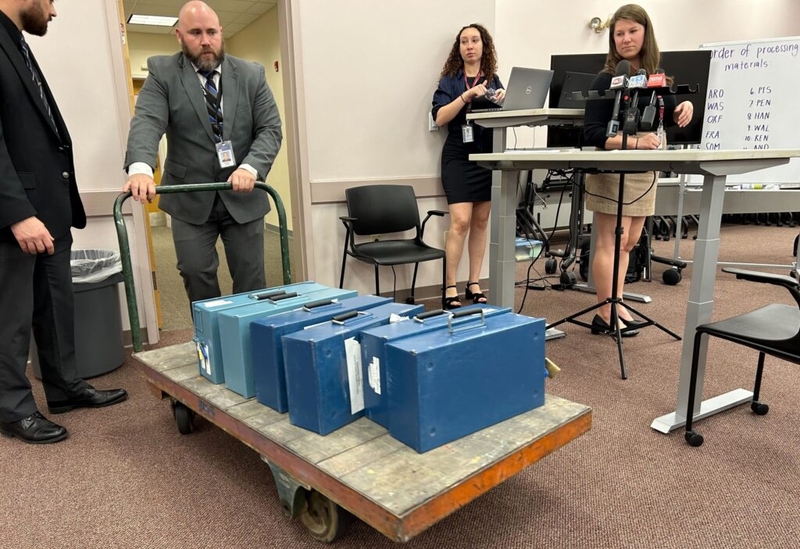
Locked ballot boxes get wheeled in by a member of law enforcement for a ranked-choice voting tabulation for Maine's 2nd Congressional District in the November 2024 election. (Photo by AnnMarie Hilton/ Maine Morning Star)
Mainers likely won’t know the outcomes of some of the most-watched primaries until days or weeks after Election Day.
That’s because several crowded races — the Democratic and Republican gubernatorial primaries, the Democratic primary for Maine’s 2nd Congressional District, and some legislative races — are expected to need ranked-choice runoffs to determine a winner.
Chief Deputy Secretary of State Kate McBrien, who will be overseeing the ranked choice tabulation process along with Deputy Secretary of State Julie Flynn, asked for Mainers’ patience.
“The process is long,” McBrien said, “but it’s long so that it can be thorough and it can be accurate and it can be very transparent.”
Maine is one of two states, along with Alaska, that allow voters to rank candidates by preference rather than selecting just one candidate in certain statewide elections. The primary elections for state and federal offices in Maine use ranked-choice voting, but the method only applies to federal races in the general election.
What’s ranked choice voting?
Voters can but don’t have to rank every candidate on their ballot. They can also vote for just one candidate, either by only selecting that candidate for their first choice or selecting that candidate for every choice all the way across their ballot. But voters can’t vote for more than one candidate as their first choice.
To win a race outright, a candidate has to receive more than 50% of the first-choice votes as counted on Election Day. (While municipalities have two days to report their results to the state, most are usually reported at some point on election night.) If no candidate appears to reach that threshold, the Secretary of State’s Office will make the determination to proceed with ranked-choice voting tabulations.
Last-place candidates are eliminated first. Votes for those candidates are then redistributed to a voter’s next-ranked choice. That’s repeated until one candidate receives more than 50% of votes.
If runoffs are needed, McBrien said the office plans to start the tabulation process on June 12 and aims to have final results no later than June 19, with tabulations for local races expected to be quicker than statewide ones.
The process will occur in Augusta and be broadcast live on the secretary of state’s YouTube. Secretary of State Shenna Bellows, who is a Democratic candidate for governor, will not be involved to avoid any conflicts of interest, McBrien said.
From the polls to the final result
Law enforcement are the only people authorized by law to transport election materials from municipalities. All municipalities have paper ballots but only some have tabulator machines. For municipalities that use tabulators, law enforcement will collect the machines’ memory sticks in sealed bags, and for municipalities that count by hand, they’ll collect the physical ballots in locked metal boxes.
Once all materials are in Augusta, staff will work from 9 a.m. to 5 p.m. doing tabulations. That involves running ballots through a tabulator, uploading memory sticks to computers (which aren’t connected to the internet), and hand counting any ballots tabulators can’t read, such as if they’re crumpled or have coffee stains.
This is the longest part of the process, and it’ll take the most time for state-wide races, which involve results from 487 municipal voting districts.
A ranked-choice runoff is likely in the five-way Democratic primary for governor, as well as the Republican gubernatorial primary, for which eight candidates will appear on the ballot (although Jim Libby dropped out in April after the deadline for candidates to be removed).
“There’s a few candidates in various races who said that they stopped campaigning, but unless they actually write to the elections office to officially withdraw as a candidate, then their name remains on the ballot and those votes are still counted for them,” McBrien said.
For example, that’s the case for Gov. Janet Mills, who suspended her campaign for U.S. Senate in late April but reminded voters she’s still on the Democratic primary ballot amid the latest controversy involving the presumptive nominee, Graham Platner.
Ranked choice voting tabulations could also be needed to determine a winner of the Democratic race for Maine’s 2nd Congressional District, with four candidates vying for the nomination, as well as several legislative primaries, such as a four-way race in one of the most conservative parts of Maine, District 4.
We followed the five Democrats running for governor on the campaign trail. Here’s what we learned.
Once all of the ballot information is uploaded, actually running the tabulation formula in accordance to the state law is quick, with results available in a matter of minutes.
Other possibilities
While recounts only happen automatically if a race is a dead tie, state law sets different thresholds for when a losing candidate can request a recount, and who is responsible to pay for it.
In ranked-choice elections, only a candidate who receives one of the top 3 rankings during the second to last round of counting can request a recount.
For example, in 2024 Austin Theriault, the Republican who challenged Democratic U.S. Rep. Jared Golden, requested a recount. Golden wasn’t confirmed as the winner of the 2nd District until nearly a month after the election.
“Our plan right now is to go through the rank choice process first because that may help to eliminate some needs for a recount,” McBrien said, “and then if there is a need for any recounts, we’ll do that after rank choice is completed.”
A brief history
Candidates on both sides of the aisle have formed alliances with one another to encourage their respective supporters to also rank certain opponents above others.
That’s notable coming from some Republicans because many of the state party’s leaders have criticized the process since Maine voters first approved use of the method in 2016.
After its initial passage by a referendum that year, the Justices of the Maine Supreme Judicial Court issued a unanimous advisory opinion at the request of legislators concluding that the parts of the law that apply to general elections for state offices were unconstitutional under the Maine Constitution, which requires the winners of those offices in a general election to be decided by a plurality.
Primary elections and elections for federal offices are governed by state statute and not by the Maine Constitution. That’s why ranked choice voting is only used in federal races in the general election.
Earlier this year, the majority of legislators in the Democratically-controlled Maine Legislature voted in favor of a bill that would have expanded ranked choice voting to special and general elections for governor, state senator or state representative. In order to avoid a veto from the governor, lawmakers asked the state’s highest court to again weigh in.
But the court followed its previous opinion on the matter and ruled that such an expansion would be unconstitutional.
Augusta, ME