El-Sayed, McMorrow highlight free speech policy at U.S. Senate forum focused on Muslim community
Oct 15, 2025 | 9:54 pm ET
Description
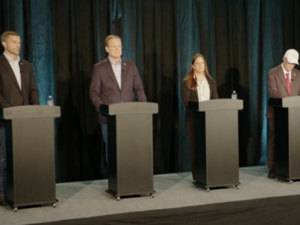
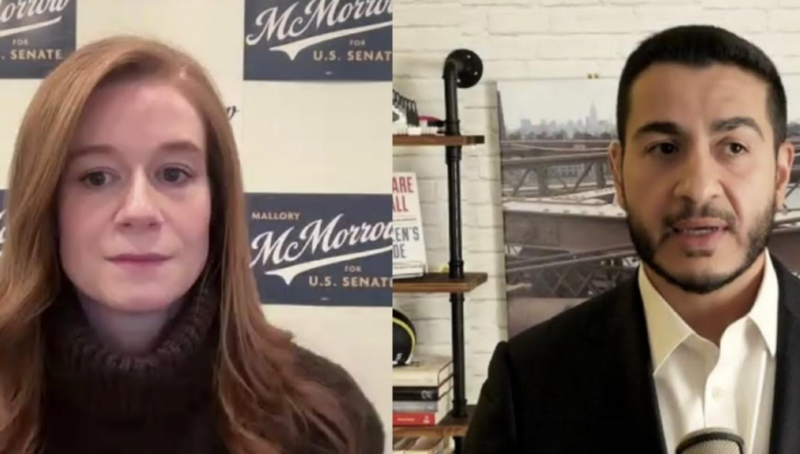
Michigan state Sen. Mallory McMorrow (D-Royal Oak), left, and Dr. Abdul El-Sayed, right, speak at a community forum focused on Michigan Arab and Muslim American issues hosted by Emgage Michigan. Oct. 15, 2025 | Screenshot
Two candidates in the race to claim Michigan’s soon-to-be vacant U.S. Senate seat shared their views on policy and the state’s future in a community forum organized by Emgage, a political advocacy group dedicated to educating and mobilizing Muslim American voters.
Appearing during a virtual webinar on Wednesday evening were Democratic candidates Abdul El-Sayed and state Sen. Mallory McMorrow of Royal Oak. The two candidates seeking to carry the torch of the retiring U.S. Sen. Gary Peters used the opportunity to further engage with the state’s Arab American and Muslim voters, which carry significant political weight in key regions of that state.
U.S. Rep. Haley Stevens (D-Birmingham), who is also seeking the seat and is considered the Democratic establishment’s favorite in the race, did not attend the forum due to a scheduling conflict, her campaign said.
Her absence, however, opened a lane for El-Sayed and McMorrow to shine. Several of the questions dealt with Muslim access to the ballot, what they would do to address the rise of anti-Muslim hate, and musings on free speech in the wake of crackdowns on pro-Palestinian protests.
Here are some of El-Sayed’s and McMorrow’s top responses to questions asked by moderators during the forum. The questions asked by Emgage are in bold and the candidates’ responses follow.
Michigan universities have silenced student dissent by branding criticism of Israel as antisemitic. Attorney General Dana Nessel criminally charged university students for expressing their freedom of speech while protesting Israel’s atrocities. Do you believe these charges were appropriate?
El-Sayed: The foundation of our democratic republic is that you have the right to peaceful protest, to freedom of expression. And when that right gets taken away, or when somebody uses the power of the state to oppress somebody for having used that right, something deep and profound is lost. We’ve seen a witch hunt lead from a Democratic attorney general’s office against students for practicing their right to freedom of speech, and I have never faltered when it comes to standing with students against this, frankly, overreach of on the part of a very particular elected official. I’m not afraid to call out my party, rather famously not afraid to call out my party. And I’ve been clear about the fact that, for me, we run on principle, and one of those principles is that any attempt to stifle speech anywhere ends up potentially silencing speech everywhere. It’s the same exact set of policies we’re seeing out of the Trump administration.
McMorrow: The fundamental right to free speech and to protest is exactly that: Fundamental. There is no place where that should be safer than college campuses, places where we send our kids to have difficult conversations and, many times, to be around people who may look different or have different backgrounds from them, maybe for the first time in their entire lives. So I will be a fierce defender of protest, of free speech. I believe that we all bear a responsibility to ensure that that is protected. When it crosses the line into crime, I spoke out when there were a couple of protesters that broke that line and went to the home of Jordan Acker, who’s a University of Michigan regent, defaced his wife’s car and threw jars of urine through the window while his family was home and his daughters were sleeping upstairs. That is where we all need to work together to ensure that free speech is protected.
What specific policies would you champion to protect the civil liberties of Arab and Muslim Americans in the face of rising Islamophobia?
El-Sayed: I remember watching as our country ripped itself apart in the post 9/11 era. … I watched as we did things that were in complete opposition to our Constitution, to people who look like us because of our names, because of our faith. First and foremost, we have to stand up to the post 9/11 surveillance state, the network that has wantonly put people who have particular names on no fly lists. I also think about infringements on our freedom of speech. You look at things like Project Ester, you look at bans when it comes to freedom of speech to advocate for the Palestinian cause. And I think in the U.S. Senate, the kind of leadership we need is the kind of leadership that’s both going to take on and dismantle the very illegal system of surveillance and oppression that we’ve seen erected since 9/11 but also its second coming in the form of the assault on basic civil liberties and freedom of speech.
McMorrow: When the Wall Street Journal published an op-ed accusing Dearborn of being a jihadist city, I spoke out, and I spoke out loudly. But it’s not enough just to use your platform. It’s what you do in legislation, as well. We passed and strengthened hate crimes legislation in the state of Michigan, something that I would advocate on the federal level. We live in a moment where social media companies are weaponizing and buying our time and attention, our energy, our names, that it’s all available in public. We need somebody who is willing to stand up to social media companies, to tech companies, to protect our privacy, to protect our data. We passed strong data privacy legislation in the state of Michigan.
We’ve already experienced the Muslim-Africa travel ban [in Donald Trump’s first presidential term], and we are seeing the U.S. Department of State targeting the community with visa suspensions. What is your stance on accepting refugees from conflict zones … and how would you address immigration processing under the Trump administration?
El-Sayed: Immigration is good. I should be 100% clear about that. One of the neat tricks that America has had is it’s been able to convince people from all over the world to bring their skills, their resources and their energy and enthusiasm here to build. I know that as a fact because my parents immigrated from another country. I shudder to think about what decision they may have made had they been making that decision in 2025 in Trump’s America, versus in 1978, when my dad immigrated here to go to Wayne State. … [It rests on] the notion that we owe a responsibility to continue to be that kind of country that welcomes people is particularly true when we’re talking about people who come from conflict zones, particularly those who come from conflict zones where our military was involved.
McMorrow: What we are watching is a weaponization of ICE and Immigration Services that actually does nothing to make us safer, and it in fact, makes us less safe. The things that law enforcement agencies need to do their job well is trust within the community. [The federal government’s immigration enforcement] is un-American, and it doesn’t benefit us as Michiganders. Michigan is a state that has attracted people from all around the world who have led us to become one of the most diverse states in the entire country, and that enriches all of our opportunities here in Michigan. I will continue to use my platform as a candidate to pull the wool back on what Kristi Noem and the Trump administration are doing, because it’s not security, it’s security theater.
Many Arab and Muslim American voters no longer trust the Democratic Party. How can you rebuild trust and earn their votes without simply echoing their frustrations?
El-Sayed: I watched, in 2024, as our party sided with a genocidal leader in a country committing a genocide with our tax dollars. And I watched so much of that trust and so much of that work dashed. I don’t know when we stopped being the party of peace, but I’ll tell you this, I remember voting for Barack Obama back in 2008. It was my second presidential election, so excited to vote for him, because he was somebody who’s willing to stand up against a stupid war, the one that we should never have fought. And my question today is, why? How can we not, as a party, recognize that those are our roots, guaranteeing people health care, siding with workers over corporations, making sure that we don’t send our money abroad to drop bombs on other people’s kids, when we could be spending it here on our schools and our health care and our own infrastructure? It’s really not that hard. And I think if we want to win back our community, we have to win back our community on principle, and those are the principles I’m running on.
McMorrow: I’ve even been disappointed by my own party. I wonder what our message is and what we stand for, how are we fighting and how are we standing up for people? I am somebody who came into this work because I believe in the power of community and bringing people together. I also, as the chair of the state Senate Economic and Community Development Committee, believe that the way for us to approach foreign policy is not by leading with the military first, it’s by creating economic opportunity, creating business exchanges, welcoming refugees, welcoming immigrants. … That is something that I have built a track record of. I would love to sit around every table with you, to hear your stories. And we have a lot of work to do to build that trust back. And I’m encouraged to see that we are facing a new generation of leadership across the board, coming into Congress and coming into the Senate, who can hopefully write a new Democratic Party.
Lansing, MI