Editor’s notebook: The Niceley Awards, election version
Nov 19, 2026 | 3:25 pm ET
Description
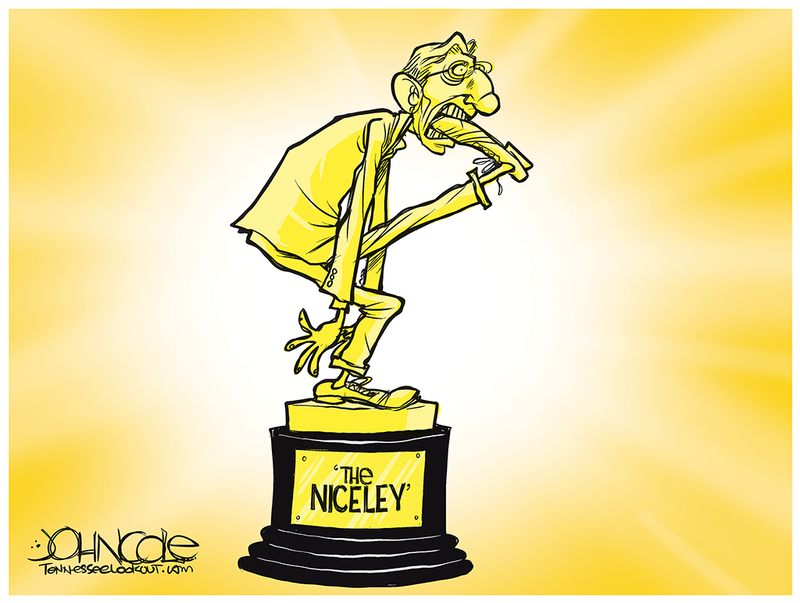
(Illustration by John Cole.)
More than two weeks after the midterm elections, the dust is starting to settle in Tennessee politics, a welcome respite before the Tennessee General Assembly gavels into session in January, full of new members and optimism about what can be accomplished before political jaundice sets in.
But over or not, politicos like almost nothing better than to rehash the coulda-woulda-shoulda from recent elections, who might have won had a few more dollars been raised and how mistakes nearly sabotaged campaigns.
The late Sen. Frank Niceley, a longtime Republican who died in 2025, was known for his colorful phrasing and sometimes controversial statements, including the equating of toll roads with fascism, arguments against outlawing cockfighting and his once holding Adolf Hitler out as an example for people living in homelessness.
There’s no substitute for Niceley, who at least could be counted on to keep the legislature interesting, but in his name, we began writing an end-of-session wrap up to recognize those lawmakers doing their best to emulate him.
In that spirit, we give you “The Niceley Awards: Election 2026 edition.”
Photo finish
After a May special legislative session redrew Tennessee’s 9th Congressional District to make it much friendlier to Republicans – Democrats have held it for almost 50 years – GOP state Sen. Brent Taylor was poised to take the seat, despite a strong challenge from Democratic state Rep. Justin Pearson.
And when the votes were counted on Nov. 3, Taylor won, despite an October surprise that came through his own unforced error.
Nashville Scene writer Eli Motycka got a tip: Taylor had, as recently as 2021, allegedly sent unsolicited nude pictures of himself to at least one woman. The woman, who asked for anonymity, didn’t have the photos anymore. Taylor hadn’t been in office at the time. Motycka’s tip could have remained just that, a story that could have been but wasn’t.
Tennessee congressional candidate responds to allegations he sent unsolicited nude pics
But Taylor picked up a call from Motycka, and once he started talking, he couldn’t stop. He interviewed with Matt Murphy, a conservative radio host for 99.7 Supertalk, saying the photos were a product of “youthful indiscretion,” though Taylor was 51 at the time of the alleged photo bomb. He talked to Action 5 News in Memphis, admitting that yes, he did send the photos.
He sent a statement to the Memphis Flyer, a weekly alternative paper. He just. Couldn’t. Stop. Talking.
Pearson issued his own statement saying, “Men of faith — let alone men who are married, in their fifties, and in public office — have no business sending unsolicited nude photos to women.”
The outcome, in addition to Taylor’s win, could be “cyberflashing” legislation, which newly-elected Democratic Rep. Jesse Huseth says he plans to file.
Camo controversy
Most political candidates say yard signs are the bane of their existence.
Are there enough of them? Are they in the right prominent locations? Will there be large signs? Is someone stealing the signs?
But the race for Congressional District 7 brought forth a new complaint: who had the right to use a camouflage design for signs?
The brouhaha began when Democratic nominee Darden Copeland created a yard sign featuring his campaign logo on a background of muted brown hunting camo, as an addition to his basic blue sign repertoire.
View this post on Instagram
“It has absolutely triggered my opponent,” said Copeland, speaking of Republican U.S. Rep. Matt Van Epps.
And indeed, during an interview on “Inside Politics” with Nashville NewsChannel 5, Van Epps, a former U.S. Army helicopter pilot, raised the issue, seemingly implying Copeland’s use of different signs for Nashville and for more rural Dickson County was dirty pool.
Copeland campaign manager Kevin Teets said the camo signs were available across the 7th District, not just in Dickson, and the Copeland team leveraged Van Epps’ angst for social media laughs, pointing out a sitting congressman should have more important issues on which to focus.
Van Epps edged Copeland out. The camo likely wasn’t the cause.
Old Hickory, we hardly knew ye
Andrew Jackson, son of Tennessee and seventh U.S. president, is a controversial figure because of many issues, including his ownership of enslaved people and, perhaps chiefly, his role as the architect of the nation’s Native American removal policies. In 1830, Jackson pushed for the creation of the Indian Removal Act, which led to the ethnic cleansing of five tribes.
So when independent gubernatorial candidate Lauren Pinkston posted a video from Jackson’s Jonesborough, Tennessee home on Sept. 22 that she called her “hottest Andrew Jackson take,” viewers interpreted it as a spit take.
“When you have a lot of trauma and you don’t know how to process it, you end up doing things that are very risky and actually sometimes very harmful to other people,” Pinkston, a former professor at Lipscomb University in Nashville said, after noting that Jackson was an orphan with childhood trauma.
After people weighed in as they are wont to do on social media, Pinkston took the video down, but the internet lives forever.
Nashville, TN