Dunleavy vetoes nine bills, but Alaska lawmakers override two in special session flurry
Jun 19, 2026 | 8:59 pm ET
Description
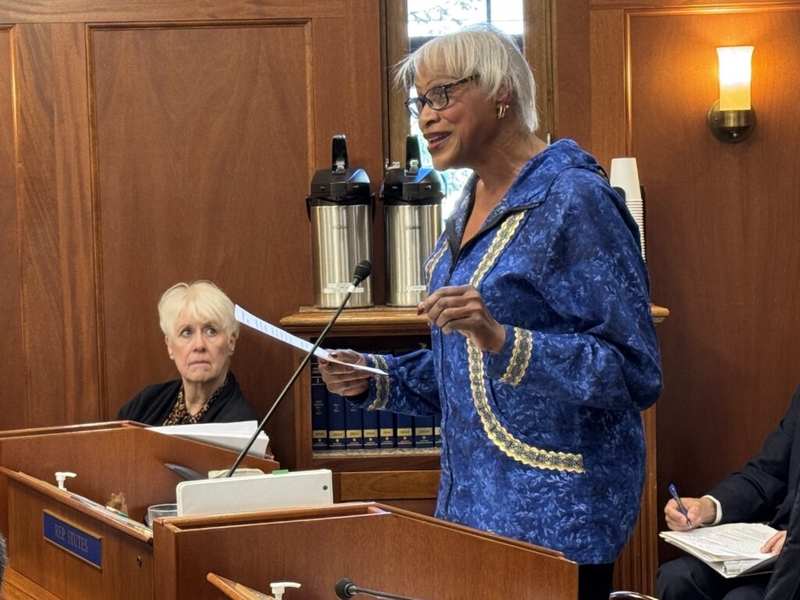
Sen. Elvi Gray-Jackson, D-Anchorage, speaks in favor of the veto override on Senate Bill 41 on Friday, June 19, 2026. Watching at left is Rep. Louise Stutes, R-Kodiak. (James Brooks photo/Alaska Beacon)
Alaska Gov. Mike Dunleavy extended his record-high veto rate Thursday by vetoing nine of the 82 bills passed by lawmakers in the second year of the 34th Alaska State Legislature.
Among the vetoed bills were measures that would have provided mental health lessons to kids in public schools, created a retirement plan for private-sector workers who don’t have one and updated the state’s corporate income tax system.
Two of the vetoed bills — one expanding the power of pharmacists and the other covering the state’s board of engineers and architects — were put into law Friday after lawmakers overrode the governor.
Dunleavy has now vetoed or attempted to veto almost one-fifth of all bills passed by the 34th Legislature. Other governors have issued more vetoes, but none have vetoed a higher proportion of bills than Dunleavy.
Pharmacists’ powers expanded
State legislators voted 43-17 on Friday to override Dunleavy’s veto of House Bill 195, which gives pharmacists more authority to prescribe medicines and conduct simple medical tests. Forty votes were needed.
Rep. Genevieve Mina, D-Anchorage, spoke in favor of the override, saying the bill will enable Alaskans to get cheaper medical care from pharmacists instead of more expensive providers.
Rep. Zack Fields, D-Anchorage, offered an example: For a parent with a child suffering from strep throat after their pediatrician had closed for the day, going to an urgent care clinic might cost hundreds of dollars, and an emergency room visit could cost thousands.
“This bill allows a parent to take their child to a pharmacy” and get a strep throat test, he said.
“We have a growing number of families in Alaska that cannot afford health insurance. If they can’t take their kid to a pharmacy, they’re just not going to get treated,” he said.
Some antiabortion advocates lobbied against the bill, saying they believe the bill could allow pharmacists to more easily dispense abortion-inducing drugs.
Rep. Jamie Allard, R-Eagle River, spoke to that point, but Rep. Mike Prax, R-North Pole and a strong antiabortion advocate himself, said that information is incorrect.
Alaska law limits who may perform an abortion in the state, Prax said.
“It just simply isn’t an issue, and therefore the benefits of this bill clearly outweigh any of the risks,” he said.
Interior designers added to architecture board
Lawmakers also overrode Dunleavy’s veto of House Bill 314 by a 45-15 margin. Forty votes were needed.
A revised version of a bill Dunleavy vetoed last year, HB 314 will regulate some aspects of interior design in the state by adding them to the State Board of Architects, Engineers, and Land Surveyors.
The bill also renewed the board’s legal authority, and when Dunleavy vetoed HB 314, it could have at least temporarily eliminated the board as a side effect. While the duties of the board would have been assumed by the Alaska Department of Commerce, Community and Economic Development, lawmakers said they did not want to eliminate the board just as the state considers a state-spanning natural gas pipeline.
No extra oversight for for kids’ psychiatric facilities
Forty of the Legislature’s 60 members are needed to override the veto of a policy bill, and legislators failed to reach that threshold on three votes Friday due to the opposition of Republican lawmakers.
On House Bill 52, which would require increased oversight of youth psychiatric facilities, the vote was 36-24. The bill, from Rep. Maxine Dibert, D-Fairbanks, was introduced in response to reports of widespread problems at North Star psychiatric hospital in Anchorage.
If enacted, the bill would have required unannounced state inspections of facilities like North Star and reports on the use of physical and chemical restraints on children, among other items.
In his veto message, the governor said that while he supports oversight, he believes the bill duplicates what the state is already empowered to do.
No mental health education in public schools
Despite an impassioned speech from Sen. Elvi Gray-Jackson, D-Anchorage, the Legislature declined to override Dunleavy’s veto of Senate Bill 41, which would have required the Alaska Department of Education and Early Development to draft a mental health curriculum in the same way that it has a physical education program.
Alaska Legislature approves plan for mental health education in schools
Local districts would have been responsible for implementing that curriculum.
The override vote was 38-22, two votes short of what was needed.
The issue, Gray-Jackson told legislators Friday, is nothing short of a matter of life and death.
Alaska has the highest suicide rate in the nation, she said, and “in many rural communities, suicide rates are nearly four times that the national average. Teaching our students how to recognize mental health challenges, to seek help and support one another, is one of the most basic and meaningful steps we can take to address this crisis.”
In his veto message, the governor said, “this bill places the state in the role of imposing upon school districts to mandate the development of mental health education at a time when districts are already working to meet existing requirements.”
“Decisions about sensitive classroom instruction, especially instruction involving a student’s mental and emotional health, should remain as close as possible to parents, local school boards, and communities,” he said.
Gray-Jackson lambasted that statement, saying it repeated “false” and “harmful” misinformation from “online blogs and commentators.”
“SB 41 didn’t remove parents from the conversation, it didn’t strip authority from local school boards, it didn’t replace community values with a one-size-fits-all mandate,” she said.
“The reality is much simpler,” Gray-Jackson said. “The governor vetoed a bill with the potential to save lives in every community represented in this chamber, and I can’t emphasize that enough.”
No retirement plans for minimum-wage workers
Legislators failed by a single vote to override Dunleavy’s veto of Senate Bill 21, which would have provided state-run retirement plans for workers in businesses that do not currently offer retirement benefits.
The program under SB 21, similar to efforts already launched by other states, would have principally affected minimum-wage workers and those in small businesses. Unless they opt out, eligible workers would have had 5% of their paychecks automatically deducted and deposited into an investment account managed by the state.
In his veto message, the governor said he opposes a mandate, even with an opt-out provision.
“Although employees may opt out, the bill relies on automatic enrollment and places employers in the middle of a state-run investment program. Alaska businesses should not be required to
administer or facilitate retirement savings accounts created by the State when private retirement
and investment options are already available,” Dunleavy wrote.
The vote on an override was 39-21, with Rep. Kevin McCabe, R-Big Lake, casting the last and decisive vote to sustain the governor’s decision.
No updates to corporate or tobacco taxes
Of the governor’s nine vetoes, legislators declined to vote on four, permitting them to stand without a vote.
Dunleavy vetoed two bills — House Bill 280 and Senate Bill 24 — saying that he is unwilling to approve tax changes without a comprehensive fiscal plan that brings state expenses and revenue into line over the long-term.
Both bills had been passed in different forms by prior editions of the Legislature and were also previously vetoed by Dunleavy. If SB 24 had been enacted, it would have imposed Alaska’s first tax on e-cigarette products. HB 280 would have modernized the state’s corporate income tax system, taking tax revenue for online sales from other states to the Alaska treasury by declaring that sales to Alaskans take place in Alaska, not at the location of a warehouse or computer server operated by the seller.
House Bill 23, also vetoed by the governor, would have subjected nonprofit businesses to the authority of the Alaska State Commission for Human Rights, which handles discrimination complaints against employers.
“While I support protecting Alaskans from unlawful discrimination, this bill expands the commission’s reach over nonprofit employers, including charitable, educational, and religious organizations. That expansion creates uncertainty for small community organizations and risks unnecessary administrative proceedings and litigation,” the governor wrote in his veto message.
The last of the vetoes, Senate Bill 258, would have forbidden the state from signing computer software deals that lock in the state to a particular company or limit the software to a particular geographic area.
The governor’s veto message said in part that the “bill places rigid statutory limits on how the State and political subdivisions may contract for software in a highly technical and rapidly changing marketplace.”
“Software licensing, cybersecurity requirements, cloud services, support, hosting, and pricing
models are complex and often negotiated together. Restricting those negotiations in statute could reduce flexibility, limit access to needed products, and increase costs for agencies and local governments,” he wrote.
Juneau