Doug Jones tells Montgomery town hall he wants to ‘phase out the CHOOSE Act’
Oct 14, 2026 | 5:59 am ET
Description
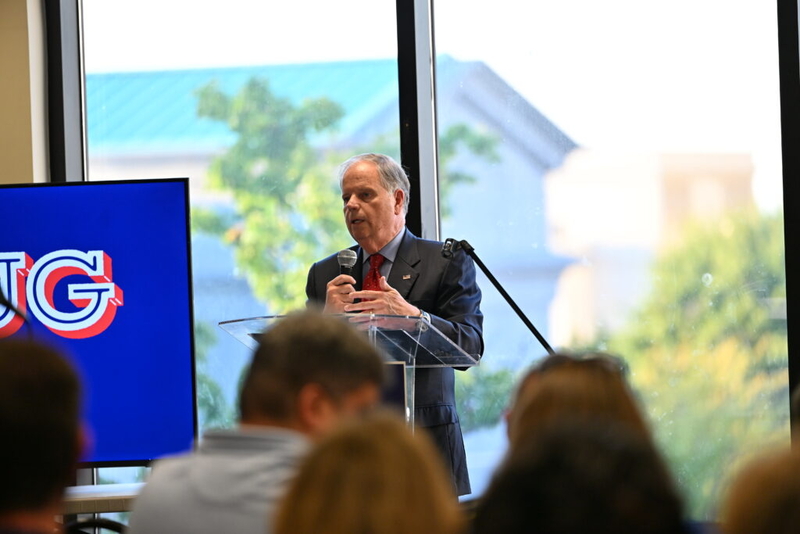
Democratic gubernatorial nominee Doug Jones talked about his education policy plan and other topics during a town hall in Montgomery on Oct. 13, 2026. (Andrea Tinker/Alabama Reflector)
Democratic gubernatorial nominee Doug Jones Tuesday fielded questions about education and other topics at a town hall in Montgomery
Speaking to a crowd of at least 100 people, Jones talked about giving teachers and retirees a cost of living adjustment and said he wanted to “phase out the CHOOSE Act,” the state’s effective school voucher program. Income caps on eligibility for the program will end on Jan. 1.
“It’s (the CHOOSE Act) going to ultimately, if it doesn’t kill public schools, it’s going to just cripple and such that we do the public, and then we are seeing that in the numbers of kids that are in public schools this year,” Jones said. “The first year of the CHOOSE Act, 5,000 to 6,000 folks dropped fewer kids. The next year it was 12,000. Why do you think it’s going to be next year when the income caps are gone and we start giving handouts to people who make a lot of money?”
Alabama State Schools Superintendent Eric Mackey said during the Alabama State Board of Education meeting last week that preliminary numbers showed 12,000 students were unenrolled from public schools. Mackey said while CHOOSE Act recipients made up some of the loss, the large drop in enrollment can’t be attributed to the voucher program alone.
Jones’ plan to phase out the program differs slightly from his earlier talks of ending school vouchers in the state entirely. Jones said he “started out candidly talking about eliminating it,” but because there are students already taking advantage of the program, he wants to phase out school vouchers instead.
“Those kids made a decision and their parents to change schools and benefited,” he said. “They believe so, and the income caps were on, so we’ll phase it out. But we’ll let those kids graduate.”
Jones also said he was “committed to making sure teacher raises go up,” but that his focus will be split with ensuring that educators have access to healthcare.
“Healthcare delivery in this state is a challenge. It’s really in a crisis right now because of the cost of health insurance, the fact that we didn’t expand Medicaid, and it is really crippling,” Jones said.
The Public Education Employee Health Insurance Plan (PEEHIP) board plans to ask the Legislature for a $222 million increase in the fiscal year 2028 budget due to rising health care costs.
One public school teacher asked what Jones thought about the Ten Commandments being displayed in schools because of how it could impact non-Christian students. Gov. Kay Ivey this spring signed SB 99, sponsored by Sen. Keith Kelley, which requires local school boards to display a poster of the Ten Commandments in fifth through 12th-grade classes and within common areas, in April. The bill went into effect on Oct. 1.
“I think we’ve got to have an attitude in this state that is more open and honest about who our neighbors are and where they are and what they are and have that respect. The Bible that I grew up with, the Sunday school lessons I grew up with, taught Christianity, but they also taught respect for others,” Jones said.
A kindergarten teacher asked if Jones would be willing to split money in the Education Trust Fund for turnaround schools, an initiative to help struggling schools in the state, to provide for all schools in the state and bring back teacher’s aides if elected.
Jones said the RAISE Act, which aims to create a needs-based funding model for K-12 schools, is on the right path to ensuring schools remain funded.
“There’s school systems that have foundations that help them because their residents will contribute to those foundations, and I don’t think they should be denied state funding. I’m not saying that, but there are, and I think the RAISE Act is a real good start of identifying those schools and putting extra money there,” he said.
Jones also addressed questions about data centers, repeating his call for a moratorium on new data center construction to give time to develop plans for the facilities.
“I believe that a moratorium would probably not even last a year. I think if right now the governor, the Legislature, whoever said we’re not going to build these things until we get it all together, I think people are going to come to the table, and they’re going to see what we need to do,” Jones said.
Jones used Lowndes County, which approved plans for a hyperscale data center Tuesday despite community members disapproval, as an example of why a moratorium is needed.
The data center in Lowndes County, called Project Red Clay, is a 800-acre facility that would be placed near a residential area.
Montgomery