Amendment 6 would remake balance of power between Missouri voters and lawmakers
Oct 14, 2026 | 6:55 am ET
Description
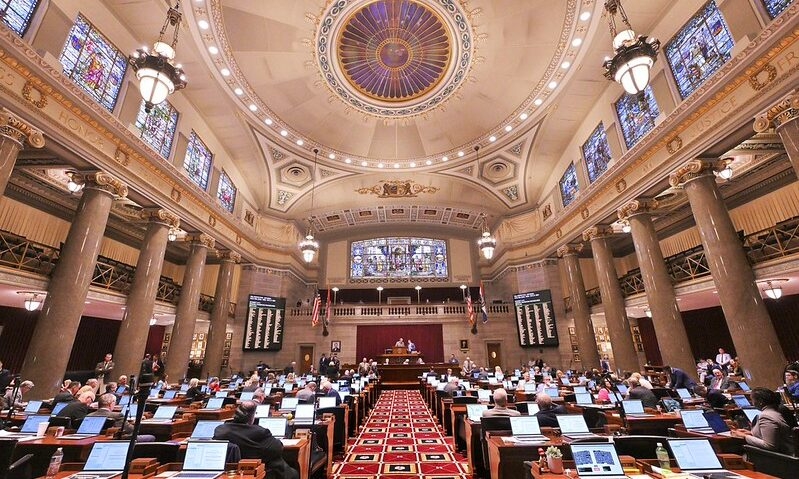
The Missouri House of Representatives on Feb. 19 (Tim Bommel/Missouri House Communications).
Missouri voters are being asked on Nov. 3 to fundamentally rewrite the balance of power between themselves and the state lawmakers they elect.
If Amendment 6 passes, future legislatures could no longer change laws enacted by voters through the initiative process on their own. Instead, at least 80% of both the House and Senate would have to agree to send any changes back to voters for another statewide election.
That would be a major departure from current law.
Today, lawmakers can amend or repeal a state law enacted through an initiative just as they can any other statute.
Voter-approved constitutional amendments are already protected from direct legislative changes, but a simple majority of each chamber can propose a new constitutional amendment and send it to voters.
Amendment 6 would require 80% support before lawmakers could propose changes to either.
And that is only part of the amendment.
It would also make initiative and referendum a “fundamental right,” preserve existing requirements for putting measures on the ballot and prohibit lawmakers from weakening the process.
The result would place Missouri among the states where laws enacted directly by voters receive the greatest protection from elected lawmakers.
“If the Missouri amendment passes, then Missouri would provide one of the highest levels of protection for voter-initiated measures that are found in any of the states,” said John Dinan, a Wake Forest University professor who studies state constitutions and direct democracy.
Supporters say that is precisely what Missouri needs after years of lawmakers attempting to revise, repeal or reverse decisions made by voters.
Opponents warn voters are being asked to trade one problem for another — protecting election results by making future governments far less able to respond when voter-written laws need to change.
At its heart is a question Missouri has wrestled with for years: When voters make law themselves, who should get the final word?
“Amendment 6 ensures that Missourians can be a check and balance on politicians when they are ignoring our voices,” said Jack Cardetti, a spokesman for the Yes on Amendment 6 campaign.
Republican state Sen. Joe Nicola of Grain Valley frames the choice differently.
“This is the most important amendment on the ballot,” Nicola recently wrote. “If it passes, it will begin to deconstruct our Constitutional Republic.”
His more practical concern is that initiatives lack the hearings, amendments, negotiations and opportunities for revision that accompany legislation. Under Amendment 6, he wrote, lawmakers could be unable to address problems even when “the change needed was substantial, a small technical change, an emergency or even just outdated over time.”
The Missouri Chamber of Commerce and Industry has raised a similar concern, warning that businesses need confidence the state can respond when a policy proves unworkable.
Missouri has a recent example of exactly the sort of legislative response Amendment 6 would make far more difficult.
Voters in November 2024 approved an initiative raising the minimum wage, requiring many employers to provide paid sick leave and tying future wage increases to inflation. Business groups, including the Chamber, opposed it.
‘Kicked a hornet’s nest’: Missouri GOP repeal of voter-approved laws inspires backlash
The sick leave requirement took effect May 1, 2025. Two weeks later, the Republican-controlled legislature passed a bill repealing it and eliminating future inflationary increases in the minimum wage. Gov. Mike Kehoe signed it in July 2025.
Under Amendment 6, lawmakers could not have done that themselves. They would have needed 80% support in both chambers just to ask voters to approve the changes.
That is a high bar even for Missouri’s Republican supermajority. Republicans won 111 of 163 House seats in 2024 and hold 24 of 34 Senate seats. Reaching 80% would take 131 House votes and 28 in the Senate, requiring Democratic support.
Cardetti argues the threshold is achievable when lawmakers broadly agree a change is needed. He noted that nearly one-third of the bills passed during the 2026 legislative session received support from at least 80% of lawmakers.
The amendment would also reach backward, covering initiatives adopted since Jan. 1, 2010. Lawmakers left the 2024 measure’s $15 minimum wage intact when they repealed sick leave. If Amendment 6 passes, changing that wage would require 80% of both chambers and another statewide vote.
What happened in Arizona
Arizona voters approved the Voter Protection Act in 1998 after lawmakers altered a voter-approved drug policy initiative.
The amendment barred lawmakers from repealing voter-approved initiatives and allowed them to amend one only if three-fourths of each chamber agreed and the change furthered the purpose of the original measure.
“They brought it on themselves,” Chuck Coughlin, a veteran Republican political consultant in Arizona, said of the state’s legislators.
And the protections worked, Coughlin said.
“If you put something on the ballot and it passes,” he said, “they can’t monkey with it.”
But that did not end the struggle between lawmakers and initiative campaigns. Instead, Coughlin said, the fight moved to the front end.
Arizona lawmakers enacted rules making initiatives more difficult and expensive to qualify. And they were explicit about why. In adopting new restrictions in 2017, the Arizona Legislature said the Voter Protection Act “greatly impairs the ability of the legislature” to make changes or corrections to voter-approved initiatives.
Coughlin said the subsequent restrictions have blunted what was once a frequently used political tool, with initiatives becoming more expensive and difficult to qualify for the ballot.
Amendment 6 would block that strategy and prohibit Missouri lawmakers from “weakening” initiative and referendum powers and preserve current signature requirements and the simple statewide majority needed for passage.
When the Missouri provisions were described to him, Coughlin said they appeared to reflect a lesson from Arizona.
“They’ve learned from our mistake out here,” he said.
Missouri lawmakers have already pursued the sort of front-end changes Coughlin described.
In August, voters overwhelmingly rejected a legislative proposal that would have required citizen-initiated constitutional amendments to win a majority in every congressional district rather than a simple statewide majority.
Nicola says the initiative process still “is not functioning well and needs to be adjusted.”
“However,” he wrote, “Amendment 6 is not what we need.”
Coughlin, meanwhile, said Arizona’s rigidity also forces initiative campaigns to be more careful because proponents know lawmakers may not be able to fix problems later.
“If you’re putting something on the ballot, you have to be very rigorous about what you’re doing,” he said.
That is essentially the same feature Nicola and Missouri business groups identify as a danger.
Opponents argue lawmakers need room to respond to mistakes and changing circumstances. Supporters argue giving them that freedom also gives them the power to substitute their judgment for a decision voters just made.
More than a fight over one election
Missouri voters established the initiative and referendum process in 1908, giving citizens a way to bypass the legislature and make laws directly.
Conflict over that power has erupted repeatedly.
Voters approved restrictions on puppy mills in 2010, only to see lawmakers peel back key provisions the next year. Missourians increasingly turned instead to the state constitution, where lawmakers could not directly undo what voters enacted.
Voters have used constitutional amendments to create a new legislative redistricting system, expand Medicaid, legalize marijuana and sports betting and enshrine abortion rights. Lawmakers have at times resisted or sought to reverse those decisions, including by sending competing constitutional amendments back to voters.
Amendment 6 would largely erase the distinction between initiated statutes and initiated constitutional amendments when it comes to lawmakers’ ability to change them.
It would also restrict lawmakers from passing laws “similar in effect” to measures rejected through the referendum process — language that could have an almost immediate consequence.
Missouri Republicans scramble to launch late campaigns on two ballot measures
Voters on Nov. 3 will also decide whether to keep the congressional map Republicans passed last year. If they reject the map and approve Amendment 6, legal experts interviewed by The Independent believe lawmakers would likely need 80% support and another statewide vote to enact a similar map before the 2030 census.
The amendment does not define “similar in effect,” meaning any attempt could ultimately be tested in court.
Richard von Glahn, executive director of People Not Politicians, the group that forced the referendum on the 2025 map, called Amendment 6 “a creature of the legislature’s own making through their own actions.”
“How many times do the people of this state have to say enough is enough?” he said. “Listen to us.”
The proposal would also give courts another significant role, constitutionally requiring ballot summaries to be clear and unbiased and ensuring judges can rewrite language found to be misleading.
The politics surrounding Amendment 6 do not divide neatly along party lines.
Supporters include the Missouri AFL-CIO, former Republican U.S. Sen. Jack Danforth, former Democratic Secretary of State Jason Kander and former Republican state Sen. Bob Johnson.
The Amendment 6 campaign also has a large financial advantage. A committee called Vote Yes on Amendment 6 has reported more than $4.7 million in large contributions since Sept. 8.
Much of that money has come from organized labor. The Missouri AFL-CIO has contributed more than $1.1 million, while the Mid-America Carpenters Regional Council gave $500,000, IBEW Local 124 gave $400,000 and Sheet Metal Workers Local 36 contributed $300,000.
The organized opposition has operated on a far smaller scale, and only recently got off the ground. MO Protect PAC reported $14,870 on hand Oct. 1 and later received $10,000 each from political committees supporting Republican state Sens. Jason Bean and Brad Hudson.
Jefferson City, MO