District judge upholds convictions against notary for Nebraska medical cannabis petitions
Oct 30, 2026 | 4:29 pm ET
Description
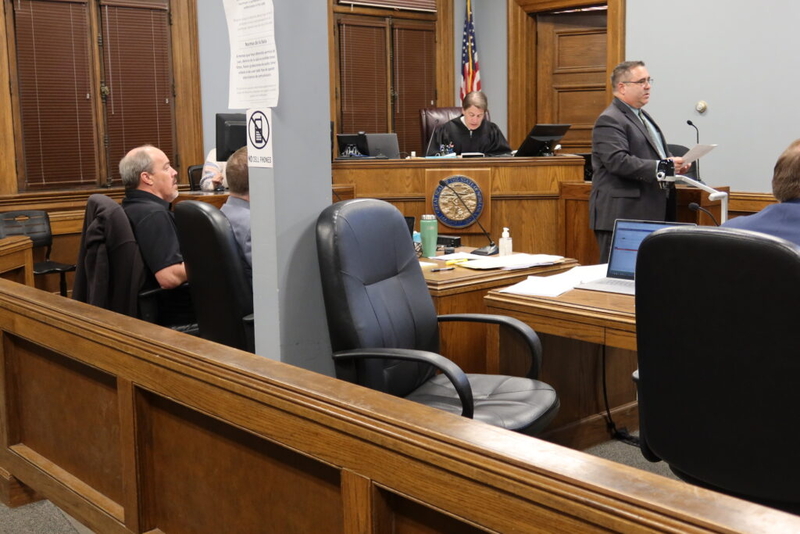
Hall County Attorney Marty Klein, standing, speaks to the jury during the first day of trial before Hall County Judge Alfred Corey, center, against a former notary public, Jacy Todd of York, at left, who is connected to two 2024 statewide medical cannabis ballot measures in Grand Island on Feb. 23, 2026. (Courtesy of Kasey Mintz-Pool/KSNB Local 4)
GRAND ISLAND, Neb. — A Hall County District Court judge on Friday upheld 24 convictions and a nearly $4,000 fine against a former Nebraska notary for 2024 petitions to legalize and regulate medical cannabis.
Hall County District Judge Andrew Butler found that Hall County Judge Alfred Corey III, who presided over a three-day February trial, did not err in refusing to issue a directed verdict (a judge stepping in where the evidence is so clear that no reasonable jury could find otherwise) or grant a mistrial because of prosecutorial statements made in opening arguments.
Butler said that the evidence was sufficient for the jury to be able to consider the facts of the case and that Corey addressed the defense’s concerns about statements in opening arguments about knowledge to commit wrongdoing, including that attorneys’ statements are not evidence.
“The court finds that the Hall County Court did not err in denying the defendant/appellant’s motion for directed verdict and did not abuse its discretion in denying the defendant/appellant’s motion for mistrial,” Butler said in his 14-page order Friday.
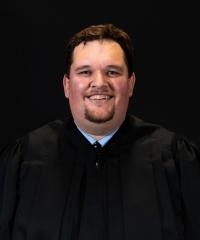
Butler is the same judge who overruled an initial November 2024 order from Corey to throw out the charges against Jacy Todd of York, a former notary. Todd would go on to run in the GOP primary for governor against Gov. Jim Pillen this spring.
Corey had said notaries were not “public servants,” a necessary element of “official misconduct.”
Much of Friday’s order affirms what Butler decided in April 2025: Notaries are public servants and can face criminal charges. That’s a continued point of contention in Todd’s appeal. His attorney, Mark Porto, has long maintained Todd is the first notary to be convicted in this way.
“A notary public is an officer, and that status supports the conclusion that a notary public may qualify as a public servant under the applicable statutory framework,” Butler wrote Friday.
Porto had pointed to an entire chapter of state law, Chapter 64, dedicated to notaries as a reason why notaries can face civil penalties, but not criminal ones. Butler and prosecutors disagreed.
“The court finds no language establishing that civil penalties are the exclusive remedies available or that criminal penalties are categorically precluded,” Butler wrote. “Nor does the court find language providing that Chapter 64 constitutes the exclusive statutory framework governing all misconduct by a notary public.”
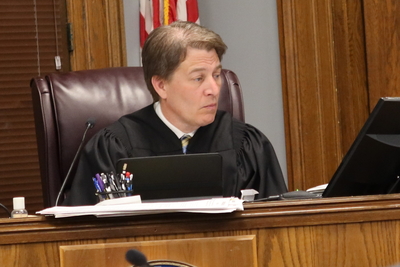
Porto did not immediately respond to a request for comment on Butler’s order or next steps. He could appeal to the Nebraska Court of Appeals.
A six-panel jury in February convicted Todd on all charges filed by the Nebraska Attorney General’s Office and Hall County Attorney Marty Klein in October 2024. Prosecutors said Michael K. Egbert, a paid Grand Island petition circulator, never appeared before Todd to notarize his petitions to legalize and regulate medical cannabis — a verification step required by law.
The jury found Todd guilty of 23 counts of official misconduct for improper notarizations (each a Class II misdemeanor) and one count of making a false statement under oath (a Class I misdemeanor). Corey assessed Todd a fine of $3,866.44, including court costs, but no jail time.
Todd is required to pay the costs by April 17, 2027.
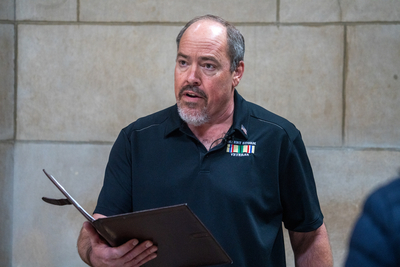
Despite allowing the charges to continue, Butler, in his April 2025 order, had also questioned the extent of resources being used to pursue such charges, and the number of them, “when looking at the current climate of the state and voice of its residents.”
Nearly 71% of voters voted to legalize medical cannabis, and about 67% approved regulating it.
“However, those decisions are left to another entity,” Butler wrote in his April 2025 order. “The court simply is tasked with applying the laws as written and, in this matter, the motion to quash should have been denied and the matter considered by a finder(s) of fact.”
Even without Todd’s valid signatures, the 2024 Nebraskans for Medical Marijuana campaign gathered enough signatures to have still qualified for the 2024 ballot. The Nebraska Supreme Court unanimously ruled against a separate challenge from the AG’s Office and a longtime marijuana opponent in September, upholding the validity of the voter-approved laws.
The Nebraska Medical Cannabis Commission has continued to work toward regulations. The next commission meeting is Nov. 16.
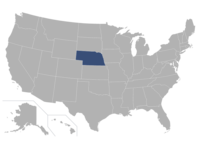
Lincoln, NE