Derelict Mōʻiliʻili Property, Home To Squatters, Plagues Neighborhood
Oct 26, 2026 | 6:01 am ET
Description
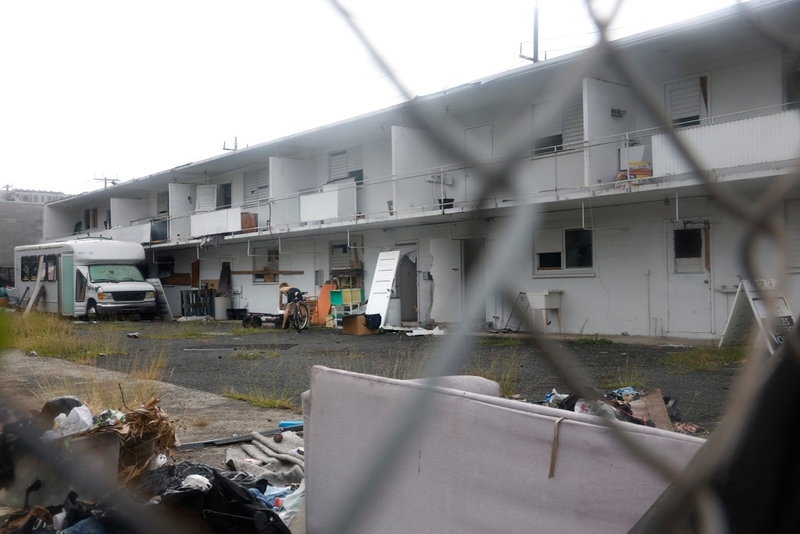
Photo courtesy of Honolulu Civil Beat
A proposed condominium building called Ohana Hale was supposed to bring 180 units of housing – more than half of them affordable – to Mōʻiliʻili.
The project received exemptions from permit fees and zoning standards in 2015 and intended to start construction in 2017 before getting pushed to 2019, and then 2020, and then 2024.
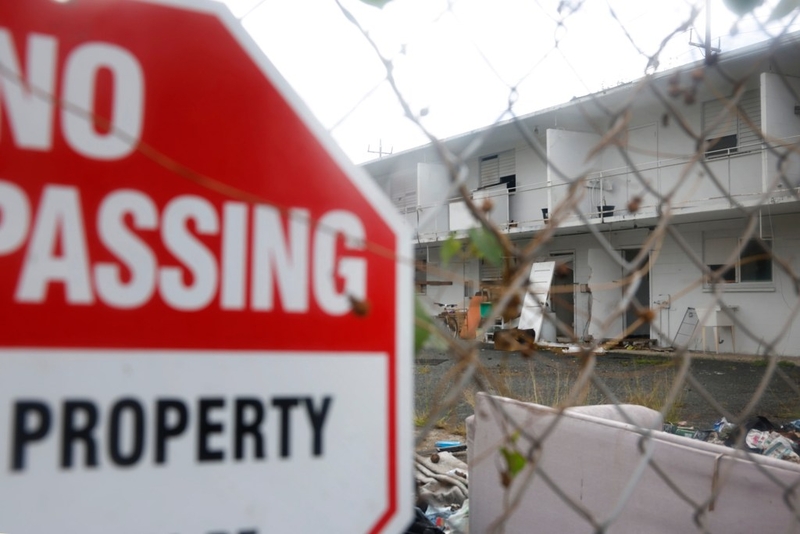
More than a decade after planning began, construction still has not commenced. The existing walkup apartment complex, built in 1961, remains standing, but it has deteriorated. Squatters have taken up residence, neighbors say, and the property has become a hotbed of crime, including illegal game rooms.
Police have responded to 23 nuisance complaints at the property since 2020, city spokesperson Brandi Higa said in an emailed statement, including seven in 2026 alone. Higa also said the property was the subject of a search warrant for an illegal gambling investigation in 2025 but the Honolulu Police Department hasn’t seen signs of illegal gambling since then.
“It’s not good for the neighborhood,” said Scott Yamashiro, the owner of Tenney’s Algaroba Auto Repair next door.
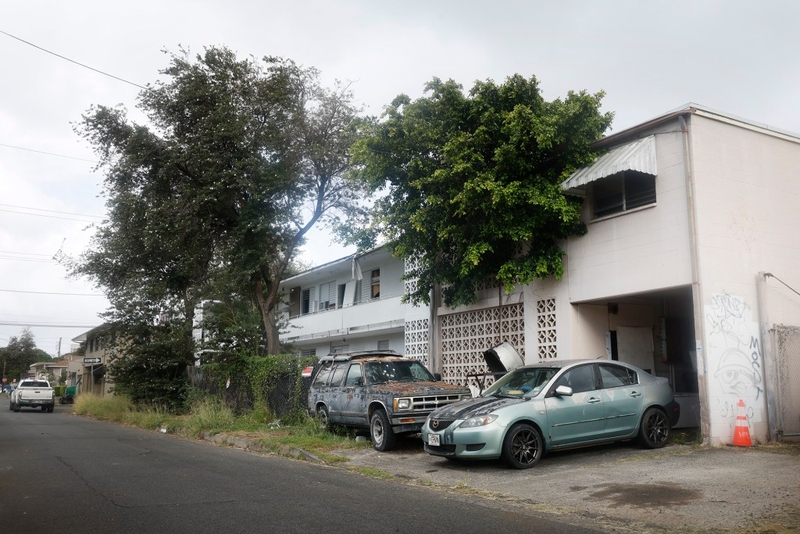
Other neighbors say the unsavory activity has impacted them personally and that law enforcement has failed to address the problem for years. Jewelry store owner Emiko Miyazawa feels the property’s owners allow the lot to languish despite constructing affordable housing elsewhere on Oʻahu and presenting themselves as do-gooders in the community.
"We’ve been complaining," Miyazawa said. "We’ve been trying to communicate with them, and they’re just leaving us hanging.”
The property owner is Ohana Hale, and it was set to be developed by California-based MJF Development Corp. The owners too are frustrated by squatters and shady activity going on around the property, MJF Assistant Manager Sean Harita said. According to him, they can’t fix the issue because they’re hamstrung by litigation among business partners over project financing.
A 2014 Honolulu law was intended to target unsafe and unsanitary property, including instances in which people are living in conditions unfit for human habitation. Penalties for maintaining a public nuisance or unsafe building range from a $1,000 fine per day of the violation to a year in prison, depending on whether enforcement is done administratively or criminal prosecution.
But the city has not used this law on the Ohana Hale property owners, instead leveling notices of violation for smaller infractions.
“A building being vacant or abandoned does not, by itself, constitute a code violation,” Department of Planning and Permitting spokesperson Davis Pitner said, referencing the 2014 law and a similar one from the year before.
He said the department’s enforcement is primarily complaint-driven, and that while residents may have complained to the city in the past about rubbish, squatters and illegal activity, it’s possible those complaints were directed to the police.
“However,” he said, “depending on how the concerns were initially communicated or understood, the potential code violations may not have been identified or referred to DPP.”
Pitner said his department will treat Civil Beat’s inquiry as a request for investigation and look into whether more enforcement action is required at the property.
Sketchy Characters
Miyazawa remembers her landlord telling her in 2020 that the apartment complex across the street would soon be demolished. But after about a year, she realized that nothing was happening.
“There was always weird, strange activity across the street,” she said. “Whether it be a whole homeless camp being there or people living inside the units and creeping out of them at like 6 a.m.”
A string of sketchy activities started occurring involving people living in and visiting the otherwise vacant apartment complex. She said she watched police raids across the street. One man masturbated right outside her front window in the middle of the day and regularly defecated in front of her shop.
“It was horrible," she said. "And that lasted for months.”
The next year, she said, her shop got robbed the week before Christmas. She said it took a toll on her mental health and her sense of security as a woman running her own business, requiring “a lot of therapy” to get through it. She feels safer now, she says – but only after spending what she estimates was at least $20,000 on repairs and added security, including an alarm and cameras.
“The neighborhood has definitely been suffering because of this,” she said.

Other neighbors echo Miyazawa’s recollections. Ikaika Tomas lives across the street from the property and said police responses over the years have been insufficient, he thinks, because the activity occurs on private property. For the time being, he said while standing outside the property, he has come to an uneasy truce with its inhabitants: As long as they keep to themselves, he doesn’t care.
“We just keep complaining and complaining," he said. "Hopefully somebody steps up."
Miyazawa said she feels for the homeless people there who need a place to live. She said she even befriended a man who would sleep outside her shop at night; for Christmas one year, she said, he brought her a candy lei.
She’s not so naive to think that the neighborhood’s issues all point back to this one property, but Miyazawa and others said it is a magnet for seedy activity, and that they’re frustrated to not see meaningful action addressing it.
“The owners of the building are not taking care of the issue,” she said.
Property In Limbo
The property owners express similar frustrations.
MJF Development Corp., founded by Franco Mola and based in California, first presented their Ohana Hale plan to the Mōʻiliʻili Neighborhood Board in 2013.
Mola’s company has built other affordable housing developments on Oʻahu, including recently in Kakaʻako at 803 Waimanu St., which the Honolulu Star-Advertiser reported last year struggled to sell its units.
The Mōʻiliʻili development was intended to include a 13-story residential tower directly over an eight-story parking structure. It would have provided a mix of mostly studios and one-bedrooms, along with a few two-bedroom units. Most of the units would have been built as affordable, which in today’s dollars means some of the units would be within reach for an individual earning $107,800 per year and others for an individual earning $129,360.
The neighborhood board, which is advisory, voted 10-1 in favor of the project, with one abstention.
But chaos embroiled the developers. Starting in late 2019, one of the partners had a disagreement with the others about finances, leading to drawn out litigation that still has yet to be resolved.
“That is why the property’s been at a standstill,” MJF assistant manager Harita said in an interview.
Harita said he and his colleagues are frustrated too. They’ve replaced the chainlink fence surrounding the property seven to 10 times since the pandemic, he estimated; squatters end up hopping the fence or breaking in again anyway.
“They’ve stolen everything you can dream of out of that place,” he said.
Round-the-clock security would be prohibitively expensive, he said — almost $30,000 per month — which would be roughly the net revenue if they were renting out the existing units. And Harita said the units can’t be rented out because the property does not comply with living standards.
“We were about to tear down those buildings,” he said.
Vincenzo Malo – whose father, Franco, founded MJF – echoed Harita’s points.
He understands that neighbors are frustrated, he said, “but I mean, we’ve gated and boarded up that property several times over the last few years.”
The problem is that homeless people keep breaking in, he said. Even after police escort them off the property, he said, they come back within a day.
Ohana Hale lost its zoning and fee exemptions after blowing through construction deadlines, but Malo and Harita said the goal is still to build housing on the site. The litigation should be over soon, Malo said, though he declined to estimate when that would be.
“Until the litigation’s done,” he said, “our hands are kind of tied.”
The Department of Planning and Permitting has issued several notices of violation to the property owners, at least two of which have since been corrected, Higa said. Those include a zoning code violation as part of the city’s illegal game room enforcement as well as a sign violation for three large banners hanging off a damaged fence and abandoned vehicles.
The city’s new permitting website HNL Build shows that it also received a notice of violation last year for electrical code violations, which the webpage’s description says is related to illegal game room operations.
DPP issued another violation for conducting demolition and alteration work without a permit, Higa said.
“A notice of order is in the process of being issued to the owner,” she said. That will impose daily fines until it’s corrected.
Harita said that violation likely refers to a wall one of the squatters knocked over last year.
"Our neighborhood could have been really sweet," Miyazawa said, "but I don't really think that it's supported in the way that it needs."
Honolulu, HI